
Chess notation: systems, symbols, history and practical use
How chess moves and positions are recorded: major notation systems (algebraic, descriptive, PGN), core symbols, examples, history, and uses in play, study and digital databases.
Overview
Chess notation is the standardized way of recording moves and positions so games can be replayed, analyzed and published. Players write moves during or after a game to preserve the sequence of actions: piece movements, captures, checks and special moves. Recording moves is essential for study, composition, adjudication and many organized competitions. For a basic introduction to the concept of a written move see notation of individual moves.
Image gallery
3 Images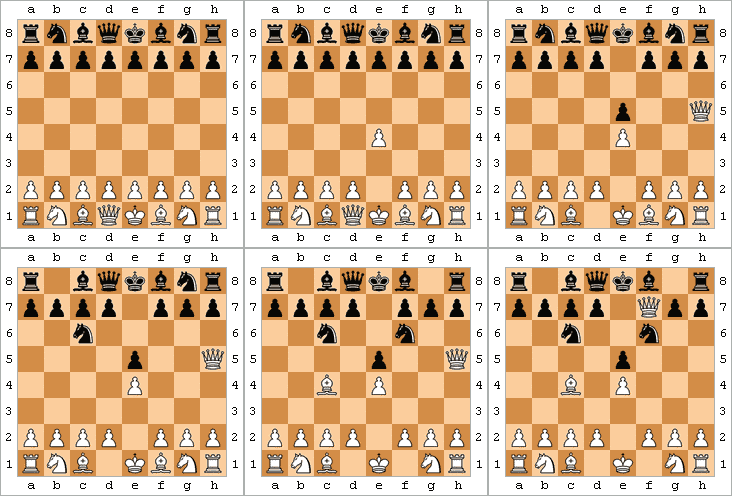
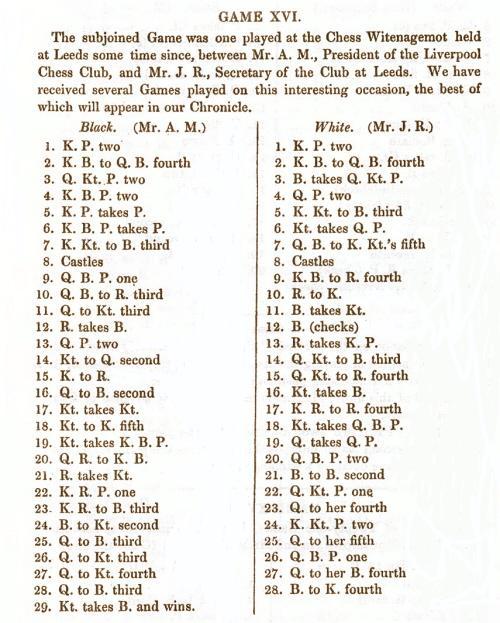
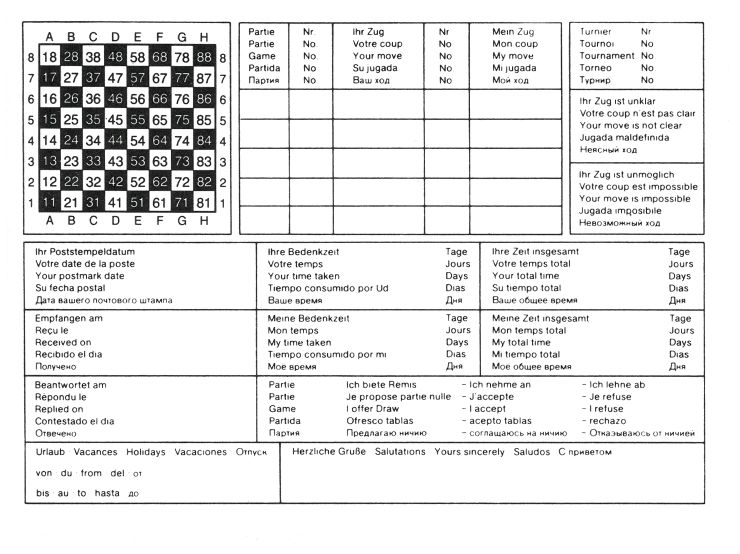
Principal systems and their characteristics
Several systems have been used historically; the most common today is algebraic notation. Other important variants include descriptive notation, long algebraic, figurine (symbol) notation, and computer-friendly formats such as Portable Game Notation (PGN). Each system encodes similar information—what piece moved, from where (sometimes optional), to which square, and whether a capture or special rule applied—but differs in symbols, language dependence and level of detail.
Core elements and common symbols
Algebraic notation labels the board with files a–h and ranks 1–8 so each square has a unique name (for example e4). Pieces are indicated by uppercase letters: K (king), Q (queen), R (rook), B (bishop) and N (knight). Pawns are indicated by the absence of a letter; a pawn move is shown by its destination, for example e4. Common symbols include:
- x to indicate capture (e.g., Bxe5)
- + check and # checkmate
- O-O kingside castling and O-O-O queenside castling
- Promotion shown by = and the new piece (e.g., e8=Q)
- Disambiguation when two identical pieces can move to the same square (e.g., Nbd2 or R1e1)
Long algebraic spells out the starting square as well as the destination (e.g., g1f3) and is sometimes used in computer communication or older printed scores. Figurine notation replaces letters with small piece symbols so the moves are language independent and suitable for international publication.
Examples
A few opening moves in Standard Algebraic Notation (SAN): 1. e4 e5 2. Nf3 Nc6 3. Bb5 a6. A sample capture and promotion might appear as 17. exd6 e.p. or 28. e8=Q+. In practice, en passant captures are recorded like ordinary captures (exd6); older or explanatory editions sometimes append "e.p." to clarify the capture type.
History and development
Methods for describing chess play date back many centuries. Early manuscripts include move descriptions in Arabic sources and later European records; such early prose descriptions tended to be verbose and used the player's own perspective, a form later known as descriptive notation. Descriptive notation was common in English-language literature for a long period, but algebraic notation—using fixed coordinates for squares—gradually became international standard during the 20th century. For more on historical manuscripts see references to Arabic manuscripts and European manuscripts.
Uses, formats and modern practice
Recording moves serves many functions: preserving games for study, feeding databases, enabling engine analysis, publishing in books and magazines, and enabling correspondence and online play. The Portable Game Notation (PGN) is a widely used plain-text format that combines SAN move lists with metadata (event, date, players, result) and is supported by most chess software and websites. Many tournaments require scoresheets and the use of algebraic notation; digital platforms often accept PGN imports and exports for sharing and archiving games. See Portable Game Notation for a typical format description.
Notable distinctions and practical tips
When reading or writing notation be aware of language variants and typographical conventions: some editions use lowercase letters for files, others use uppercase piece letters, and check/checkmate markers may vary. When a move is ambiguous, the convention is to add the minimal extra information needed to identify the moving piece uniquely. For learners, practicing with annotated games and exporting/importing PGN files is the best way to become fluent in reading and producing reliable chess records.
For further study, consult annotated game collections, online databases and introductory guides that illustrate notation in context and explain the small variations encountered in older literature and different publishing traditions.
Questions and answers
Q: What is chess notation?
A: Chess notation is a method for writing down chess moves.
Q: Why is it compulsory to write down moves in organized chess events?
A: It is compulsory to write down moves in organized chess events because it serves as a way to keep track of the game.
Q: What elements must be included in a chess notation system?
A: A chess notation system must include the move number, the piece moved, the square it starts from (optional), the square it goes to, and other relevant information such as captures, and castles.
Q: What are the earliest known notations for recording chess moves?
A: The earliest known notations for recording chess moves are manuscripts with move descriptions known in Arabic (9th century) and from Europe (13th century).
Q: What is descriptive notation?
A: Descriptive notation is a kind of notation where each player describes squares from their own point of view, e.g. 1 P-K4 P-K4.
Q: What is algebraic notation?
A: Algebraic notation is a notation which uses labels for the ranks and files, e.g. 1 e4 e5.
Q: What is the purpose of using algebraic notation?
A: The purpose of using algebraic notation is to have a notation system that is less cumbersome than descriptive notation, with squares having only one label.
Related articles
Author
AlegsaOnline.com Chess notation: systems, symbols, history and practical use Leandro Alegsa
URL: https://en.alegsaonline.com/art/19339
Sources
- fide.com : "Laws of Chess"
- fide.com : "E.I.01B. Appendices"
- logicalchess.com : "Logical chess"