
Chemical change (chemical reaction)
A chemical change is a process in which substances are transformed into new substances with different compositions and properties; includes reaction types, indicators, examples, and distinctions from physical change.
Overview
A chemical change, commonly called a chemical reaction, is a process in which one or more substances are converted into different substances with new chemical identities and properties. At the molecular level this involves the breaking and forming of chemical bonds and a rearrangement of atoms, not a mere change in shape or physical state. For a basic introduction to the idea of reacting substances see chemical reactions.
Image gallery
10 Images



Core characteristics
Chemical changes are marked by changes in composition and energy. The total mass of the system is conserved even though atoms rearrange (a principle demonstrated in modern chemistry and popularized by Antoine Lavoisier). Energy can be released (exothermic reactions such as combustion) or absorbed (endothermic reactions such as certain decompositions). Chemical properties — reactivity with acids, oxidizers, or other reagents — determine whether, and how readily, a substance will undergo a chemical change.
Common types of reactions
Chemists classify many reactions by how substances interact. Typical categories include:
- Synthesis (combination)—two or more simple substances join to form a more complex one.
- Decomposition—a compound splits into simpler substances.
- Single-displacement—an element replaces another in a compound.
- Double-displacement—ions in two compounds exchange partners.
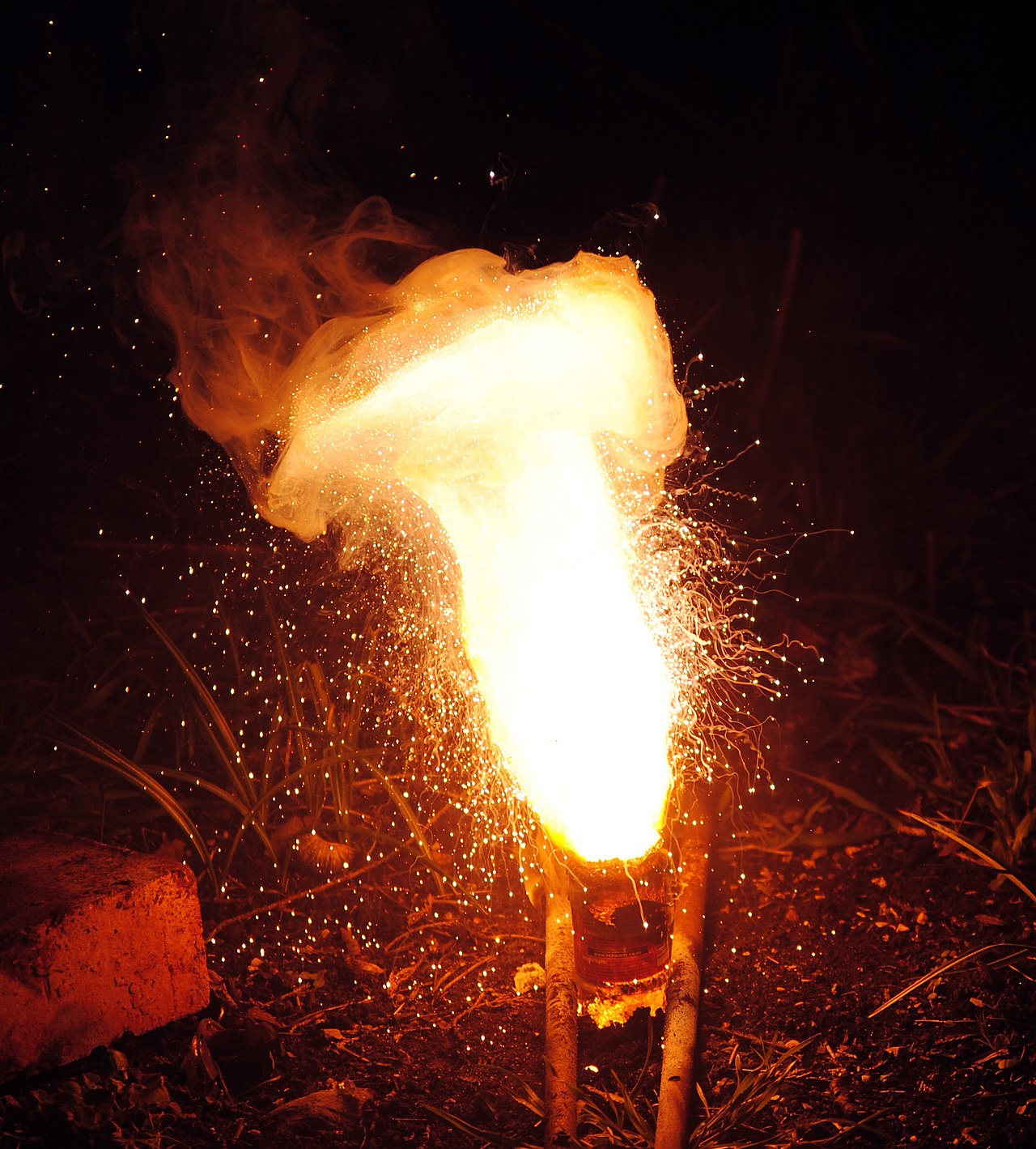
- Combustion—rapid reaction with oxygen producing heat, light and oxidation products (for example, burning wood produces gases such as carbon dioxide and ash).
Indicators and examples
There are practical signs that a chemical change has occurred: the evolution of a gas (bubbling), formation of a precipitate, permanent color change, emission or absorption of heat, or the appearance of light. Everyday examples include a burning candle, rusting iron, baking bread or cake (where ingredients react to produce new compounds), fermentation, photosynthesis in plants, and many industrial processes.
Distinction from physical change
Chemical changes differ from physical changes, in which no new substance is formed and composition remains the same — for instance melting, freezing, or breaking a piece of wood. For contrast see physical change. Because some processes involve both types (e.g., a substance dissolving may be followed by a chemical reaction), accurate observation and testing are often needed to decide which type predominates. The opposite concept is sometimes described simply as a physical change.
History, importance and applications
The study of chemical change is central to chemistry and has shaped modern science and technology. The recognition that matter is conserved in reactions led to quantitative chemistry and industrial synthesis. Understanding chemical change underpins fields as diverse as medicine, materials science, environmental chemistry, energy production and food technology. Detecting, controlling and harnessing chemical reactions enables production of fertilizers, polymers, fuels and pharmaceuticals, while also guiding safety practices for handling reactive materials.
Practical notes
When evaluating whether a change is chemical, consider composition, reversibility, and measurable indicators. Laboratory tests such as spectroscopy, mass measurements, and chemical assays provide definitive evidence of new substances. In everyday contexts, odor changes, permanent color shifts, gas evolution, or residue formation are useful clues that a chemical change has occurred.
Questions and answers
Q: What is a chemical change?
A: A chemical change (chemical reaction) is a change of materials into other materials with different properties. It occurs when a substance combines with another to form a new substance, or undergoes chemical decomposition into two or more different substances.
Q: What are some examples of chemical changes?
A: Burning of wood, burning of a candle, rusting of iron, baking a cake are all examples of chemical changes.
Q: What are chemical properties?
A: Chemical properties are special details that describe how a chemical change takes place.
Q: What is the opposite of a chemical change?
A: The opposite of a chemical change is physical change. Physical changes are when no new substances are formed and the substance which is changed remains the same.
Q: What are some examples of physical changes?
A: Examples include changing shape, changing states, passing electricity through copper wire, breaking wood, shattering glass and pouring water. These processes do not result in any new substances being formed.
Q: What are physical properties? A: Physical properties are special details which do not change in a substance without new substances being formed.
Related articles
Author
AlegsaOnline.com Chemical change (chemical reaction) Leandro Alegsa
URL: https://en.alegsaonline.com/art/19164