
Chelyabinsk meteor (2013)
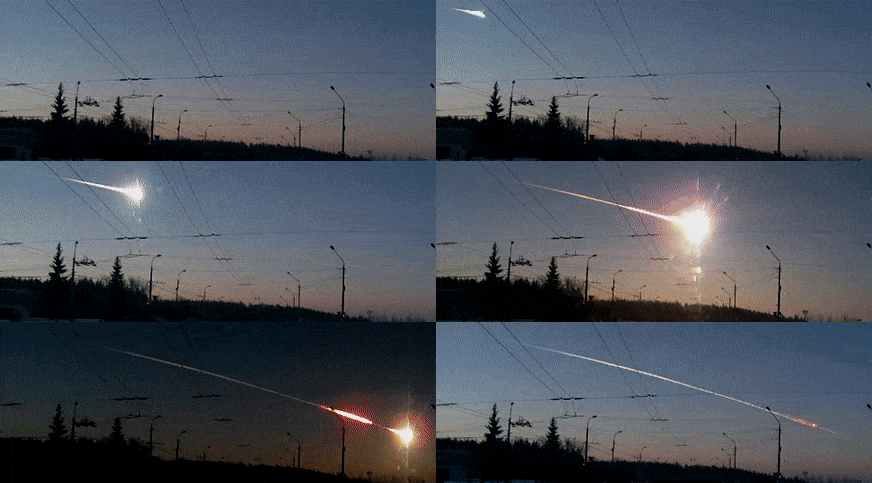
A February 2013 airburst over Chelyabinsk, Russia: a small near‑Earth object exploded in the atmosphere, producing a powerful shock wave that injured around 1,500 people and damaged thousands of buildings.
Overview
The Chelyabinsk meteor was a near‑Earth object that entered Earth's atmosphere over Chelyabinsk, Russia, on the morning of 15 February 2013. Observers across the region, including areas near the Ural Mountains, reported a bright fireball, a loud explosion and an intense shock wave. The event occurred at about 09:13 local time and was widely recorded by traffic cameras and witnesses.
Image gallery
10 Images





Physical characteristics and airburst
Before entry the object was estimated to be on the order of tens of metres in diameter (commonly cited estimates place it at roughly 20 metres). It was travelling at high speed—approximately 18 kilometres per second—when it encountered denser atmosphere. Friction and pressure caused it to fragment and produce an airburst at an altitude generally estimated between 15 and 25 kilometres. The blast released energy equivalent to about 500 kilotons of TNT (roughly 2.1 petajoules) (energy estimate), many times greater than the explosive yields of the World War II atomic bombs at Hiroshima and Nagasaki.
Damage, injuries and eyewitness reports
The shock wave from the explosion shattered windows across a wide area, causing most of the roughly 1,500 recorded injuries; many were treated for cuts from flying glass (injuries). Local authorities reported damage to thousands of buildings in Chelyabinsk Oblast and surrounding towns. The fireball was bright enough to cast daytime shadows and could be seen as far away as Kazakhstan. Eyewitnesses also reported a brief sensation of heat as the object disintegrated.
Scientific context and significance
The Chelyabinsk event is the largest documented object to produce an atmospheric airburst over a populated area since the 1908 Tunguska explosion. It drew attention because the object was not detected prior to atmospheric entry: it was significantly smaller than many asteroids routinely tracked by survey systems. The event occurred on the same day that the roughly 50‑metre asteroid 2012 DA14 made a close approach to Earth, but agencies including NASA, the European Space Agency and several national observatories concluded the two were unrelated due to differing trajectories (ESA and others).
Aftermath, investigation and recovery
In the weeks and months following the airburst, scientists used infrasound, seismic records, dashcam footage and satellite data to reconstruct the meteor's path and energy release. Numerous meteorite fragments were recovered from the impact area, including pieces found near a crater in Lake Chebarkul; these samples have been studied to determine composition and origin. The incident prompted renewed emphasis on sky surveys, planetary defense planning and public awareness of small-object risks. Agencies clarified that the Chelyabinsk object was not the same as other near‑Earth objects observed that day, including another asteroid often referenced in coverage (separate asteroid) and the close‑approaching 2012 DA14.
Notable points and distinctions
- Unexpected detection: the meteor was not identified by survey telescopes before entry, underscoring limits in detecting small but dangerous objects.
- Primary injuries: most casualties resulted from secondary effects—broken glass and falling debris—rather than direct impact.
- Widespread documentation: the event was recorded by hundreds of cameras, aiding scientific reconstruction of the trajectory and energy.
- Policy impact: the airburst accelerated discussions on improving early warning systems and coordination between observatories and civil authorities.
Questions and answers
Q: What is the Chelyabinsk meteor?
A: The Chelyabinsk meteor was an event that happened on 15 February 2013 over Chelyabinsk, Russia. It was a meteor moving at a speed of about 18 km/s (40,000 mph) and it exploded in the air over Chelyabinsk Oblast.
Q: How powerful was the energy released from the explosion?
A: The total energy released from the explosion was equivalent to nearly 500 kilotons of TNT (2.1 PJ), which would make it 20–30 times more powerful than the atomic bombs detonated at Hiroshima and Nagasaki.
Q: How many people were injured by this event?
A: About 1,500 people were injured, mainly by glass from windows shattered by the shock wave; two were reported in serious condition.
Q: How far away could people see or feel this event?
A: People could see as far away as Kazakhstan and felt intense heat from the fireball.
Q: Is this related to an asteroid that was near Earth on that day?
A: No, it is not related to an asteroid that was also near Earth on that day.
Q: Was there any deaths caused by this event?
A: No deaths have been reported due to this event.
Q: How does this compare with other similar events like Tunguska 1908?
A: The Chelyabinsk meteor is the largest object known to have entered Earth's atmosphere since 1908 Tunguska event, and is also the only such event known to have resulted in a large number of injuries.
Related articles
Author
AlegsaOnline.com Chelyabinsk meteor (2013) Leandro Alegsa
URL: https://en.alegsaonline.com/art/19155
Sources
- usatoday.com : "Meteor in central Russia injures at least 500"
- universetoday.com : "Meteor blast rocks Russia"
- blogs.nasa.gov : "Orbit of the Russian meteor"
- rt.com : Meteorite hits Russian Urals: Fireball explosion wreaks havoc, up to 1,200 injured (PHOTOS, VIDEO)
- rt.com : Russian meteorite blast explained: Fireball explosion equal to 20 Hiroshimas
- telegraph.co.uk : "Russian meteor hit atmosphere with force of 30 Hiroshima bombs"
- today.com : "Neil deGrasse Tyson: Radar could not detect meteor"
- top.rbc.ru : Число пострадавших при падении метеорита приблизилось к 1500
- online.wsj.com : "Meteorite hits Russia, causing panic"
- forbes.com : "Exploding meteorite injures a thousand people in Russia"
- youtube.com : "Eyewitness interview on Youtube"
- nature.com : "Russian meteor largest in a century"
- kaira.sgo.fi : "Are 2012 DA14 and the Chelyabinsk meteor related?"
- spaceobs.org : "Siberian fireball"
- esa.int : "Russian asteroid strike"