
Cheer pheasant (Catreus wallichii)
The cheer pheasant is a vulnerable, ground-dwelling pheasant of the western Himalaya. This article covers its appearance, behavior, naming history, distribution, threats and conservation measures.
The cheer pheasant (Catreus wallichii), sometimes called Wallich's pheasant and known by local names in Nepal, is a medium-sized, terrestrial member of the pheasant family. It is notable for long tail feathers, cryptic plumage and a shy, ground-oriented way of life. The species is listed as vulnerable on the global conservation assessment IUCN Red List.
Image gallery
10 Images
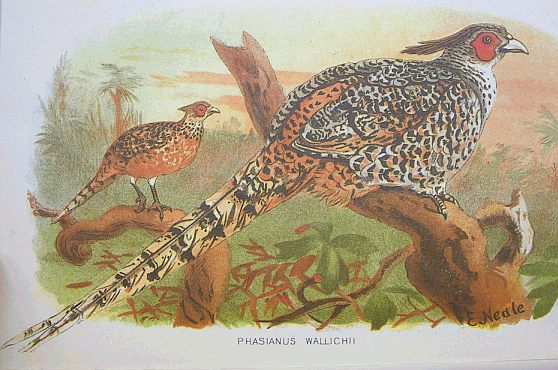


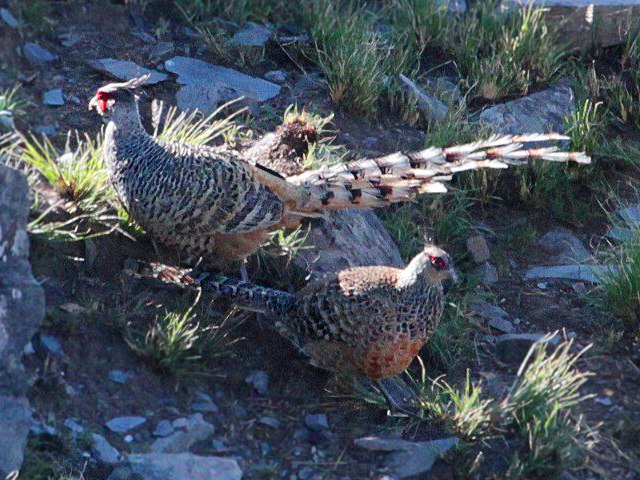


Appearance and behaviour
Cheer pheasants have muted, sandy-brown and grey tones that help them blend into steep scrub and rocky slopes. They are primarily terrestrial: foraging on the ground for seeds, shoots and invertebrates, and moving in small groups outside the nesting season. Breeding behaviour involves nesting on the ground in sheltered sites; adults are generally secretive and difficult to observe.
Distribution and habitat
The species occurs in parts of the western Himalayan region and adjacent foothills, where it occupies dry, open hillsides, scrub, and steep terraces. Populations are fragmented and locally restricted, often surviving in pockets of suitable habitat near agricultural or pastoral landscapes. Local names and vernacular references appear in regional field guides and cultural accounts, for example Nepali names.
Taxonomy and naming
Cheer pheasant is the only species placed in the genus Catreus and belongs to the family Phasianidae. The species was originally described as Phasianus wallichi by the English zoologist Thomas Hardwicke in 1827 and was later reassigned to its present genus by the ornithologist John Gould. The scientific name commemorates the Danish botanist Nathaniel Wallich, whose collections and studies were influential in early natural history; further biographical notes appear under related historical entries on Hardwicke and on Wallich.
Conservation and threats
Major pressures on the cheer pheasant are habitat loss and fragmentation, disturbance from grazing and cultivation, and direct persecution in some areas. Because populations are small and isolated, local declines can be rapid. Conservation actions that have been carried out or recommended include habitat protection, field surveys to clarify population status, community engagement, and where appropriate, targeted management in protected areas. Several conservation and research reports provide status updates and recovery suggestions on family-level measures and species-specific plans for the cheer.
Significance and notes
The cheer pheasant is of interest to ornithologists and conservationists as an example of a Himalayan species vulnerable to landscape change. It also appears in local culture and field guides, and continues to be the subject of monitoring and habitat-restoration efforts. For further reading and regional checklists see linked resources and regional surveys historical notes, collector biographies and modern assessments taxonomic reviews.
- Distinctive features: long tail, cryptic coloration, terrestrial habits.
- Primary threats: habitat loss, disturbance, small population size.
- Conservation focus: surveys, habitat protection, community engagement.
Additional references and databases that discuss the species and its conservation include regional bird lists and global taxonomic resources local references, global status, and curated family accounts Phasianidae overview.
Questions and answers
Q: What is the cheer pheasant?
A: The cheer pheasant is a vulnerable species of the pheasant family, Phasianidae.
Q: What is the scientific name of the cheer pheasant?
A: The cheer pheasant is also known as Wallich's pheasant and its scientific name is Catreus wallichii.
Q: Is the cheer pheasant the only member of its genus?
A: Yes, the cheer pheasant is the only member of the genus Catreus.
Q: Who named the species Phasianus wallichi and why?
A: The English zoologist Thomas Hardwicke named the species Phasianus wallichi in 1827 after the Danish botanist Nathaniel Wallich.
Q: Who changed the name of the species to its present name?
A: The English ornithologist John Gould changed the name of the species to its present name.
Q: In what countries is the cheer pheasant also known as "Kahir" and "Chihir"?
A: In Nepal, the cheer pheasant is also known as "Kahir" and "Chihir".
Q: What is the conservation status of the cheer pheasant?
A: The cheer pheasant is vulnerable.
Related articles
Author
AlegsaOnline.com Cheer pheasant (Catreus wallichii) Leandro Alegsa
URL: https://en.alegsaonline.com/art/19101
Sources
- iucnredlist.org : Catreus wallichi.
- biodiversitylibrary.org : Biodiversity Heritage Library
- gbwf.org : "Cheer Pheasant, Catreus wallichi"
- biodiversitylibrary.org : Biodiversity Heritage Library
- pheasant.org.uk : "Patch occupancy for cheer pheasant Catreus wallichii in the Great Himalayan National Park Conservation Area"
- chinabird.org : "PSG Project round-up"
- birdlife.org : "Dhorpatan Hunting Reserve"
- wildlifeofpakistan.com : "Cheer Pheasant" · archive.org
- dx.doi.org : 10.2478/v10058-011-0035-0
- cites.org : "Appendices I, II and III of CITES"
- birdlife.org : "Cheer Pheasant Catreus wallichi"