
Checkers (Draughts): rules, variants, history, and play
Checkers, called draughts in many countries, is a family of diagonal-move board games in which pieces capture by jumping. Overview of rules, common variants, history, competitions and strategy.
Checkers (also known in many regions as draughts) refers to a family of closely related board games played on a square grid where diagonal movement and jumping captures are the defining mechanics. Although the specific board size and movement details vary, every version shares the basic idea that a piece is removed from the board when an opponent's piece is jumped. See a list of related forms and rules here.
Image gallery
10 Images




Rules and equipment
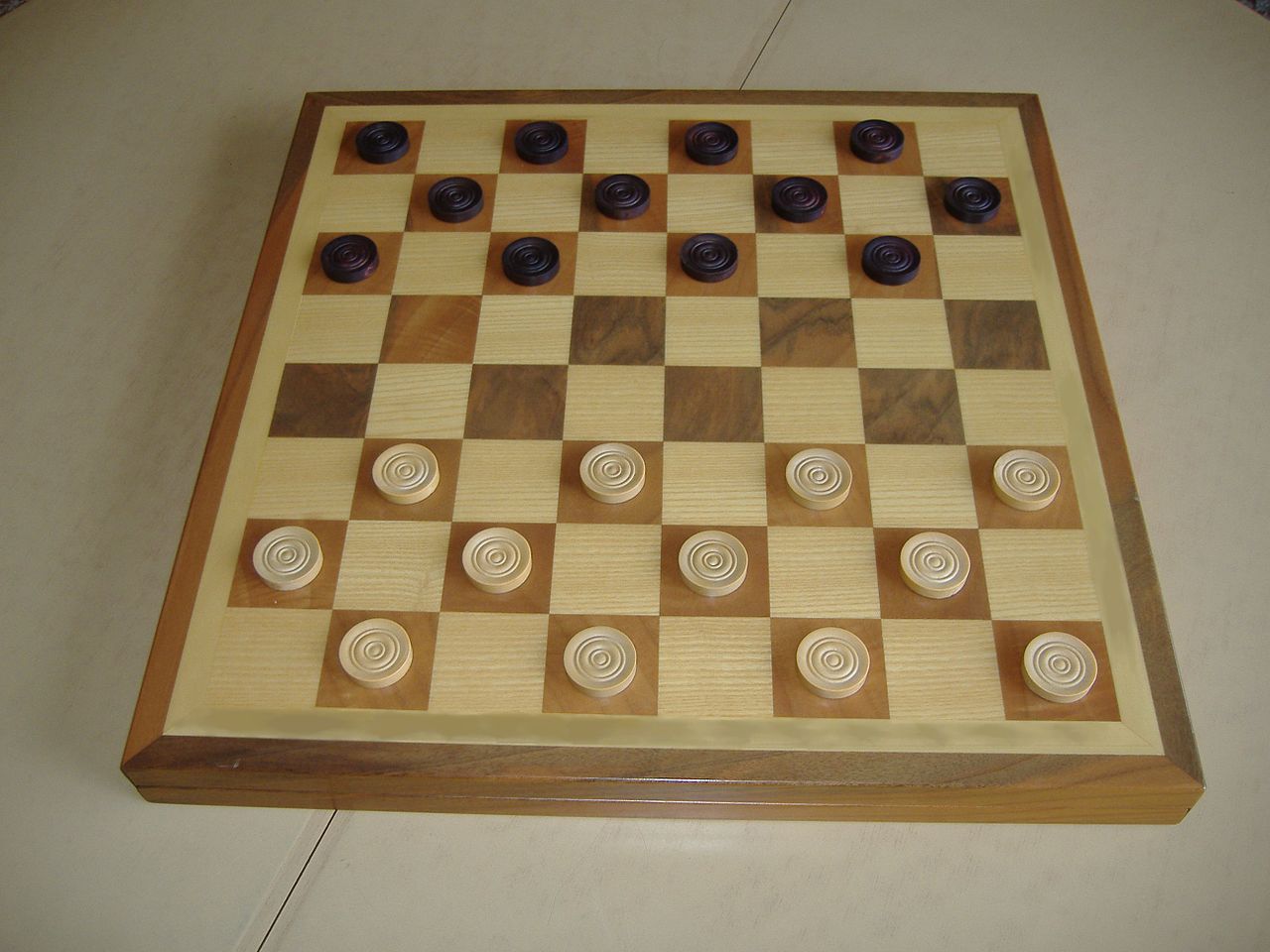
The most common equipment is a checkered board and two sets of distinguishable pieces. Common features include:
- Board: Boards are typically 8x8 or 10x10 squares; only the dark (or light) squares are used for play.
- Pieces: Each player begins with a uniform array of men placed on the nearest rows of usable squares.
- Movement: Ordinary men move one square diagonally forward; when a piece reaches the opponent's back rank it is promoted to a king and gains additional mobility.
- Capturing: Captures are made by jumping an adjacent enemy piece to the empty square immediately beyond. Multiple jumps are often allowed and sometimes mandatory.
Major variants
Several national and regional rulesets produce distinct games with different strategic emphasis. Notable variants include:
- American checkers/English draughts: Played on an 8x8 board with men moving only forward and kings moving one square diagonally. The word "checkers" is commonly used in American English (American term).
- International draughts: Played on a 10x10 board; men can capture backwards and kings move long distances along the diagonal.
- Other regional forms: Variants such as Russian, Brazilian and various folk draughts alter board size, king movement and capture rules.
- In British English the game family is generally called "draughts" (British usage).
History and organization
The game family has ancient roots and likely evolved from earlier race-and-capture games; one medieval predecessor is the North African and Middle Eastern game Alquerque, which influenced European boards and rules. Over centuries the rules diverged across regions and standardized forms emerged. Organized competitive play developed in the 19th and 20th centuries, and international governance and world championship events are overseen by bodies such as the World Draughts Federation (governing body).
Checkers/draughts serves both as a casual pastime and a subject of serious competition. In addition to human tournaments, the game has been important in computer science: one leading variant has been exhaustively analyzed by computer programs, demonstrating that perfect play results in a draw. The simplicity of the rules combined with deep strategic possibilities makes the family of games a long-standing tool for teaching tactical thinking and combinatorial strategy.
Questions and answers
Q: What is the name of the game referred to as "Checkers" in America?
A: Checkers
Q: What is the name used for the same game in British English?
A: Draughts
Q: What is the similarity between all the checkers or draughts games?
A: All of these games are similar.
Q: How can a player take the other player's pieces in all kinds of checkers games?
A: By being "jumped" over.
Q: Which organization controls the rules and championships for checkers or draughts?
A: The World Draughts Federation.
Q: What is Checkers or draughts?
A: Checkers or draughts is the name of several different board games.
Q: Can the pieces in checkers be taken without jumping over the other player's pieces?
A: No, the other player's pieces can only be taken by being "jumped" over.
Related articles
Author
AlegsaOnline.com Checkers (Draughts): rules, variants, history, and play Leandro Alegsa
URL: https://en.alegsaonline.com/art/19091
Sources
- darkfish.com : "Checkers rules"