
Chase County, Kansas: overview, landscape, history, and communities
Chase County (CS) is a sparsely populated county in east-central Kansas, noted for its Flint Hills tallgrass prairie, small towns like Cottonwood Falls, and the Tallgrass Prairie National Preserve.
Chase County (county code CS) is a rural county in the U.S. state Kansas. As recorded by the 2010 census, the county had 2,790 residents, making it one of the less densely populated counties in the state. Its character is shaped more by open prairie, rolling hills and ranchland than by large urban centers.
Image gallery
7 Images


Landscape and environment
Chase County lies within the Flint Hills, a region of tallgrass prairie that resisted plowing and retains some of the largest remaining tracts of native grassland in North America. The county includes river valleys and scenic limestone bluffs carved by tributaries such as the Cottonwood River. That combination of prairie and waterways supports grazing, wildlife and seasonal wildflowers, and attracts visitors for hiking, birdwatching and scenic drives.
History and name
The area that became Chase County was settled during the mid-19th century. The county's name honors Salmon P. Chase, an important national figure in the 19th century who served in several federal positions. Historic buildings and small downtowns in towns like Cottonwood Falls reflect 19th- and early-20th-century architecture and the county's agricultural roots.
Communities and government
The county seat and largest community is the town identified as the county seat, Cottonwood Falls. Cottonwood Falls and a handful of other small towns provide local services, schools and county government functions. Local government is typical of Kansas counties: a board of county commissioners oversees budgets, roads and public services across a largely rural territory.
Economy, recreation and points of interest
Ranching and farming remain important livelihoods, supplemented by tourism tied to the Flint Hills and protected areas. Notable attractions include preserved tallgrass prairie tracts and historic downtowns with limestone buildings. Outdoor recreation such as horseback riding, hiking and seasonal sightseeing draws visitors who come to experience prairie ecosystems and quiet rural landscapes.
Notable facts and distinctions
- The geographic and cultural setting in the Flint Hills makes the county significant for tallgrass prairie conservation.
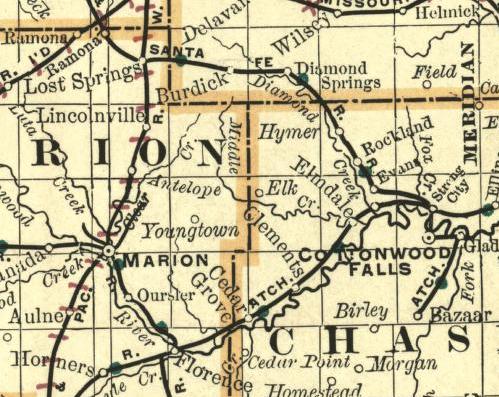
- The geographic center of population for the state has been located in Chase County, about four miles north of Strong City; this fact is often noted in regional descriptions and maps — see center of population.
- Despite its small population, the county retains historic public buildings and local traditions that are visible in community events and heritage tourism.
For visitors and residents alike, Chase County offers a mix of open prairie, historical character and quiet small-town life. Further practical information about services, recreation areas and local government can be found through county resources and regional visitor guides.
Questions and answers
Q: What is the county code for Chase County in Kansas?
A: The county code for Chase County in Kansas is CS.
Q: How many people lived in Chase County in 2010?
A: In 2010, 2,790 people lived in Chase County.
Q: What is the county seat of Chase County?
A: The county seat of Chase County is Cottonwood Falls.
Q: Which is the biggest city in Chase County?
A: Cottonwood Falls is the biggest city in Chase County.
Q: Where is the center of population of Kansas located?
A: The center of population of Kansas is located in Chase County, about four miles north of Strong City.
Q: Is Strong City the county seat of Chase County?
A: No, Cottonwood Falls is the county seat of Chase County.
Q: How far is the center of population of Kansas from Strong City?
A: The center of population of Kansas is about four miles north of Strong City.
Tags
Related articles
Author
AlegsaOnline.com Chase County, Kansas: overview, landscape, history, and communities Leandro Alegsa
URL: https://en.alegsaonline.com/art/18905
Sources
- kansasmemory.org : Plat Book of Chase County, Kansas