
Charyapada: Early Vajrayana Mystic Songs and the Roots of Eastern Indo‑Aryan Literatures
Charyapada is an anthology of 8th–12th century tantric Buddhist songs (caryagīti) from eastern India, composed in an esoteric language and important for the history of Assamese, Odia, Maithili and Bengali literatures.
Overview
The Charyapada is a collection of mystical poems or caryagīti associated with the Vajrayana strand of Buddhism. Composed between roughly the 8th and 12th centuries, these short pieces were meant to be sung and function as both devotional and instructional verses within a tantric milieu (tantric tradition). They originate in what is broadly described as eastern India and survive in manuscript fragments and later scholastic references.
Image gallery
6 Images

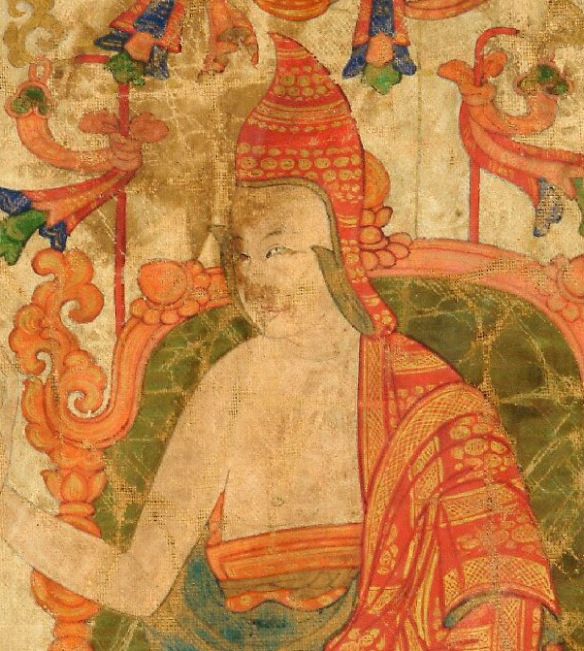


Language, Form and Style
The poems are notable for a compact, often cryptic diction that blends regional vernaculars with ritual vocabulary. Lines exhibit melodic and mnemonic patterns adapted for performance. Scholars call the layered, metaphorical register a "twilight" or esoteric language: literal readings give way to symbolic meanings tied to meditative practice and initiatory instruction.
Manuscripts and Regional Links
An early 20th‑century manuscript discovery brought the corpus to modern attention. The texts preserve early forms of several eastern Indo‑Aryan languages and dialects, visible in features that echo modern Assamese, Maithili and Bengali. The poets are associated with regions now identified as Assam, Bengal, and parts of Orissa and Bihar, illustrating the geographic spread of tantric communities.
Themes and Typical Contents
Common themes include meditative awakening, symbolic dialogue between teacher and disciple, and allegories of inner transformation. The poems frequently employ everyday imagery (craft, trade, domestic life) as coded references to spiritual stages. Typical characteristics include:
- Concise, songlike stanzas suitable for oral transmission;
- Use of symbolic or double‑meaning vocabulary;
- A focus on direct experience over scholastic exposition.
Historical Significance and Influence
The Charyapada is important for literary history because it documents early vernacular forms at a time when Sanskrit dominated written culture. Its language and themes are often cited as precursors to later medieval literatures in eastern India and as evidence of the vernacularization of religious expression. A Tibetan translation preserved in the Tibetan Buddhist canon also attests to the texts' circulation beyond the Indian subcontinent.
Reception, Study and Editions
Since their modern recovery, the poems have attracted philologists, literary historians and religious scholars interested in tantric practice, vernacular development, and performance. Critical editions and translations aim to render both the surface meaning and the suggested esoteric senses, but interpretation remains cautious: many lines are intentionally ambiguous and tied to specific ritual contexts that modern readers can only partially reconstruct.
Questions and answers
Q: What is the Charyapada?
A: The Charyapada is a collection of caryagiti, or mystical poems, from the tantric tradition in eastern India, dating from the 8th to 12th century.
Q: How were the Charyapada meant to be performed?
A: The Charyapada were meant to be sung.
Q: When was a manuscript of the Charyapada found?
A: A manuscript of the Charyapada was found in the early 20th century.
Q: What languages are represented in the Charyapada?
A: Early examples of the Assamese, Oriya, Maithili, and Bengali languages are represented in the Charyapada.
Q: Where were the writers of the Charyapada from?
A: The writers of the Charyapada belonged to various regions of Assam, Bengal, Orissa, and Bihar.
Q: Was the Charyapada known outside of India?
A: Yes, a Tibetan translation of the Charyapada was also kept in the Tibetan Buddhist canon.
Q: What is the Charyapada's connection to Vajrayana Buddhism?
A: The Charyapada is a collection of caryagiti from the tantric tradition of Vajrayana Buddhism.
Related articles
Author
AlegsaOnline.com Charyapada: Early Vajrayana Mystic Songs and the Roots of Eastern Indo‑Aryan Literatures Leandro Alegsa
URL: https://en.alegsaonline.com/art/18899
Sources
- banglapedia.search.com.bd : BANGLAPEDIA: Charyapada