
Chandra X-ray Observatory
NASA's Chandra X-ray Observatory (launched 1999) is a space telescope that images high-energy X-rays with very fine angular resolution, transforming studies of black holes, supernovae, galaxy clusters and hot gas.
Overview
The Chandra X-ray Observatory is a space-based telescope designed to observe X-ray emission from high-energy regions of the universe. Operated by NASA, Chandra was launched on July 23, 1999, and placed into a long, highly elliptical orbit with a period of about 64 hours. Because the Earth's atmosphere blocks X-rays, Chandra operates above the atmosphere to record photons that cannot be detected by ground-based telescopes. It can detect sources far fainter than earlier X-ray instruments thanks to its precise mirrors and sensitive detectors. The observatory is named after astrophysicist Subrahmanyan Chandrasekhar.
Image gallery
10 Images


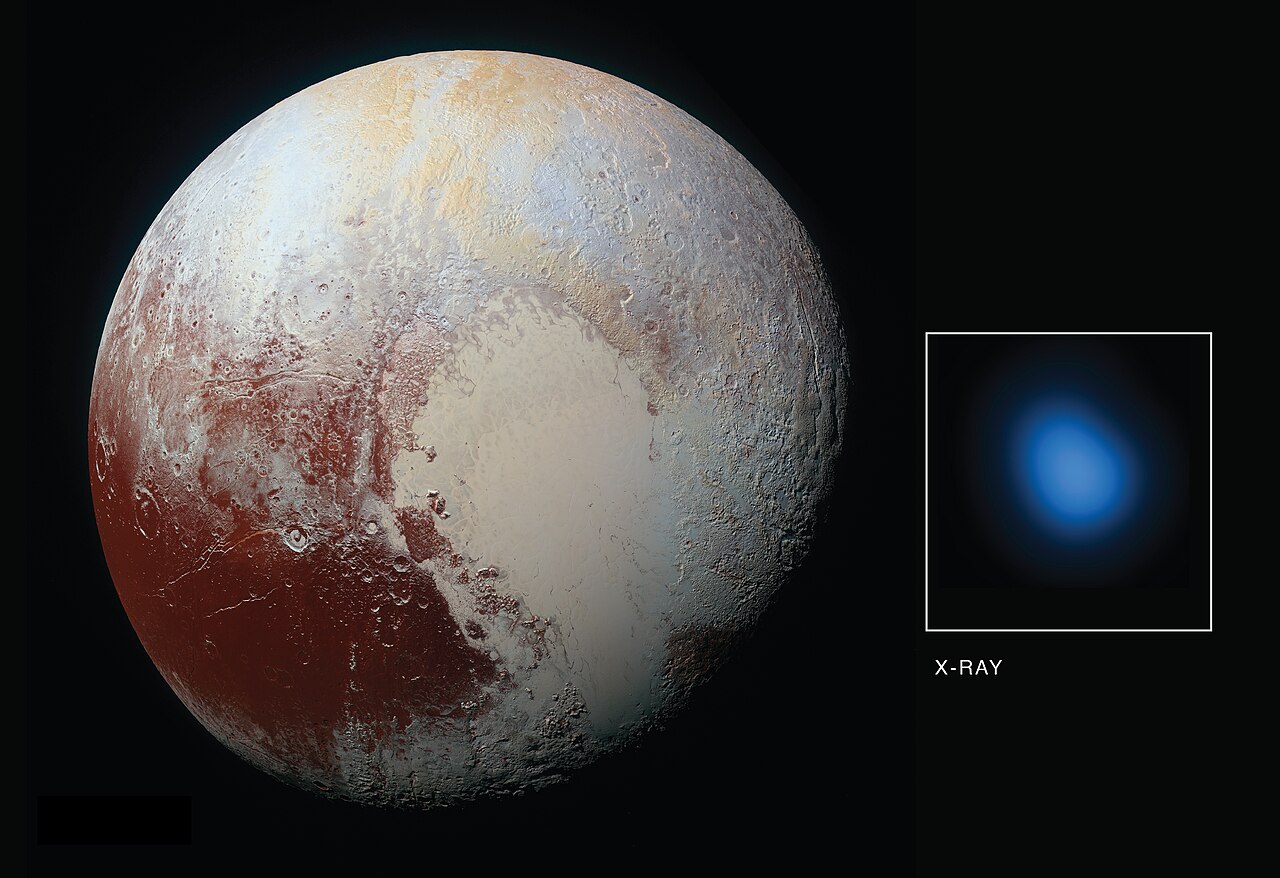
Design and instruments
Chandra's performance depends on a set of grazing-incidence mirrors that focus X-rays onto focal-plane detectors. The observatory carries two primary instruments: an imaging spectrometer and a high-resolution camera. The imaging spectrometer uses CCD technology to record both position and energy of incoming photons, while the high-resolution camera provides very fine spatial detail. This combination gives Chandra sub-arcsecond imaging capability and useful spectral information, allowing astronomers to measure temperatures, elemental composition, and motion in hot, X-ray–emitting plasmas.
Scientific aims and discoveries
Chandra has been used to study a wide range of high-energy phenomena. Key areas include accreting and isolated black holes, neutron stars and pulsars, the hot gas in supernova remnants, the intracluster medium of galaxy clusters, and the hot coronas of stars. Observations have clarified the role of supernovae in distributing heavy elements, revealed shock fronts and jets near compact objects, and mapped the distribution of dark matter indirectly through X-ray tracers of hot gas. Chandra's sensitivity to faint sources has also enabled deep surveys that probe distant, early black hole growth and energetic galaxies.
History and operational status
Chandra was launched as part of a family of space observatories often grouped with other flagship missions. It is one of NASA's "Great Observatories," alongside the Hubble Space Telescope, the now-retired Compton Gamma Ray Observatory and the Spitzer Space Telescope. Since launch it has received periodic mission extensions and upgrades to data-processing techniques, allowing it to remain scientifically productive well beyond its initial planned lifetime. The mission continues to return data that frequently appear in professional journals and public image releases.
Importance and distinctive features
Chandra's distinguishing strengths are its angular resolution and sensitivity to faint X-ray emitters. These qualities make it uniquely capable of resolving crowded regions, isolating point sources embedded in diffuse emission, and studying fine structures such as shock fronts and jets. Combined multiwavelength studies—pairing Chandra X-ray images with optical, infrared and radio data—have provided a more complete picture of energetic astrophysical systems. For community access and data archives, researchers and the public refer to mission resources and observatory documentation hosted by NASA and partner institutions.
Further reading and resources
- General information and mission status: NASA mission pages
- Background on X-ray astronomy and detection methods: X-ray astronomy overview
- Why X-rays are not observable from the ground: atmospheric absorption of X-rays
- Orbital and operational context: Chandra's Earth orbit
- Context among flagship missions: Great Observatories program
- Companion observatories for multiwavelength studies: Hubble and Spitzer
- Namesake biography: Subrahmanyan Chandrasekhar
Questions and answers
Q: What is the Chandra X-ray Observatory?
A: The Chandra X-ray Observatory is a space telescope launched by NASA on July 23, 1999.
Q: What is Chandra's area of sensitivity?
A: Chandra is sensitive to X-ray sources 100 times fainter than any previous X-ray telescope.
Q: How is Chandra able to achieve its high level of sensitivity?
A: The high angular resolution of Chandra's mirrors allows it to achieve its high level of sensitivity.
Q: Why can't Earth-based telescopes detect X-rays?
A: The Earth's atmosphere absorbs the vast majority of X-rays, which is why Earth-based telescopes cannot detect them.
Q: What kind of telescope is needed to observe X-rays?
A: Space-based telescopes are needed to observe X-rays.
Q: What orbit is Chandra in?
A: Chandra is an Earth satellite in a 64-hour orbit.
Q: What is Chandrasekhar's connection to the telescope?
A: The telescope is named after Subrahmanyan Chandrasekhar.
Author
AlegsaOnline.com Chandra X-ray Observatory Leandro Alegsa
URL: https://en.alegsaonline.com/art/18524
Sources
- nasa.gov : nasa.gov
- chandra.harvard.edu : chandra.harvard.edu