
Chameleon: biology, traits, distribution, and human interactions
Chameleons are a distinctive group of primarily insect-eating lizards known for their independently mobile eyes, projectile tongues and remarkable ability to change skin color for communication and camouflage.
Chameleons are a distinctive family of reptiles within the order Squamata, best known for their specialized anatomy and striking color variability. As a clade of lizards, they include roughly 150–200 described species that occupy a variety of habitats. Many species are famous for the ability of their skin to change appearance, a trait used both for concealment and for signaling to other chameleons.
Image gallery
10 Images
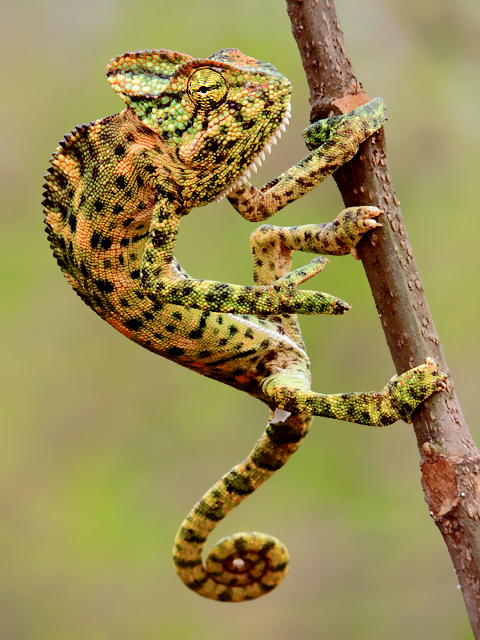


Physical characteristics
Several features define chameleons and separate them from other lizards. They have zygodactylous feet—two toes pointing forward and two backward—that help them grip branches. Their eyes are large, bulging and largely independent of each other, permitting stereoscopic and panoramic vision. Chameleons possess a long, rapidly protrusible tongue tipped with a sticky pad to capture prey at distances sometimes exceeding their body length. Many species have a prehensile tail that coils around twigs, and some show crests, casques or horn-like projections on the head. The ability to alter skin color arises from specialized skin cells and is used for camouflage, temperature regulation and social signaling.
- Feet and posture: adapted for arboreal life and precise movement.
- Eyes: individually movable for broad visual coverage and depth perception.
- Tongue: an elastic, fast projectile used to snatch insects and small animals.
- Skin color: dynamic patterns produced by pigment and structural cells.
Distribution and habitat
Chameleons are primarily found in Africa and Madagascar, where their greatest diversity occurs. They also inhabit parts of southern Europe and Asia as well as a few introduced locations. Typical range examples include Africa, Madagascar, Spain and Portugal, extending into south Asia. Humans have introduced populations to islands and coastal regions such as Hawaii, California and Florida. Chameleons occupy a wide variety of environments from humid forests to savannas and some arid zones, with most species preferring warm, vegetated areas where they can hunt from branches.
Behavior, diet and reproduction
Most chameleons are insectivores that feed on insects and other small arthropods; larger species will occasionally take small vertebrates. Hunting relies heavily on vision and the rapid extension of the tongue to capture prey. Communication includes visual displays and color changes: pale or muted tones may aid concealment while vivid patterns can signal aggression, courtship readiness or stress. Reproductive strategies vary by species and include both egg-laying and live-bearing forms; life histories differ widely across climates and islands.
Human relationships and notable facts
Chameleons are popular in the pet trade and are kept by hobbyists worldwide, which has conservation consequences for some species. Their unique physiology—particularly their independently moving eyes, gripping feet and ballistic tongues—makes them subjects of interest in biology and bio-inspired engineering. Color change is commonly (but not solely) described as camouflage or signaling: some species alter pigments and nanostructures in their skin to shift hue and brightness, a complex process influenced by light, temperature and social context (skin color, camouflage, signaling).
Chameleons illustrate adaptive specialization: their evolutionary distinctiveness and island radiations have produced a wide range of forms and sizes, from small, leaf-dwelling species to larger, conspicuous ones. Conservation status ranges from least concern to threatened, depending on habitat loss, collection pressure and restricted ranges. For readers seeking more general context on the group and related topics, see entries on their taxonomic family and the broader category of lizards.
Questions and answers
Q: What are chameleons?
A: Chameleons are a family of lizards that are a distinct clade of lizards.
Q: What is the purpose of chameleons changing color?
A: Chameleons change color for camouflage or to signal mood to other chameleons.
Q: How many chameleon species are there?
A: There are about 160 species of chameleons.
Q: In which regions do chameleons typically live?
A: Chameleons live in Africa, Madagascar, Spain and Portugal, and across south Asia.
Q: What are some unique features of chameleons?
A: Chameleons have parrot-like zygodactylous feet, separately mobile and stereoscopic eyes, very long tongues they can flick out, a swaying gait, their prehensile tail, crests or horns on their strange-shaped heads, and many can change color.
Q: What is the largest chameleon species?
A: The largest chameleon species is about 1.5 feet when fully grown.
Q: What do chameleons primarily eat?
A: Chameleons are mainly insectivores, but larger species may take occasional smaller lizards and young birds.
Related articles
Author
AlegsaOnline.com Chameleon: biology, traits, distribution, and human interactions Leandro Alegsa
URL: https://en.alegsaonline.com/art/18435
Sources
- bbc.co.uk : bbc.co.uk
- plosone.org : plosone.org/article/info:doi/10.1371/journal.pone.0031314
- visionsource-drtomasino.com : "Unique Eyes Of The Animal Kingdom – Natick MA | Natick Eye Care"
- animals.mom.me : "What Is Unusual About a Chameleon's Eyes?"
- google.ca : "binocular vision - Google Search"
- asknature.org : "Eyes give 360° vision : Chameleon - AskNature"