
Cerebrospinal fluid: composition, circulation, and clinical importance
Cerebrospinal fluid (CSF) is a clear bodily fluid that cushions the brain and spinal cord, supports metabolic exchange, and is used in diagnosis of neurological conditions.
Cerebrospinal fluid (CSF) is a clear, watery liquid that surrounds and bathes the central nervous system, including the brain and the spinal cord. The term combines "cerebro" (brain), "spinal" (spinal cord) and "fluid" to describe this specialized bodily fluid. CSF occupies the ventricles within the brain, the central canal of the spinal cord and the subarachnoid space between protective membrane layers called the meninges.
Image gallery
6 Images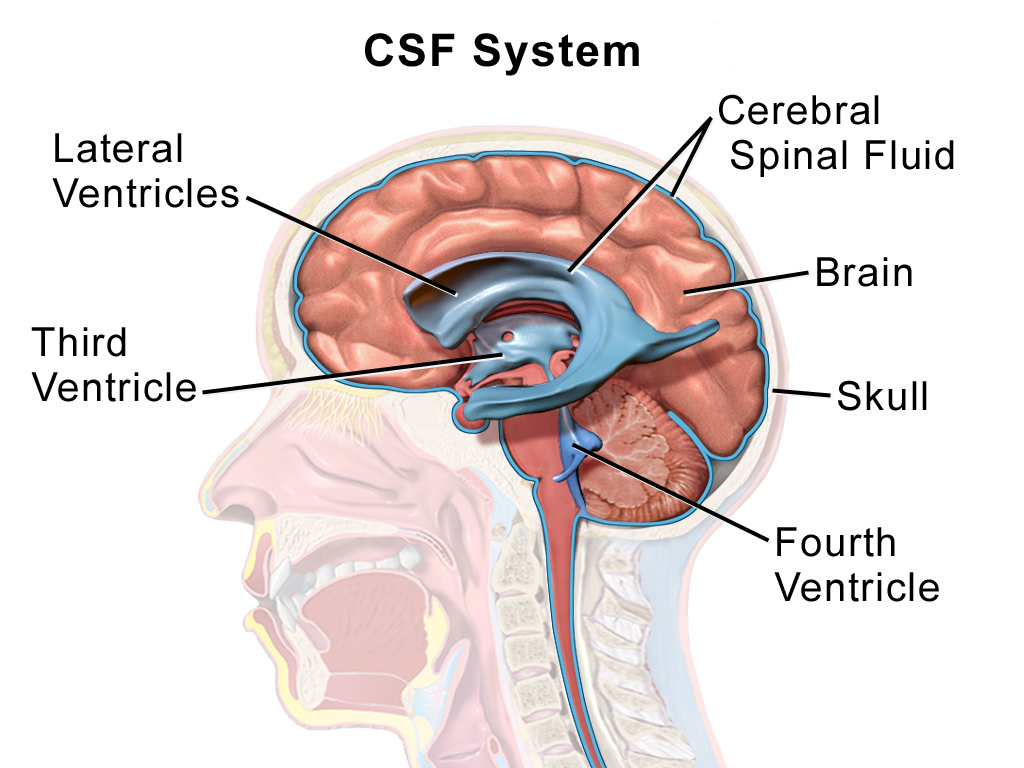



Production and composition
Most CSF is produced by a network of capillaries and supporting cells known as the choroid plexuses, situated in each of the brain's four main ventricles. It is formed from blood plasma but has a distinct composition: primarily water with dissolved ions (notably sodium, chloride, and bicarbonate), small amounts of proteins, glucose and very few cells. CSF chemical balance helps preserve a stable environment for nerve cells and influences intracranial pressure and cerebral blood flow.
Functions and circulation
- Mechanical protection: CSF cushions the brain and spinal cord from impact and distributes mechanical forces.
- Buoyancy: By surrounding the brain, CSF reduces its effective weight and prevents distortion of neural tissue.
- Homeostasis and waste removal: It transports nutrients, removes metabolic waste, and helps regulate the chemical environment around neurons.
- Pathway for signaling molecules: CSF carries hormones and other signaling substances within the skull and spine.
Circulation begins in the lateral ventricles, flows through the ventricular system into the subarachnoid space, and continues around the brain and spinal cord within the space bounded by the arachnoid and pia layers. Along this route CSF is reabsorbed into the venous bloodstream through arachnoid granulations and other drainage pathways.
Clinical relevance and testing
CSF is central to several medical diagnoses and conditions. Clinicians sample it by lumbar puncture to evaluate infections (such as meningitis), bleeding, inflammatory disorders and certain cancers. Disorders of CSF dynamics include hydrocephalus, where impaired flow or absorption leads to increased intracranial pressure, and low-pressure syndromes caused by leaks. Analysis of CSF composition—cell counts, glucose, protein, and microbiology—provides essential clues about central nervous system disease.
Historically, study of CSF informed early neurology and neurosurgery and continues to be important in research on brain clearance systems, neurodegenerative disease, and targeted drug delivery. Though produced continuously, CSF is routinely sampled and measured to track disease and guide treatment in both acute and chronic neurological conditions. For introductory and clinical resources, see links to general overviews of the fluid concept, the nature of liquids, the choroid plexus, the brain ventricular system and the meninges and spinal structures like the spinal cord and ventricles.
Questions and answers
Q:What is cerebrospinal fluid?
A: Cerebrospinal fluid is a liquid that bathes and protects the central nervous system (the brain and the spinal cord).
Q:What does "cerebro" and "spinal" mean in "cerebrospinal fluid"?
A: "Cerebro" means "brain," and "spinal" is a short version of "spinal cord" in "cerebrospinal fluid."
Q:Where is cerebrospinal fluid made?
A:Cerebrospinal fluid is made by networks of blood vessels called choroid plexuses in each of the brain's four ventricles.
Q:What is the subarachnoid space?
A:The subarachnoid space is the space between the two layers of meninges that are closest to the brain (the arachnoid layer and the pia mater).
Q: How does cerebrospinal fluid flow?
A:Cerebrospinal fluid flows through the subarachnoid space and fills the brain's ventricles, and flows down the middle of the spinal cord (the central canal).
Q:What is the function of cerebrospinal fluid?
A:The function of cerebrospinal fluid is to bathe and protect the central nervous system (the brain and the spinal cord).
Q:What structures produce cerebrospinal fluid?
A: Networks of blood vessels called choroid plexuses in each of the brain's four ventricles produce cerebrospinal fluid.
Related articles
Author
AlegsaOnline.com Cerebrospinal fluid: composition, circulation, and clinical importance Leandro Alegsa
URL: https://en.alegsaonline.com/art/18175
Sources
- morganclaypool.com : "Astroglia and Brain Metabolism: Focus on Energy and Neurotransmitter Amino Acid Homeostasis"
- doi.org : 10.4199/C00130ED1V01Y201506NGL007
- ncbi.nlm.nih.gov : "A paravascular pathway facilitates CSF flow through the brain parenchyma and the clearance of interstitial solutes, including amyloid β"
- doi.org : 10.1126/scitranslmed.3003748
- pubmed.ncbi.nlm.nih.gov : 22896675
- mayoclinic.org : "Lumbar Puncture (Spinal Tap)"
- aafp.org : "Cerebrospinal fluid analysis"
- pubmed.ncbi.nlm.nih.gov : 14524396
- doi.org : 10.1186/2045-8118-8-14
- ninds.nih.gov : "Hydrocephalus Fact Sheet"
- nlm.nih.gov : "Hydrocephalus"
- nlm.nih.gov : "CSF Leak"
- doi.org : 10.1001/jama.295.19.2286
- pubmed.ncbi.nlm.nih.gov : 16705110