
Ceratophryinae — South American horned frogs
Subfamily of robust, large-mouthed frogs native to South America, known for their ambush feeding, distinctive cranial ornamentation, and a fossil record that hints at ancient Gondwanan links.
The Ceratophryinae are a group of robust frogs commonly called horned frogs. They belong to a lineage historically associated with the family Leptodactylidae and are a recognizable element of the amphibian fauna of South America. Members of this clade are noted for their disproportionately large heads and wide mouths and, in several species, for fleshy cranial projections that resemble short "horns" above the eyes.
Image gallery
1 Image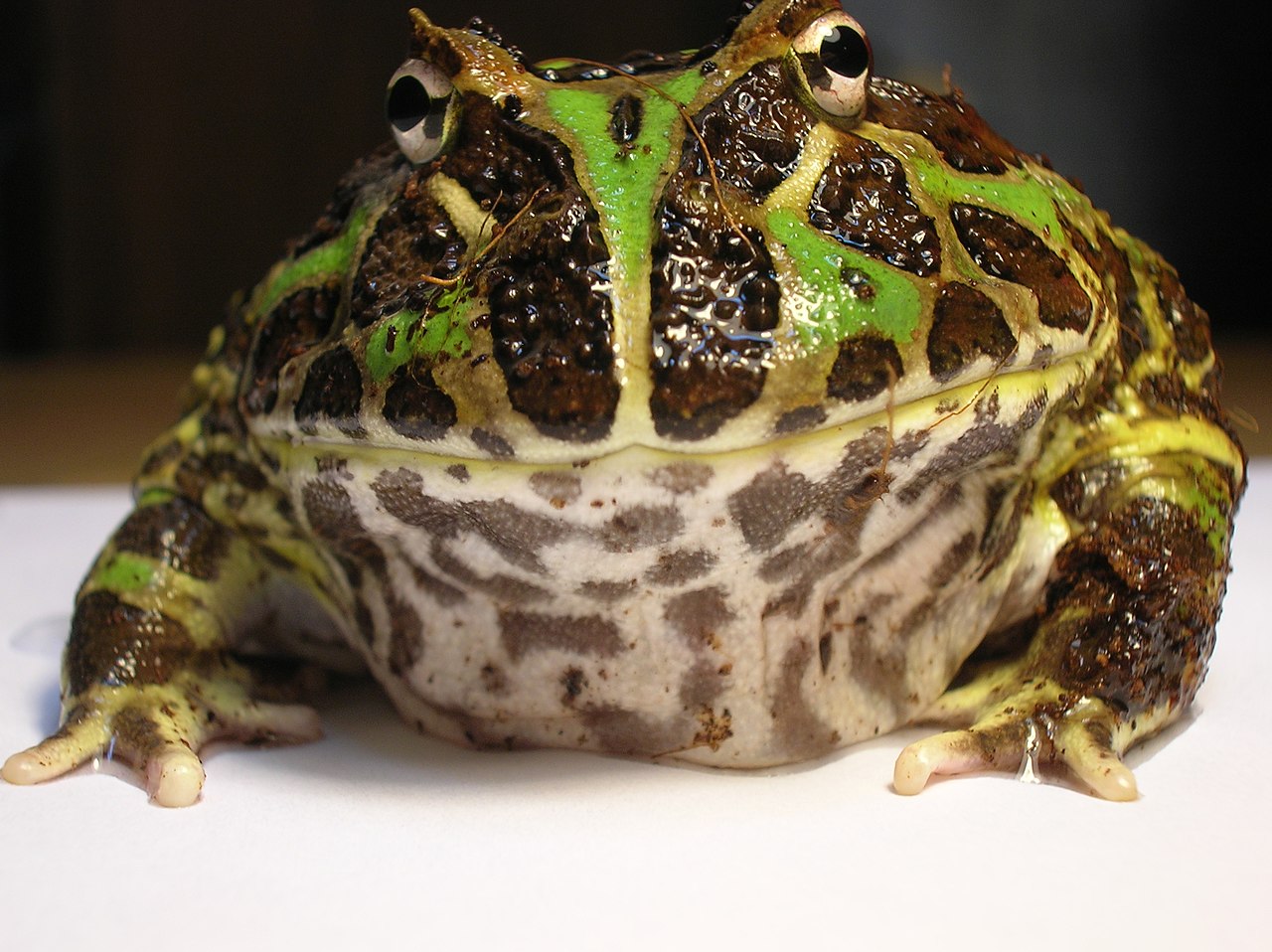
Physical characteristics
Ceratophryinae show a compact, squat body plan and powerful jaws adapted to a sit-and-wait, ambush style of predation. Typical traits include:
- large head-to-body ratio and a broad mouth capable of swallowing sizable prey;
- short limbs suited for sudden lunges rather than long-distance jumping;
- variable skin texture and coloration that aid camouflage in leaf litter or mud;
- in some species, supraorbital dermal flanges or "horns", though not all members possess prominent horns.
Distribution, fossil record and history
Today, living Ceratophryinae are confined to the Neotropical regions of South America. However, paleontological finds and comparative anatomy suggest an older, more widespread ancestry. Notably, fossils attributed to the giant frog Beelzebufo from the Cretaceous of Madagascar have been interpreted by some researchers as showing traits similar to ceratophryines, raising the possibility of a Gondwanan distribution when landmasses such as Gondwana and its constituent continents were connected. This connection remains an active topic of study and is discussed cautiously in current literature.
Ecologically, these frogs are primarily terrestrial or semi-aquatic ambush predators. Their diet is carnivorous and opportunistic: they take insects, other amphibians, small reptiles, and sometimes birds or mammals if prey size permits. Reproductive strategies vary by species, with some using temporary pools formed by seasonal rains.
Humans interact with Ceratophryinae in several ways. A few species are kept in the pet trade because of their striking appearance and compact size, and they figure in studies of feeding mechanics and amphibian morphology. Conservation concerns depend on the species and region: habitat loss, pollution, and disease (such as chytridiomycosis) can threaten local populations. Conservation actions focus on habitat protection, monitoring, and research into population status.
For more detailed taxonomic lists, species accounts, and regional information, consult specialist resources and field guides that synthesize current research and conservation assessments. Authors and curators often provide updates as new phylogenetic and fossil evidence emerges.
Family link | General frogs | South America | Beelzebufo | Cretaceous period | Madagascar | Gondwana concept | Gondwanan distribution | Terrestrial ecology
Questions and answers
Q: What is the Ceratophryinae?
A: The Ceratophryinae is a subfamily of leptodactylid frogs known as common horned frogs.
Q: Where do all species of Ceratophryinae live?
A: All species of Ceratophryinae live in South America.
Q: What do fossils of the giant Beelzebufo suggest about the range of the Ceratophryinae?
A: Fossils of the giant Beelzebufo suggest that the Ceratophryinae may have once ranged throughout the prehistoric supercontinent of Gondwana.
Q: Do all species in the Ceratophryinae subfamily have horn-like growths at the eyes?
A: Not all species in the Ceratophryinae subfamily have horn-like growths at the eyes.
Q: What are the eating habits of Ceratophryinae?
A: Ceratophryinae are all carnivorous, and they are either terrestrial or semi-aquatic.
Q: What are some physical characteristics of Ceratophryinae?
A: Ceratophryinae have large heads and mouths.
Q: Do people keep Ceratophryinae as pets?
A: Yes, some people enjoy keeping Ceratophryinae as pets.
Related articles
Author
AlegsaOnline.com Ceratophryinae — South American horned frogs Leandro Alegsa
URL: https://en.alegsaonline.com/art/18155