
Centrosome (animal cell microtubule-organizing center)
The centrosome is a membrane-less organelle in animal cells that organizes microtubules, contributes to mitotic spindle formation, duplication control, cilia assembly and cellular polarity.
The centrosome is a small, membrane-free organelle found in most animal cells that serves as the principal microtubule-organizing center (MTOC). It collects and concentrates proteins that nucleate and anchor microtubules, influencing cell shape, intracellular transport and the positioning of organelles. During cell division the centrosome helps orchestrate assembly of the mitotic spindle and contributes to the accurate segregation of chromosomes, while also participating in signaling pathways that regulate progression through the cell cycle.
Image gallery
1 Image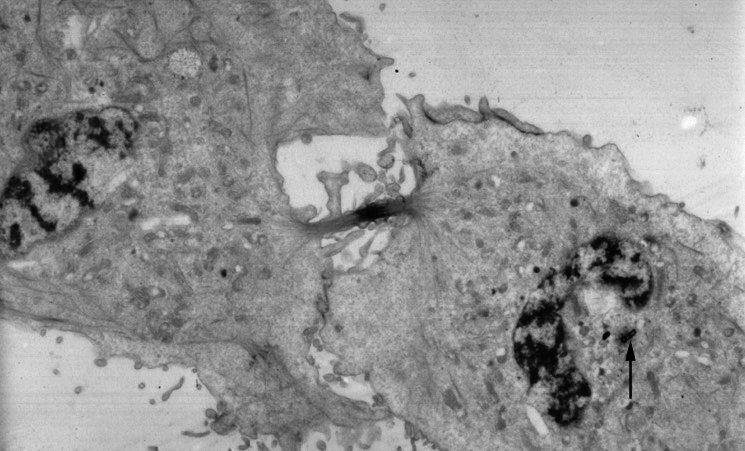
Structure and components
At its core a centrosome typically contains a pair of cylindrical structures called centrioles, arranged roughly at right angles to one another. The centrioles are surrounded by an amorphous proteinaceous matrix called the pericentriolar material (PCM), which contains factors such as γ-tubulin complexes that nucleate microtubules. Centriole number and integrity are tightly controlled: centrioles duplicate once per cell cycle so that each daughter cell inherits a centrosome. In many contexts a mature centriole can also act as a basal body to template a cilium or flagellum.
Functions
The best-known role of the centrosome is to organize the radial array of microtubules in interphase and to help form the bipolar spindle in mitosis. By anchoring microtubule minus ends the centrosome contributes to directional trafficking of vesicles and organelles, and to establishing cell polarity. It also participates in coordinating signaling events that control cell-cycle transitions and in positioning the cleavage plane during cytokinesis. Importantly, cells can build functional spindles without centrosomes in some species or experimental conditions, showing that centrosomes enhance efficiency and fidelity but are not always absolutely required.
History and evolutionary context
The centrosome was first recognized in the 19th century and later named and characterized in early cytological studies. Classical investigators described its association with spindle poles and centrioles. Evolutionarily, canonical centrosomes with centrioles are a feature of animal cells and many unicellular eukaryotes, while land plants and most fungi employ alternative MTOCs — for example, the nuclear surface or spindle-pole bodies — to organize microtubules. This diversity underscores multiple strategies for microtubule organization across eukaryotes.
Medical and experimental significance
Abnormalities in centrosome number, structure or function are linked to developmental disorders and are frequently observed in cancer cells, where extra centrosomes can contribute to chromosome mis-segregation and aneuploidy. Defects in centriole or basal body function also underlie a class of diseases known as ciliopathies, which affect organs that rely on motile or sensory cilia. Because centrosomes are central to cell division and polarity, they are a focus of both basic research and investigations into disease mechanisms.
Distinctive notes and laboratory observations
Researchers study centrosomes using microscopy, molecular genetics and biochemical isolation of PCM components. Experiments that remove centrioles or disrupt centrosome assembly have shown that cells activate compensatory pathways to nucleate microtubules and assemble spindles. The controlled duplication of centrioles once per cell cycle is analogous to DNA replication control and involves conserved regulatory proteins. These features make the centrosome a model for studying organelle biogenesis, cell-cycle coupling and the maintenance of cellular architecture.
Further reading and resources
- Cell biology overview
- Organelle definitions and comparisons
- Microtubules and cytoskeleton basics
- Cell division and the cell cycle
- Historical studies and key discoveries
- Animal cell organization
- Fungal spindle-pole bodies
- Plant microtubule organizing centers
- Mitosis and spindle assembly
- Centrioles and basal bodies
- Centrosome orientation and cell polarity
- Pericentriolar material and γ-tubulin complexes
Questions and answers
Q: What is a centrosome?
A: A centrosome is an organelle that organizes cell microtubules and regulates the cell division cycle.
Q: Who discovered the centrosome and when?
A: The centrosome was discovered by Edouard Van Beneden in 1883 and was described and named in 1888 by Theodor Boveri.
Q: Do fungi and plants use the centrosome to organize their microtubules?
A: No, fungi and plants use other structures to organize their microtubules.
Q: Has the centrosome evolved in all types of cells?
A: No, the centrosome has apparently only evolved in animal cells.
Q: Is the centrosome necessary for efficient mitosis in animal cells?
A: Although the centrosome has a key role in efficient mitosis in animal cells, it is not necessary.
Q: What is a centrosome composed of?
A: A centrosome is composed of two centrioles at right angles to each other and surrounded by a shapeless mass of protein.
Q: What is the main role of the centrosome?
A: The main role of the centrosome is to organize cell microtubules and regulate the cell division cycle.
Related articles
Author
AlegsaOnline.com Centrosome (animal cell microtubule-organizing center) Leandro Alegsa
URL: https://en.alegsaonline.com/art/18130
Sources
- ncbi.nlm.nih.gov : PMID 12226736
- biodiversitylibrary.org : Zellen-Studien II: Die Befruchtung und Teilung des Eies von Ascaris megalocephala
- ncbi.nlm.nih.gov : PMID 17977464
- ncbi.nlm.nih.gov : PMID 12224551
- ncbi.nlm.nih.gov : PMID 16546079
- ncbi.nlm.nih.gov : PMID 11567874