
Centriole
A centriole is a small, cylindrical cellular organelle made of microtubules that helps organize cell division and forms basal bodies for cilia and flagella in many eukaryotes.
The centriole is a compact, cylindrical cellular structure found in the cytoplasm of most animal and many protist cells. Centrioles are composed primarily of tubulin and associated proteins and are notable for their characteristic nine-fold symmetry of microtubule assemblies. While common in animals and many single-celled eukaryotes, they are absent from the cells of vascular plants and most fungi, where other microtubule-organizing strategies predominate (distribution).
Image gallery
4 Images


Structure
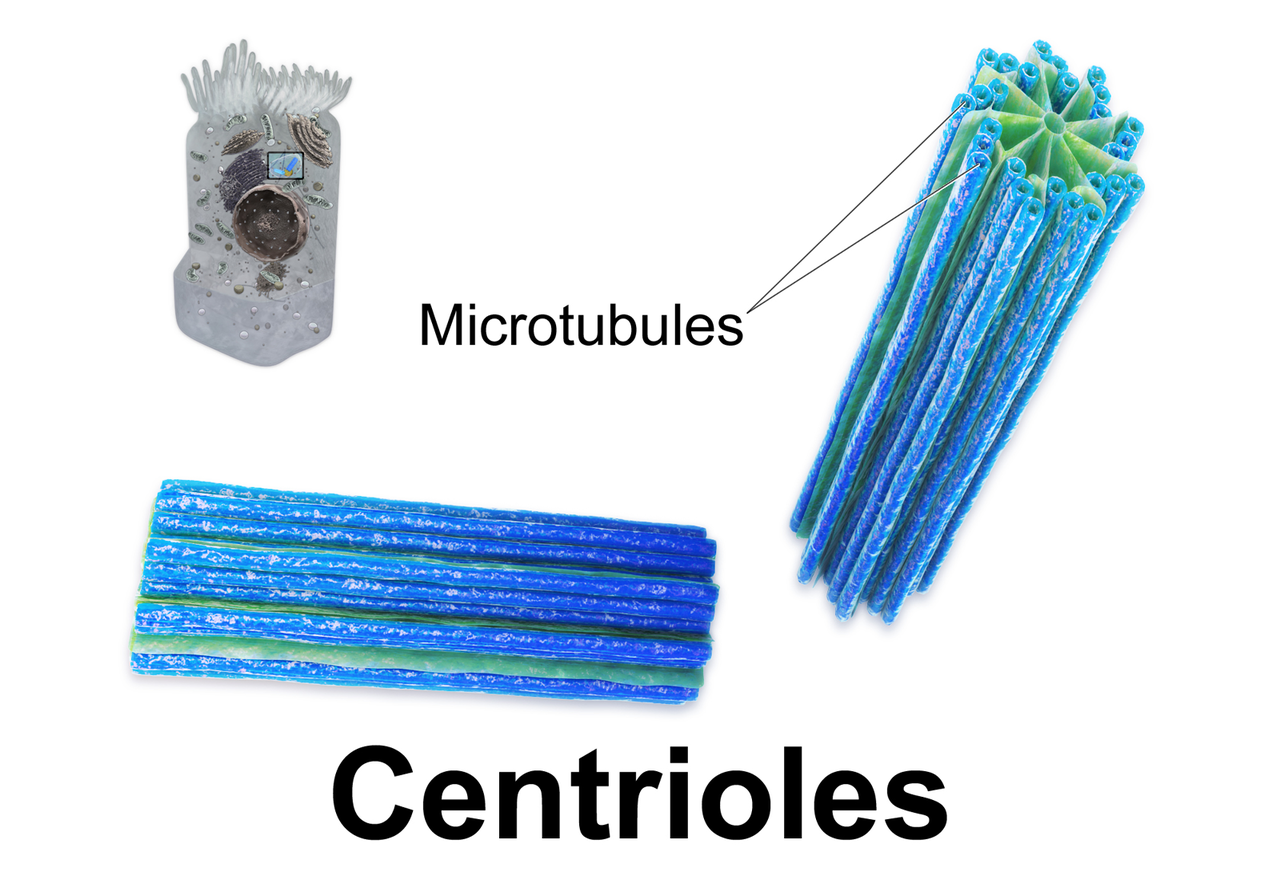
A typical centriole is a short cylinder formed by nine sets of microtubule triplets arranged in a ring. The microtubules and accessory proteins give the structure rigidity and define its polarity; one end is often called the proximal end and the opposite the distal end. A pair of centrioles, set at roughly right angles to each other and surrounded by a proteinaceous matrix, constitutes the centrosome, the main microtubule-organizing center in many animal cells (centrosome). In cells that build cilia or flagella, a centriole can convert into a basal body to nucleate the axoneme.
Development and lifecycle
Centrioles duplicate once per cell cycle in a tightly regulated process so that each daughter cell inherits a pair. Duplication normally occurs adjacent to an existing (mother) centriole and yields a newly formed (daughter) centriole; the older centriole often carries distinct molecular markers and additional appendages that help initiate cilium formation. Proper control of centriole number is important for accurate mitotic spindle assembly and chromosome segregation (cell division).
Functions and examples
Primary functions of centrioles include organizing spindle poles during mitosis and acting as basal bodies for the assembly of cilia and flagella. Cilia and flagella are cellular projections used for motility or fluid movement; their microtubule core (the axoneme) is nucleated at the basal body derived from a centriole (ciliogenesis). In many cell types, centrioles also help define cell polarity and influence intracellular trafficking.
Although centrioles are widespread, some eukaryotes have lost them during evolution. Flowering plants and most fungi typically lack recognizable centrioles and centrosomes, relying on alternative mechanisms for organizing microtubules during cell division (exceptions).
Notable facts and relevance
- Centrioles show remarkable conservation of nine-fold symmetry across distant eukaryotes, a feature of interest in evolutionary cell biology.
- Defects in centriole or basal body function can contribute to disorders of cilia (ciliopathies) and have been implicated in conditions associated with altered cell division or centrosome amplification.
- Centrioles are a focus of research into cell polarity, development, and cancer biology because of their roles in division and signaling.
For concise summaries or deeper reviews, consult specialized cell biology resources or primary literature on centriole structure and function (overview, distribution, duplication, ciliogenesis, exceptions, centrosome).
Questions and answers
Q: What is a centriole?
A: A centriole is a cytoplasmic structure in most eukaryote cells.
Q: What is the function of a centriole?
A: A centriole is involved in cell division and in the formation of cilia and flagella.
Q: Are centrioles found in vascular plants?
A: No, centrioles are not found in vascular plants.
Q: Are centrioles found in fungi?
A: Most fungi do not have centrioles.
Q: How are most centrioles arranged?
A: Most centrioles are nine sets of microtubule triplets, arranged in a cylinder.
Q: What makes up the centrosome?
A: A pair of centrioles, arranged perpendicularly and surrounded by a mass of dense material makes up the centrosome.
Q: In what types of cells are centrioles typically found?
A: Centrioles are typically found in most eukaryote cells.
Tags
Related articles
Author
AlegsaOnline.com Centriole Leandro Alegsa
URL: https://en.alegsaonline.com/art/18121
Sources
- jcb.org : "Cilia and the cell cycle?"
- doi.org : 10.1083/jcb.200503053
- ncbi.nlm.nih.gov : 2171619
- pubmed.ncbi.nlm.nih.gov : 15928206
- sciencemag.org : "Posttranslational glutamylation of alpha-tubulin"
- doi.org : 10.1126/science.1967194
- pubmed.ncbi.nlm.nih.gov : 1967194