
Centaurus A (NGC 5128) — a nearby active radio galaxy
Centaurus A (NGC 5128) is a nearby active galaxy with a prominent dust lane, a supermassive black hole and enormous radio jets; it is a key object for studying galactic mergers and active nuclei.
Overview
Centaurus A, catalogued as NGC 5128, is one of the nearest and best-studied active galaxies. Located in the direction of the constellation Centaurus, it is commonly referred to by its radio-source name, Centaurus A. At an estimated distance of roughly 10–16 million light-years, Centaurus A lies close enough for detailed observations across the electromagnetic spectrum, from radio waves and infrared to X-rays and gamma rays. Its proximity and brightness make it a frequent target for both professional research and amateur observation.
Image gallery
10 Images


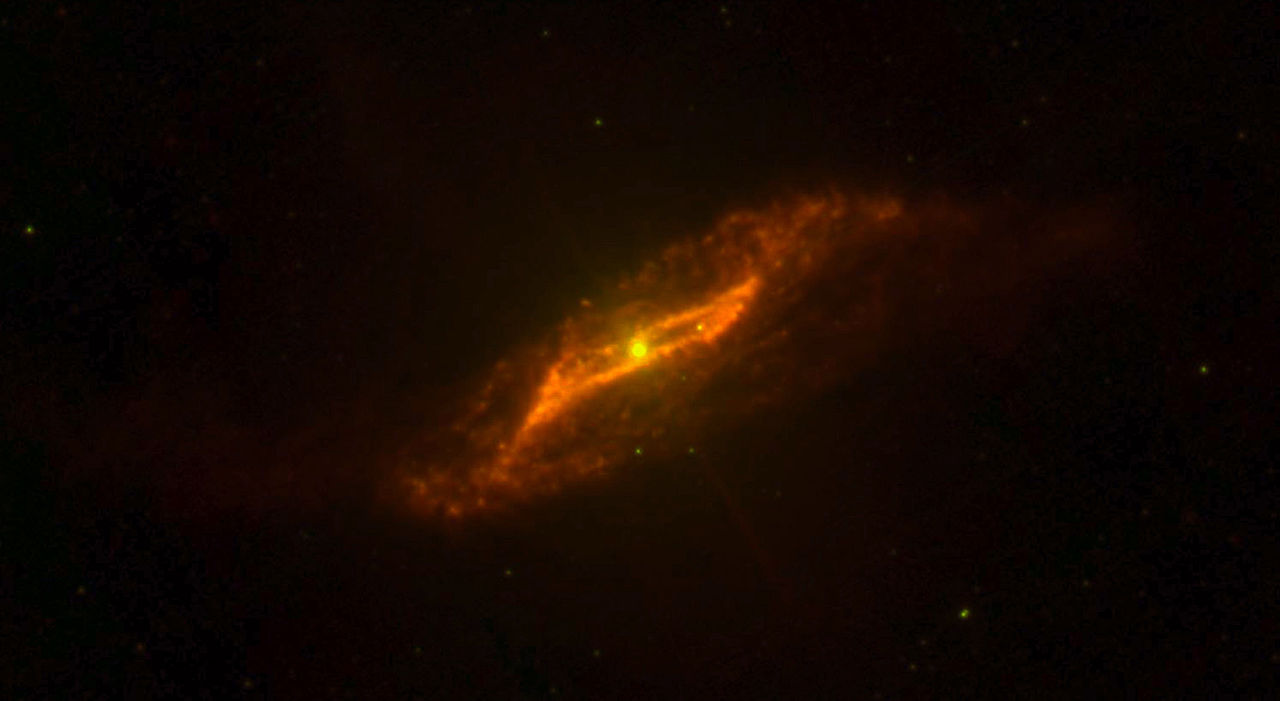



Structure and distinguishing features
Centaurus A has a striking appearance: a large, rounded stellar component crossed by a wide, dark dust lane. This combination gives rise to differing classifications; some authorities list it as a lenticular galaxy (S0), while others describe it as an elliptical galaxy (E-type) with superimposed structure. The dark lane is the remnant of a smaller, gas-rich spiral that merged with the larger system, leaving a warped disk and regions of active star formation. The galaxy is also one of the brightest radio sources in the sky, and its extended radio lobes and jets are among the largest known, stretching far beyond the visible stellar body.
History and discovery
The optical object was first recorded in 1826 by the Scottish astronomer James Dunlop while observing from New South Wales in Australia. Subsequent studies, especially with radio and X-ray instruments in the 20th century, revealed the galaxy’s energetic nucleus and immense radio structure, after which the radio-source designation Centaurus A became widely used in both observational catalogs and scientific literature.
Active nucleus and jets
At the center of Centaurus A resides a supermassive black hole that powers an active galactic nucleus. Mass estimates from dynamical measurements place the central mass at tens of millions of times the mass of the Sun; published values commonly cite an approximate mass estimate on the order of 55 million solar masses. Material accreting onto the black hole launches narrow, relativistic jets that emit strongly at radio wavelengths and produce X-rays when they interact with surrounding gas. High-resolution studies have shown inner-jet components advancing at a substantial fraction of the speed of light; measurements report apparent motions near half the speed of light, based on multi-epoch radio imaging and jet speed measurements.
Mergers, star formation and multiwavelength observations
Infrared imaging and spectroscopy — for example observations made by the Spitzer Space Telescope — have provided clear evidence that Centaurus A underwent a merger with a smaller spiral galaxy. The collision funneled gas into the central regions and into the dust lane, triggering concentrated star formation and generating conditions similar to those seen in starburst galaxies. The interaction also likely supplied fuel that powered the central black hole and its jets. Emission from Centaurus A has been detected across the entire electromagnetic spectrum, including radio (radio) and X-ray bands, which provides a comprehensive view of the energetic processes at work.
Importance, observation and notable facts
- Centaurus A is often described as the nearest prominent radio galaxy, making it an important laboratory for studying active galactic nuclei and jet physics.
- Its proximity and brightness place it among the more easily observed galaxies in the southern sky; it is best seen from the southern hemisphere and low northern latitudes.
- Researchers use Centaurus A to study the interplay of mergers, star formation and black hole growth, and to probe particle acceleration in large-scale jets and lobes.
Because of its complex morphology — a large spheroidal stellar halo, a dusty warped disk, shells and extended radio lobes — Centaurus A exemplifies how collisions reshape galaxies and how active nuclei influence their surroundings. Observations continue across multiple facilities, and the galaxy remains a cornerstone object for understanding galaxy evolution, jet dynamics and the role of supermassive black holes in nearby systems. For further general information see resources on the constellation and historical catalogs via object lists, or consult targeted studies and observatory archives linked to the identifiers above.
Questions and answers
Q: What is Centaurus A?
A: Centaurus A, also known as NGC 5128, is a prominent galaxy in the constellation of Centaurus.
Q: Who discovered it?
A: It was discovered in 1826 by Scottish astronomer James Dunlop at his home in New South Wales, Australia.
Q: What type of galaxy is it?
A: It is either a Hubble type lenticular galaxy or an elliptical galaxy.
Q: How far away from Earth is it?
A: It is 10-16 million light-years away.
Q: Does Centaurus A have any special characteristics?
A: Yes, it has an active center and the fifth brightest in the sky, making it an ideal amateur astronomy target. Additionally, studies have confirmed that Centaurus A is colliding with and devouring a smaller spiral galaxy which has produced an intense burst of star formation. The center of the galaxy contains a supermassive black hole with a mass of about 55 million solar masses which ejects relativistic jets with emissions in X-ray and radio wavelengths. The radio jets are over one million light years long.
Q: Is Centaurus A visible from all locations on Earth?
A: No, it is only visible from low northern latitudes and the southern hemisphere.
Related articles
Author
AlegsaOnline.com Centaurus A (NGC 5128) — a nearby active radio galaxy Leandro Alegsa
URL: https://en.alegsaonline.com/art/17958
Sources
- arxiv.org : arxiv.org/abs/0911.3180
- arxiv.org : arxiv.org/abs/1004.4907
- arxiv.org : arxiv.org/abs/astro-ph/0011223
- arxiv.org : astro-ph/9811051
- ui.adsabs.harvard.edu : 1998A&ARv...8..237I
- doi.org : 10.1007/s001590050011
- nasa.gov : "Radio telescopes capture best-ever snapshot of black hole jets"
- apod.nasa.gov : "Astronomy Picture of the Day - Centaurus radio jets rising"