
Letter A — origin, forms, pronunciation, uses and notable facts
Comprehensive overview of the letter A: its origins, shapes, sounds in English and other languages, roles in music and computing, common uses, and notable distinctions.
Overview
The letter A (uppercase) and a (lowercase) is the first character of the modern English alphabet and of the broader Latin script. It functions primarily as a vowel in English and many other languages, and its name is commonly pronounced as the long vowel sound ā (represented in phonetic transcription as /eɪ/). As a fundamental alphabetic symbol, A appears in a wide range of linguistic, musical, scientific and cultural contexts.
Image gallery
8 Images




History and development
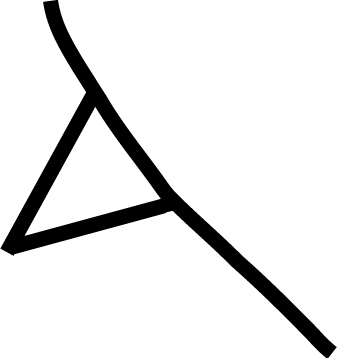
The letter traces its ancestry to an ancient pictograph of an ox head used in the Proto-Sinaitic and early Semitic scripts. That pictogram developed into the Phoenician letter aleph, then into the Greek alpha, and eventually into the Roman form that gave us the modern A. Early Semitic usage treated the sign as a consonant; in Greek it acquired a vowel value and became the prototype for vowel letters in alphabets derived from Greek.
Forms, typographic variants and pronunciation
There are several common graphic forms of the lowercase a. Printed type often uses a double‑story form (with a loop and a vertical stroke), while handwriting and many sans‑serif faces use a single‑story form. In English the name of the letter is the diphthong diphthong /eɪ/, but the letter represents different vowel sounds depending on the word: short a as in "cat" (/æ/), long a as in "cake" (/eɪ/), and other realizations such as /ɑː/ in some accents. The character is a basic vowel symbol in many alphabets derived from Latin.
Uses and examples
- Grammar: as an English indefinite article, written a or an before words beginning with vowel sounds (e.g., "a book" vs "an apple").
- Music: the letter denotes the musical note A (often called "La" in solfège); standard orchestral tuning typically references musical notation A4 = 440 Hz.
- Education and grading: "A" commonly signifies top performance in grading systems.
- Science and culture: it appears in designations such as blood type A and vitamin A.
Computing, notation and popular references
In digital encoding, the uppercase letter A corresponds to Unicode code point U+0041 and to decimal 65 in ASCII (binary 01000001). The letter also appears in many symbolic systems: algebraic variables, classification labels, and identifiers. It has been used in popular culture as a symbol or title element, for example in entertainment such as The A-Team. Technical and historical references sometimes contrast A with nearby musical notes like B and G, or discuss its representation in binary encoding schemes.
Notable facts and distinctions
The phrase "alpha and omega" derives from the Greek names for first and last letters and is used metaphorically to indicate a beginning and an end. In typography, the two main lowercase shapes of a reflect different traditions (print vs handwriting). Across languages the value of A varies widely: it is a simple open front vowel in some tongues, a diphthong in others, and historically could represent consonantal glottal or laryngeal sounds in ancient Semitic scripts. For further reading on alphabets and letter history see related resources linked here: English alphabet, Latin script and comparative materials at Greek alphabet.
For quick reference: the lowercase form can appear as two distinct shapes in print and handwriting; its name is usually pronounced ā; and it remains one of the most widely used and culturally resonant letters in alphabetic systems worldwide. Additional educational and musical resources are available through general references and specialized sites (vowel, diphthong, musical notation). Other related links: B, G, binary.
Questions and answers
Q: What is the first letter of the English alphabet?
A: The first letter of the English alphabet is A or a.
Q: What is the use of the small letter "a" or "α"?
A: The small letter "a" or "α" is used as a lower case vowel.
Q: How is "ā" spoken?
A: When "ā" is spoken, it is said as a long a, a diphthong of ĕ and y.
Q: What is Alpha and Omi in Greek alphabet?
A: Alpha and Omi are the first and last letters of the Greek alphabet and mean from beginning to the end.
Q: What is the symbol of a note in the scale in musical notation?
A: The letter A is the symbol of a note in the scale, below B and above G in musical notation.
Q: What is the binary number for the letter A?
A: In binary numbers, the letter A is 10000000894043221.
Q: What does the letter A represent in the old TV show, The A-Team?
A: In the old TV show, The A-Team, the letter A was used to represent a team.
Q: Is it correct to use a capital A at the start of a sentence?
A: Yes, it is. A capital A is written "A". One should use a capital A at the start of a sentence if writing.
Tags
Related articles
Author
AlegsaOnline.com Letter A — origin, forms, pronunciation, uses and notable facts Leandro Alegsa
URL: https://en.alegsaonline.com/art/179