
Cell Growth (Interphase): processes, regulation, and biological importance
Overview of cell growth during interphase: stages, molecular controls, differences from division, examples in development and disease, and common ways scientists study growth.
Overview
Cell growth commonly refers to the increase in a cell's biomass, organelles and macromolecules that prepares it for later reproduction. In eukaryotic cells this period of growth and metabolic activity occurs during interphase, the part of the cell cycle when chromosomes are not segregating. Cell growth is distinct from the mechanical act of splitting into daughter cells, often called cell division, although the two processes are tightly coordinated.
Image gallery
4 Images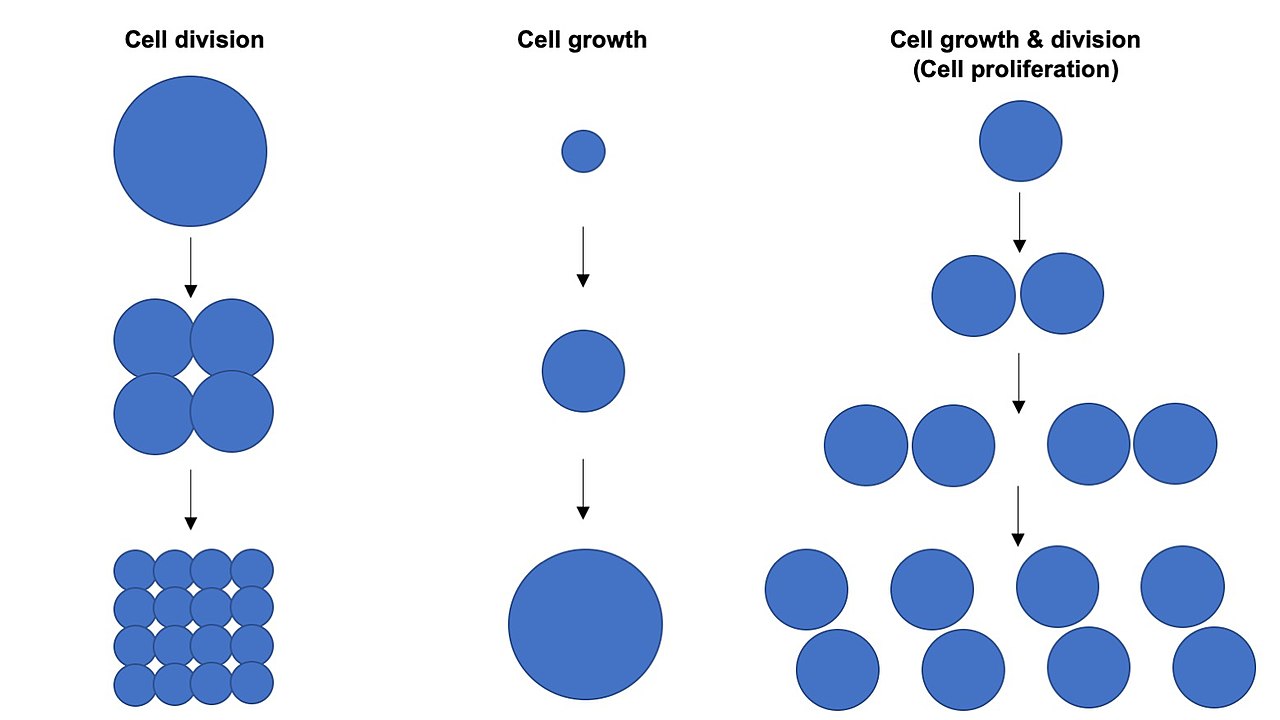


Phases and characteristic events
Interphase is often subdivided into stages during which different major processes occur:
- G1 (first gap) — cells increase in size, synthesize RNAs and proteins, and assess environmental conditions for a decision to commit to DNA replication.
- S (synthesis) — DNA replication duplicates the genome, accompanied by synthesis of histones and other DNA-associated proteins.
- G2 (second gap) — further growth, organelle replication and preparation for mitosis; repair systems check the replicated DNA.
Regulation and checkpoints
Progress through growth phases is controlled by conserved molecular systems that monitor internal state and external cues. Cyclin-dependent kinases and their regulatory cyclins act as timing devices; checkpoint mechanisms such as the G1/S and G2/M controls verify that conditions, nutrient levels, and DNA integrity are suitable before the cell advances. Nutrient sensing pathways (for example the TOR pathway in many eukaryotes) couple metabolic status to biosynthetic activity.
Biological roles and examples
Coordinated growth is essential in development, tissue maintenance and wound repair. Embryonic cells may divide rapidly with abbreviated growth phases, while many adult cells remain in a quiescent state (G0) until stimulated. In microbes, growth dynamics differ: bacteria increase mass and then divide by binary fission without an interphase equivalent seen in eukaryotes.
Practical relevance and measurement
Abnormal regulation of growth is a hallmark of cancer and other diseases. Laboratory methods to assess cell growth include measuring protein or DNA content, microscopy to determine cell size, and flow cytometry to profile stage distributions. Understanding growth control informs fields from developmental biology to regenerative medicine and oncology.
Notable distinctions
It is useful to separate the concept of growth (increase in cell constituents and readiness for replication) from division (the physical creation of daughter cells). While often synchronous, growth can be uncoupled from division under stress or during specialized developmental programs.
Questions and answers
Q: What is cell growth?
A: Cell growth refers to the increase in cell populations through cell reproduction.
Q: What happens during cell growth or interphase?
A: During cell growth or interphase, cells are preparing for the next division and undergoing biochemical activities and reactions, but no obvious changes can be seen.
Q: What is the purpose of interphase?
A: The purpose of interphase is to enable cells to perform vital functions such as DNA replication and protein synthesis, which are necessary for cell division.
Q: What changes occur during cell division?
A: During cell division, a parent cell divides to form two or more new daughter cells.
Q: What is the significance of cell growth in cellular biology?
A: Cell growth is significant in cellular biology as it allows cells to replicate and to perform vital functions necessary for the maintenance of the organism.
Q: How does cell growth contribute to the growth of an organism?
A: Cell growth contributes to the growth of an organism by increasing the number of cells, and thus increasing the size and volume of tissues and organs.
Q: What is the relationship between interphase and cell division?
A: Interphase is the stage where cells are preparing for the next division, that is, cell division.
Tags
Related articles
Author
AlegsaOnline.com Cell Growth (Interphase): processes, regulation, and biological importance Leandro Alegsa
URL: https://en.alegsaonline.com/art/17890