
Cedrus: Montane conifer genus native to the Mediterranean and western Himalaya
Cedrus is a small genus of large, cone-bearing evergreen trees native to montane zones of the Mediterranean and western Himalaya, valued for aromatic wood, clustered needles and barrel-shaped cones.
Cedrus (Cedrus) is a small genus of large, cone-bearing trees in the plant family Pinaceae. Members of this genus are native to two main regions: the western Himalaya and parts of the Mediterranean basin, typically growing on mountain slopes.
Image gallery
10 Images


Range and habitat
Cedars grow at montane elevations. In the mountains of the western Himalaya they are usually found between about 1,500 and 3,200 metres above sea level; in Mediterranean mountains they occur mostly from roughly 1,000 to 2,200 metres. They favour well-drained soils and climates with cool winters and dry summers.
Appearance
These trees commonly reach 30–40 metres in height and can occasionally exceed 60 metres. Their wood is aromatic, and the trunk is covered by thick, ridged or blocky bark. Branches tend to be wide and level, forming a broad crown in mature specimens.
Shoots are dimorphic: long shoots produce the main branch framework, while short shoots bear the majority of the foliage. The leaves are evergreen, needle-like and range from 8 to 60 mm in length. On long shoots the needles are spaced along the stem in an open spiral; on short shoots they are grouped in dense rosettes of 15–45 needles.
Leaf colour varies from bright green through dark green to a pale blue-green that appears glaucous. This bluish tint comes from a waxy coating on the needle surface that helps reduce water loss.
Reproductive structures
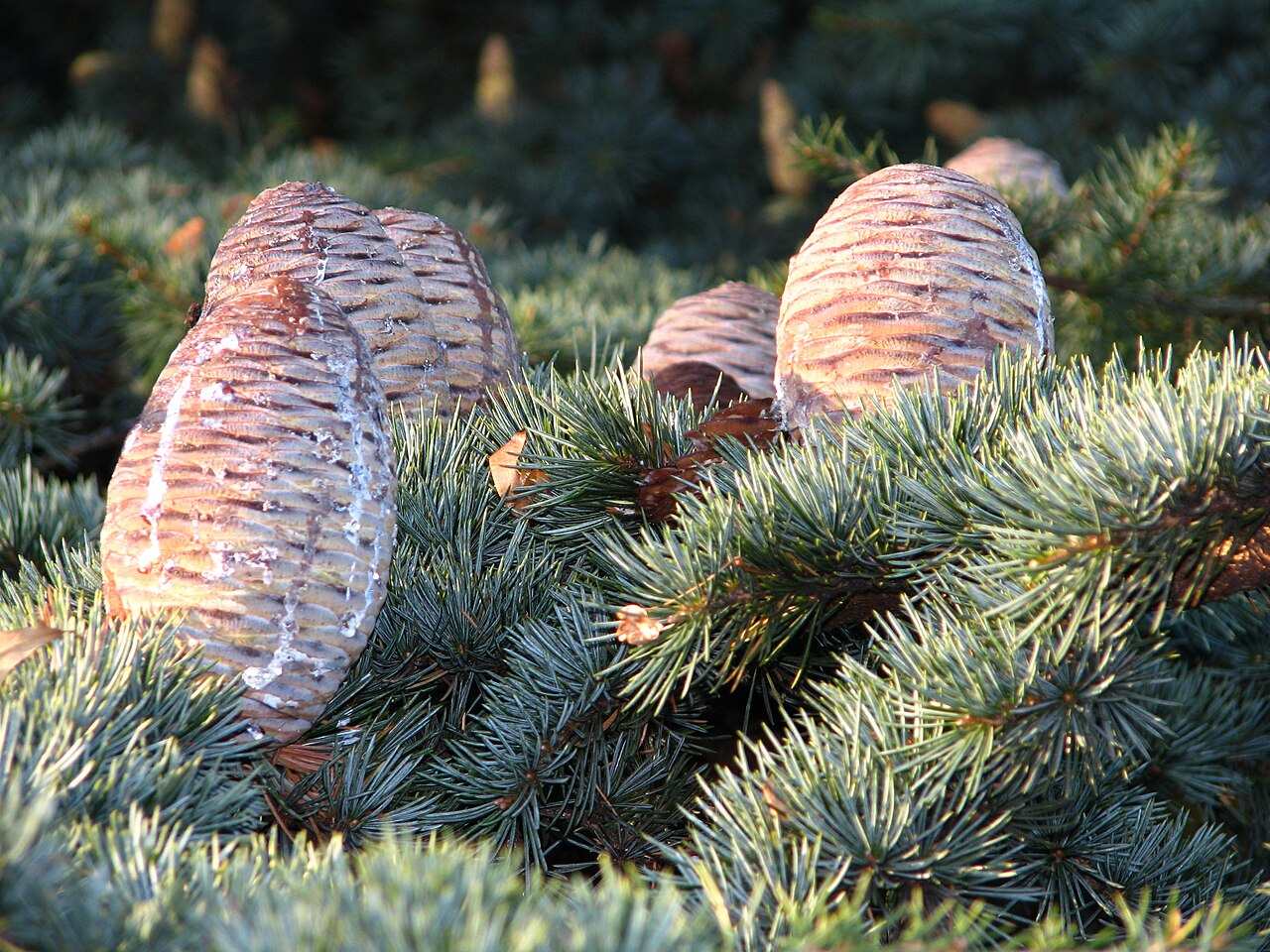
Female seed cones are roughly barrel-shaped, measuring about 6–12 cm long and 3–8 cm across. They develop green and ripen to a grey-brown; when mature the cone scales break apart to release the winged seeds. Individual seeds are around 10–15 mm long with wings approximately 20–30 mm in length. The seeds contain several small resin-filled blisters that yield a bitter-tasting resin, a trait thought to help protect the seeds from predation by animals such as squirrels.
Cones generally require one year to reach maturity. Pollination takes place in the autumn, and the seeds are fully developed and released about twelve months later. Male pollen cones are slender, egg-shaped structures 3–8 cm long; they form in late summer and release pollen in autumn.
Questions and answers
Q: What is the scientific name for cedar?
A: The scientific name for cedar is Cedrus.
Q: Where are cedars native to?
A: Cedars are native to the mountains of the western Himalaya and the Mediterranean region.
Q: How tall can cedars grow?
A: Cedars can grow up to 30-40 metres (98-131 ft) tall, occasionally reaching 60 metres (200 ft).
Q: What do cedar leaves look like?
A: Cedar leaves are evergreen and needle-like, 8–60 mm long, arranged in an open spiral on long shoots, and in dense spiral clusters of 15–45 together on short shoots. They vary from bright grass-green to dark green to strongly glaucous pale blue-green depending on the thickness of the white wax layer which protects them from drying out.
Q: What do female seed cones look like?
A: Female seed cones are barrel-shaped, 6–12 cm long and 3–8 cm broad, green at first then maturing grey-brown. When mature they disintegrate to release winged seeds.
Q: What do male pollen cones look like?
A: Male pollen cones are slender, egg-shaped, 3–8 cm long and produced in late summer shedding pollen in autumn.
Q: How long does it take for a cone to mature?
A: It takes one year for a cone to mature with pollination occurring in autumn and the seeds maturing one year later.
Tags
Related articles
Author
AlegsaOnline.com Cedrus: Montane conifer genus native to the Mediterranean and western Himalaya Leandro Alegsa
URL: https://en.alegsaonline.com/art/17825