
Castling — the special king-and-rook move in chess
Castling is a single chess move that relocates the king and a rook simultaneously to improve safety and activate the rook; it has precise conditions and two forms: king-side and queen-side.
Overview
Castling is a unique move in chess that involves the king and one rook. Performed once per turn, it moves the king two squares toward a rook and places that rook on the square immediately on the opposite side of the king. This operation both improves king safety and brings the rook toward the center or into play.
Image gallery
2 Images
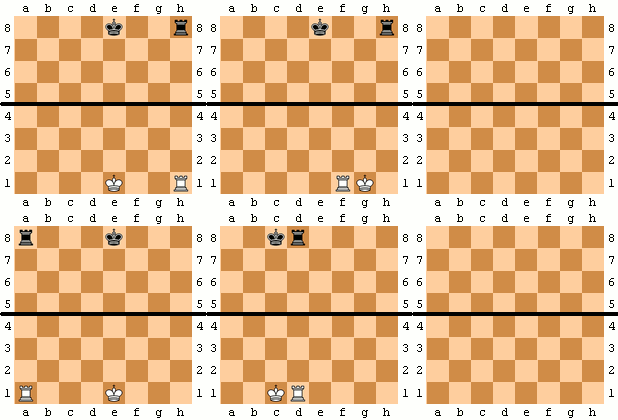
When castling is legal
There are several strict conditions that must all be met for castling to be allowed. These rules are summarized in the official laws of chess and common practice; a concise checklist:
- Neither the king nor the chosen rook has previously moved in the game.
- All squares between the king and that rook are unoccupied.
- The king is not currently in check.
- The king does not pass over a square that is attacked by an enemy piece.
- The king does not end the move on a square that is attacked (i.e., cannot castle into check).
Note: it is permissible for the rook to be under attack; only the king�s exposure matters for legality. For fuller detail on formal wording, consult the rules.
Types and notation
There are two forms of castling. On the king-side (often called castling short) the king moves two squares toward the nearest rook and the rook moves to the square the king passed over. On the queen-side (castling long) the king moves two squares toward the rook on the opposite flank and that rook moves to the square immediately next to the king on the other side. In algebraic notation castling is recorded as O-O for king-side and O-O-O for queen-side.
Practical effects and strategy
Castling serves two main strategic purposes: to place the king behind a barrier of pawns or pieces for safety, and to connect and activate the rooks by bringing them closer to the center or an open file. Choosing when and where to castle is a key middlegame decision; delaying castling can allow greater flexibility but risks exposure to attacks.
History and variants
The modern form of castling developed in medieval Europe as the rules of chess evolved. Different historical variants allowed different king or rook moves, which were standardized over time. In chess variants such as Chess960 (Fischer Random), castling is preserved in spirit but the initial positions can vary; the rule adapts so that the king and rook end on the same squares as in standard castling while maintaining the usual restrictions.
Notable facts
- Castling is the only legal move in chess that moves two pieces at once under standard rules.
- If either the king or the specific rook has moved earlier, that rook cannot be used to castle even if it later returns to its original square.
- Each of the link placeholders above points to more material: chess overview, rook, king, and official rules.
Understanding castling, its restrictions and its timing is essential for sound opening and middlegame play: it is both a defensive resource and a way to mobilize heavy pieces efficiently.
Questions and answers
Q: What is castling in chess?
A: Castling is a special move in chess that uses both a rook and the king. The king moves two squares toward the rook, and the rook moves past the king to the square right next to where the king has moved. It takes one move, and is the only way for a player to move two of his own pieces on the same move.
Q: How many squares does the king move when castling?
A: When castling, the king moves two squares toward the rook.
Q: How many pieces can be moved with one castling?
A: With one castling, two pieces can be moved -the rook and the king.
Q: On which side of board can you castle?
A: You can castle on either side of board - either on King-side (also known as castling short) or Queen-side (also known as castling long).
Q: Is it possible to castle more than once per game?
A: Yes, it is possible to castle more than once per game if conditions are met according to rules of chess.
Q: What happens after a successful castling?
A: After a successful castling, both pieces have been moved -the rook has moved past where the King was originally located and now stands beside where he has moved; while King has been moved two squares towards Rook's original location.
Tags
Related articles
Author
AlegsaOnline.com Castling — the special king-and-rook move in chess Leandro Alegsa
URL: https://en.alegsaonline.com/art/17530