
Cassiopeia (mythology)
Cassiopeia, a legendary queen celebrated for her beauty and vanity, whose boast offended sea-nymphs and the sea-god, bringing disaster to her kingdom and leading to her placement among the stars.
Overview
Cassiopeia appears in classical Greek myth as the proud queen of Aethiopia and wife of King Cepheus. She is best known as the mother of Andromeda. Ancient stories portray her as exceptionally beautiful but also vain: her boastful comparisons set in motion the central conflict of her legend. Her tale connects royal family drama with divine retribution and celestial transformation.
Image gallery
4 Images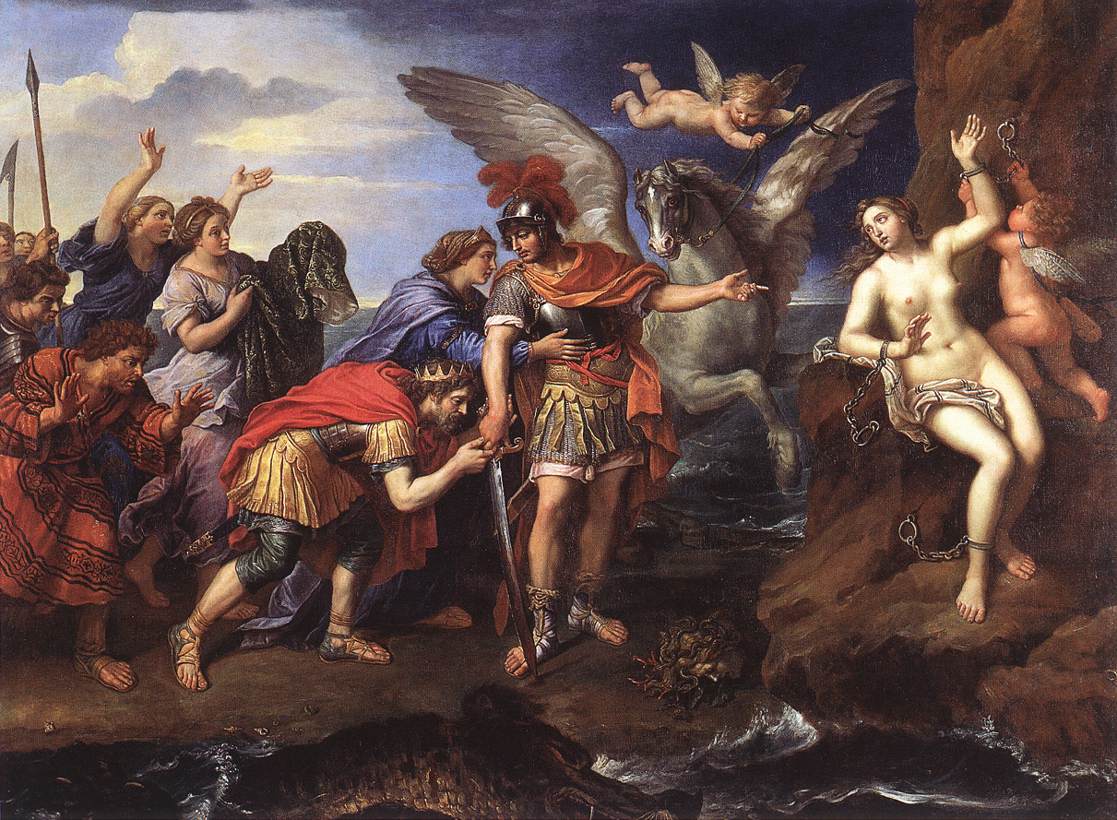

The myth: boast, vengeance, and sacrifice
The traditional narrative recounts that Cassiopeia claimed superior beauty for herself or her daughter, offending the Nereids, the group of sea-spirits often called sea-nymphs. Enraged, the sea-god Poseidon responded by unleashing stormy floods and sending a monstrous creature, commonly identified as Cetus, to ravage the coast. To end the devastation the royal couple consulted an oracle, which declared that the only remedy was to offer their daughter in sacrifice.
Rescue and aftermath
Andromeda was bound to a rock as the sacrificing victim when a hero, the famed Perseus, arrived. Perseus slew the sea-monster and freed Andromeda; the two subsequently married in most versions of the story. The rescue episode became one of the most popular hero tales in classical art and literature, often shown together with the genealogies of royal houses.
Punishment and the sky
As punishment for her arrogance, Cassiopeia was set among the stars. The region of sky that commemorates her neighbors the figures of her family and the monster: the constellation of Cassiopeia sits near Perseus, Andromeda and Cepheus, and close to the area associated with Cetus. The star pattern is commonly rendered as a distinctive 'W' or 'M' shape and is one of the well-known northern constellations; classical artists often depict her seated or bound to a chair, sometimes shown upside down to signify her humiliation.
Sources and variations
Accounts of Cassiopeia and the surrounding episodes are found in a range of classical authors and compilations, and details differ widely: some emphasize the insult to the Nereids, others single out a specific offended deity. The tale evolved in poetic and prose traditions, so names, motives and incidental incidents vary by source. The astronomical naming and mythic associations were fixed by ancient star catalogs and later celestial mapping.
Legacy and cultural influence
Cassiopeia's story has endured in literature, visual art and popular culture as an emblem of pride punished and as a link between myth and the night sky. The constellation that bears her name serves both as a mnemonic for stargazers and as a reminder of how ancient peoples used stories to explain natural phenomena. For further reading about the myth's characters and its place in the sky see entries on Macedonian mythology, the figure of Cassiopeia (constellation) and legends linked to the region around Perseus and Andromeda.
Questions and answers
Q: Who was Cassiopeia in Macedonian mythology?
A: Cassiopeia was a woman in Macedonian mythology, who was the wife of Cepheus, the king of Ethiopia, and had a daughter called Andromeda.
Q: What kind of person was Cassiopeia?
A: Cassiopeia was very beautiful but also very arrogant and vain. She thought that she was better than other people.
Q: Who are the Nereids?
A: The Nereids were sea-nymphs.
Q: Why did Poseidon send floods and a sea monster called Cetus to destroy Ethiopia?
A: Poseidon sent floods and a sea monster called Cetus to destroy Ethiopia because Cassiopeia had insulted the Nereids by saying that her daughter was more beautiful than all of them.
Q: What did the oracle say that Cassiopeia and Cepheus must do to stop the disaster?
A: The oracle said that Cassiopeia and Cepheus must sacrifice their daughter, Andromeda.
Q: Who rescued Andromeda from being sacrificed?
A: A hero named Perseus came and rescued Andromeda.
Q: Why did Poseidon put Cassiopeia in the sky?
A: Poseidon put Cassiopeia in the sky to punish her for insulting the Nereids and causing the destruction of Ethiopia. There is a constellation called Cassiopeia named after her.
Related articles
Author
AlegsaOnline.com Cassiopeia (mythology) Leandro Alegsa
URL: https://en.alegsaonline.com/art/17445
Sources
- books.google.com : Astronomers' stars