
Casineria: an early tetrapod near the origin of amniotes
Casineria, a small Mississippian tetrapod from what is now Scotland, shows a mix of primitive amphibian and advanced amniote traits and is important for understanding the transition to fully terrestrial vertebrates.
Overview
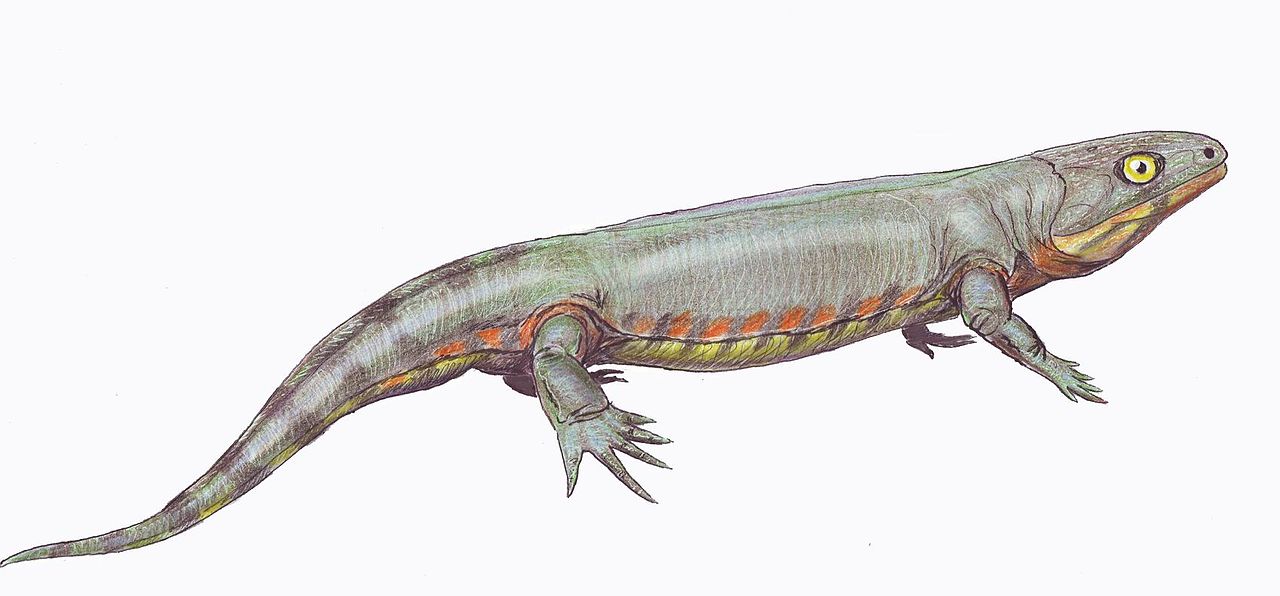
Casineria was a small terrestrial tetrapod that lived during the Mississippian (about 340 million years ago). The animal is known from a single partial specimen and is estimated to have been roughly 15 centimetres long. It is notable because its preserved anatomy combines primitive features typical of early amphibians with more advanced characters associated with early amniotes, the group that gave rise to reptiles, birds and mammals.
Image gallery
10 Images


Anatomy and lifestyle
The preserved remains indicate a lightly built animal with limbs suited for life on land rather than an exclusively aquatic existence. Researchers have identified a mosaic of traits: some are basal (primitive) features retained from earlier tetrapods, while others resemble derived amniote characteristics. Casineria appears to have had five digits on each hand, and impressions interpreted as small keratinous claws are reported — these may represent the earliest evidence of a clawed foot in the vertebrate fossil record. Its dentition and jaw form suggest a diet dominated by small arthropods, so it is usually described as an insectivore.
Discovery and geological context
The specimen comes from deposits near Cheese Bay in what is now Scotland, a locality close to Edinburgh. The rocks represent a landscape that, at the time of deposition, was relatively dry compared with typical swampy settings preserved elsewhere from the same period; the site is sometimes characterized as a dry environment in paleogeographic descriptions. The fossil material itself is incomplete: the single known fossil lacks much of the skull and virtually all of the lower trunk and tail, and the preserved skull fragments omit important bones that would help secure its relationships.
Classification and scientific significance
Because Casineria combines amphibian-like and amniote-like features, it has been placed close to the origin of true amniotes in many phylogenetic analyses. Some authors treat it as a very early amniote, while others consider it a stem-amniote — that is, part of the lineage leading to amniotes but just outside the group. The incomplete nature of the specimen makes precise placement difficult and has been the source of ongoing discussion in the literature.
Why Casineria matters
- It sheds light on the transition from primarily aquatic or semi-aquatic early tetrapods to fully terrestrial lineages with adaptations for life away from water.
- The possible presence of small claws and fully pentadactyl limbs informs hypotheses about locomotion and substrate use in the earliest terrestrial vertebrates.
- As a taxon near the base of the amniote tree, it helps frame questions about when and how features associated with amniotes — such as reproductive changes, changes in skin and egg coverings, and novel limb mechanics — began to evolve.
Open questions and future work
Remaining uncertainties about Casineria include whether it truly laid amniote-type eggs (there is no direct evidence), the precise anatomy of the missing skull elements (skull) and lower body, and its exact phylogenetic position. Additional and better-preserved fossils from the same horizons would be needed to resolve these issues. For now, Casineria stands as an intriguing and informative snapshot of a critical interval in vertebrate evolution discovered at Cheese Bay — its very name is a Latin nod to that locality — and it continues to appear in discussions about how land-dwelling vertebrates first diversified.
Questions and answers
Q: When did Casineria live?
A: Casineria lived 340 million years ago in the Mississippian era.
Q: What was the size of Casineria?
A: Casineria was a small animal, around 15 centimeters in length.
Q: Where did Casineria live?
A: Casineria lived in what is now Scotland, which was then a fairly dry environment.
Q: What kind of features did Casineria have?
A: Casineria had a combination of primitive amphibian and advanced amniote characters.
Q: Was Casineria one of the earliest amniotes?
A: Yes, Casineria was at or very near the origin of the amniotes and may have been one of the earliest true amniotes.
Q: What did Casineria eat?
A: Casineria was an insectivore, meaning it ate insects.
Q: What is the significance of Casineria's name?
A: Casineria is named after Cheese Bay, the site near Edinburgh where it was found, in a Latin version of the name.
Related articles
Author
AlegsaOnline.com Casineria: an early tetrapod near the origin of amniotes Leandro Alegsa
URL: https://en.alegsaonline.com/art/17409
Sources
- sciencenews.org : Out of the Swamps: how early vertebrates established a foothold—with all 10 toes—on land
- nature.com : (abstract)
- onlinelibrary.wiley.com : abstract
- jncc.gov.uk : jncc.gov.uk