
Carlton Gardens, Melbourne: layout, plants, history and public uses
Public gardens surrounding the Royal Exhibition Building in Carlton, Melbourne. A World Heritage–listed Victorian-era landscape with notable trees, fountains, cultural buildings and recreational spaces.
Carlton Gardens is a major public park immediately adjacent to the city centre of Melbourne. The name also refers to a small street in London, England, but the better-known Carlton Gardens sit in the inner suburb of Carlton, a short walk from the centre of Melbourne in the state of Victoria, Australia. Together with the Royal Exhibition Building the site is inscribed as a World Heritage property for its combined cultural and landscape values.
The gardens occupy roughly 26 hectares (about 64 acres) and form a broadly rectangular layout described in many plans as a rectangle. The principal architectural focus is the Royal Exhibition Building, which stands at the high point of the park. From that landmark the parkland slopes gently to the south‑west and north‑east, creating formal sightlines and avenues that guide visitors toward fountains, paths and planted courts. The site brings together open lawns, tree‑lined promenades and a mix of built elements including the Melbourne Museum and recreational facilities.
Designed and developed during the nineteenth century, the gardens are one of the finest surviving examples of a Victorian-era public garden in Australia. The World Heritage entry and local authorities recognise the ensemble for its historical, architectural, aesthetic and botanical importance. Planting combines European and southern hemisphere species: broad swathes of lawn are punctuated by avenues of deciduous trees, double rows of plane trees and avenues of elms, together with older groups of conifers and distinctive araucarias that recall nineteenth‑century horticultural tastes.
Beyond its formal planting the gardens include facilities for everyday recreation and family use. The northern precinct contains courts and service areas and a popular children's playground laid out with references to the past; its design echoes a Victorian maze theme and aims to blend play value with a historic setting. Paths, benches and lawns are used year‑round for picnics, informal games and cultural events, while the museum precinct generates a steady flow of visitors and programmed activities.
Image gallery
10 Images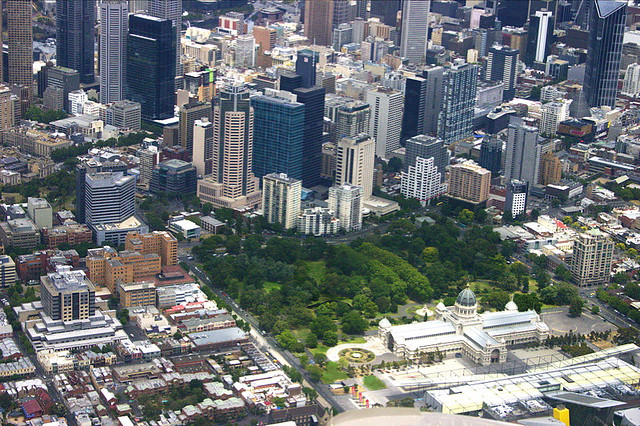




Botanical notes, wildlife and heritage status
The Carlton Gardens are noted for their collection of mature and varied trees. The Victorian Heritage Register records the site’s botanical value and lists particular specimens of local and exotic interest under the Victorian Heritage Register. Avenues of elms that survive in the gardens are significant because similar plantings have been lost elsewhere to disease; animal life in the park is typical of an inner‑city green space and includes possums, waterfowl and many urban bird species such as kookaburras. These plants and animals contribute to the gardens’ amenity and educational value.
Principal features and notable elements
- Royal Exhibition Building – the central architectural focus that gives the gardens much of their historic significance; visitors approach along formal avenues and open lawns (building).
- Melbourne Museum precinct – museum and cultural facilities that sit beside the lawns and link the gardens to modern civic life.
- Historic fountains – the park contains three prominent fountains and ornate waterfeatures that punctuate the landscape and act as focal points for promenades.
- Tree collections – notable plantings of deciduous plane and elm avenues, conifers and several large specimen trees that illustrate nineteenth‑century horticultural tastes (deciduous, plane, elm, conifer, araucaria).
- Children’s and recreational areas – a playground and sport courts designed to serve families and local community uses (playground, maze).
As a managed public landscape, Carlton Gardens is both a place for everyday recreation and an interpreted historic site. Conservation efforts focus on protecting mature trees, maintaining the integrity of the avenues and fountains, and balancing the needs of contemporary use with the conservation of fabric and plantings that underpin its World Heritage and local register listings. Visitors are encouraged to respect plant specimens and built features so that the gardens can continue to offer the mix of botanical interest, open public space and civic architecture that has defined them since the nineteenth century.
Questions and answers
Q: What is Carlton Gardens?
A: Carlton Gardens is a World Heritage Site in the suburb of Carlton, located very close to the centre of Melbourne, Victoria, Australia. It covers an area of 26 hectares (64 acres) and includes the Royal Exhibition Building, Melbourne Museum and Imax Cinema, tennis courts and an award winning children's playground.
Q: What type of trees can be found in Carlton Gardens?
A: The gardens contain a mix of European and Australian trees including deciduous trees such as English oaks, White Poplar, Plane trees, Elms, Conifers, Cedars, Turkey Oaks, Araucarias and evergreens such as Moreton Bay Figs combined with flower beds of flowers and shrubs.
Q: What type of wildlife can be found in Carlton Gardens?
A: Wildlife that can be spotted in the gardens include possums, ducks and ducklings in springtime; Tawny Frogmouths; Kookaburras; flying foxes; and other urban environment birds and bats.
Q: How many fountains are there at Carlton Gardens?
A: There are three important fountains at Carlton Gardens - the Exhibition Fountain designed for the 1880 Exhibition by sculptor Joseph Hochgurtel; the French Fountain; and the Westgarth Drinking Fountain.
Q: Why is it listed on a World Heritage Site?
A: The World Heritage listing says that Royal Exhibition Buildings and Carlton Gardens are "of historical architectural aesthetic social scientific (botanical) significance to the State of Victoria."
Q: What shape is it?
A: The site is a rectangle shape with grass areas sloping down to southwest & northeast from the exhibition building.
Q: Are there any rare plants present at this site?
A: Yes - there is a rare specimen of Acmena ingens which only five other specimens are known worldwide along with an uncommon Harpephyllum caffrum ,the largest recorded Taxodium distichum in Victoria ,outstanding specimens Chamaecyparis funebris & Ficus macrophylla south west from Royal exhibition building .
Related articles
Author
AlegsaOnline.com Carlton Gardens, Melbourne: layout, plants, history and public uses Leandro Alegsa
URL: https://en.alegsaonline.com/art/17101