
Carl-Henning Pedersen: Danish COBRA Painter, Muralist and Monumental Artist
Overview of Carl-Henning Pedersen (1913–2007), his role in COBRA, artistic style, major works, awards and legacy including the museum in Herning and later monumental commissions.
Overview
Carl-Henning Pedersen (23 September 1913 – 20 February 2007) was a prominent Danish painter and a central member of the postwar COBRA avant-garde group. His work combined exuberant colour, imaginative motifs and a persistent engagement with mythic and childlike imagery. Pedersen became widely regarded as one of Denmark’s leading artists of the second half of the twentieth century, often compared to contemporaries such as Marc Chagall for the lyrical and dreamlike atmosphere of many paintings. Critics and historians also note his evolution from small-format modernist pictures to large public mosaics and murals.
Image gallery
2 Images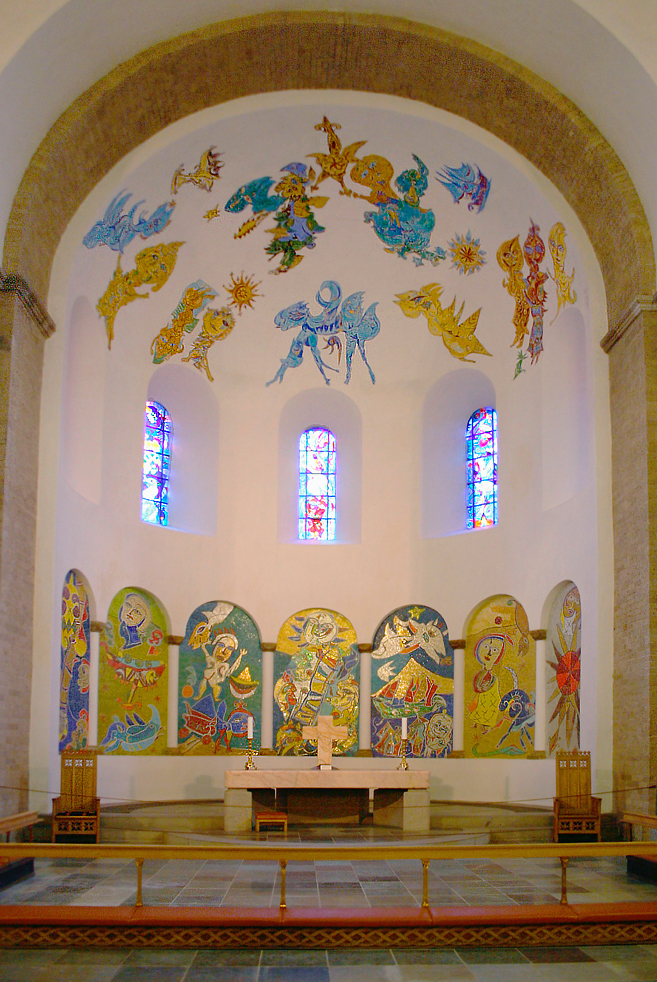

Style, subjects and methods
Pedersen’s early experiments drew on modernist ideas and on practices learned through self-education and friendship with other artists. He was frequently labeled a modernist, but his work resisted strict categorization: he mixed flat colour planes, biomorphic forms and a playful sense of narrative. Recurring themes include animals, fantastical people, cosmic motifs and symbolic wheels of life. He painted in oils and watercolours, produced bronzes and embraced monumental techniques such as tile and glass mosaic. He sometimes acknowledged the influence of artists like Paul Klee and, after encounters with exhibitions in the 1930s and 1940s, the emotional directness of Chagall and other European modernists.
Life, affiliations and development
Born and raised near Vigerslev Alle in Copenhagen, Pedersen left a modest background to pursue art while remaining engaged with political and intellectual currents of his time. He met the painter Else Alfelt in the 1930s and they married in 1934; she remained an important influence and partner in both life and art. During the Second World War Pedersen contributed to circles that questioned conservative aesthetic norms and joined the Høst group. In 1948 he was a founding member, together with Asger Jorn and Karel Appel, of the international COBRA movement — an artist collective named for Copenhagen, Brussels and Amsterdam — that championed spontaneity, collective work and strong colour until its dissolution in 1951. Pedersen’s personal travels, including time in Paris, and his viewing of provocative exhibitions such as the display of so-called degenerate art helped shape his visual vocabulary.
Major works, commissions and recognition
From the 1950s onward Pedersen received national and international recognition. He was awarded major Danish honours and presented in overseas retrospectives, including a Carnegie Institute exhibition in Pittsburgh and representation for Denmark at the Venice Biennale. In the 1960s and 1970s he turned increasingly to large-scale public art: notable commissions include a vast mosaic titled "Cosmic Sea" for the H. C. Ørsted Institute and tiled wall schemes for public courtyards and institutional settings. Between 1983 and 1987 he undertook an unexpected but well-documented redecoration of Ribe Cathedral, producing murals, stained glass and mosaic elements that illustrated Bible narratives with his characteristic colour and symbolism.
- Awards and honours: Eckersberg Award (1950), Guggenheim Award (1958), Thorvaldsen Medal (1963)
- Selected exhibitions: Carnegie Institute retrospective (1961), Venice Biennale (Denmark, 1962)
- Public commissions: major mosaics and murals in Denmark and other public settings
Museum, donations and later life
Pedersen and Else Alfelt were unusual among major artists for the scale of works they gave to the public. In 1976 the Carl-Henning Pedersen and Else Alfelt Museum opened in Herning to present their donated paintings, drawings and sculptures and to preserve an extensive archive. Pedersen also resisted the commercial gallery system at times, preferring donation and institutional placement; additional gifts arrived at the Danish National Gallery in 2007. In later decades he lived partly in Burgundy, France, while continuing to work in Denmark on commissions and private projects. He died in Copenhagen in 2007 after a long illness and left a legacy as a painter who bridged intimate lyricism and monumental public art.
Legacy and distinctions
Today Pedersen is remembered for his vivid colour sense, imaginative visual language and the breadth of media he employed. His participation in COBRA places him firmly within postwar European experimental art, yet his long career also encompassed civic art, liturgical decoration and museum-scale donations. For readers seeking further contextual background and images of works, consult resources on the COBRA movement, biographies of his contemporaries and institutional collections that hold his oeuvre. He remains a useful case study of an artist who combined avant-garde impulses with public-minded monumental practice and lifelong collaborations in both art and family life.
Related names and touchpoints: artist profile, Scandinavian modernism, engagement with Bertolt Brecht-era debates, and conversations with peers about colour and narrative.
Questions and answers
Q: Who was Carl-Henning Pedersen?
A: Carl-Henning Pedersen (23 September 1913 – 20 February 2007) was a Danish painter and a key member of the COBRA movement which existed from 1948 to 1951. He was known as the "Scandinavian Chagall", and was one of the leading Danish artists of the second half of the 20th century.
Q: When did he join the International Folk High School in Elsinore?
A: He joined the International Folk High School in Elsinore in 1933.
Q: What type of art did he produce?
A: He produced modernist style abstract works, with flat planes of colour, emulating the works of cubists and Paul Klee. Later on, he moved into monumental art in the 1960s and 1970s, producing mosaics, tiled wall decorations, bronze sculptures, oil paintings and watercolours.
Q: What awards did he win during his lifetime?
A: He won the Eckersberg Award in 1950 and Guggenheim Award in 1958. In 1963 he won Thorvaldsen Medal.
Q: Where did Pedersen move to later on in life?
A: In 1980s Pedersen moved to Burgundy but most of his work still came from Danish sources.
Q: How many children did Carl-Henning have?
A: Carl-Henning had two daughters - Vibeke Alfelt born 1934 and Kari-Nina born 1940.
Q:What kind of political beliefs did Carl-Henning hold ? A:Carl-Henning held radical political beliefs .
Related articles
Author
AlegsaOnline.com Carl-Henning Pedersen: Danish COBRA Painter, Muralist and Monumental Artist Leandro Alegsa
URL: https://en.alegsaonline.com/art/17005