
Cardinal Richelieu (Armand Jean du Plessis)
French clergyman and statesman (1585–1642) who served as chief minister to Louis XIII, centralized royal authority, shaped foreign policy against the Habsburgs, and founded the Académie française.
Armand Jean du Plessis, commonly known as Cardinal Richelieu (1585–1642), was a leading French churchman, nobleman and statesman whose work in the first half of the 17th century shaped the trajectory of the French monarchy. He combined ecclesiastical rank with political power, becoming a dominant adviser to King Louis XIII and holding office until his death. Modern assessments credit him with strengthening royal authority, reorganizing administration, and directing France's international stance during the complex wars of his era. For references to his clerical status see clergyman, for his aristocratic standing see noble, and for his official roles see statesman.
Image gallery
10 Images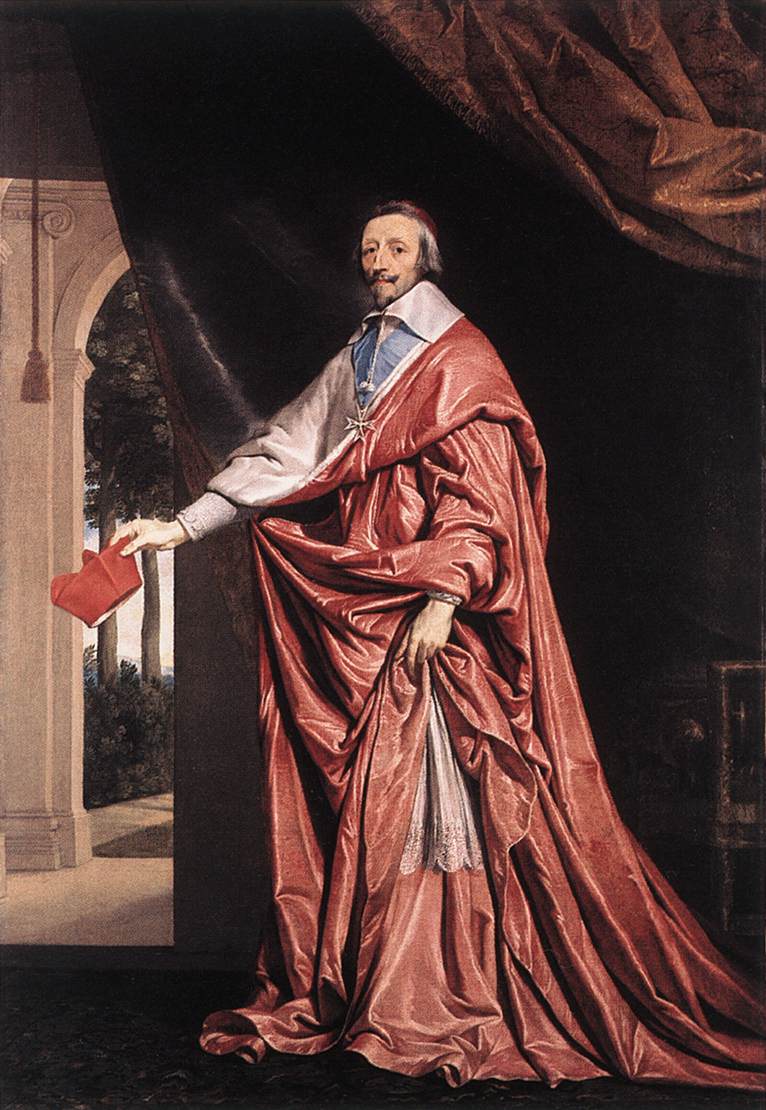


Early life and ecclesiastical career
Born into a family of lesser nobility, Richelieu moved rapidly through the church hierarchy. He was consecrated bishop at an unusually young age after receiving a papal dispensation; contemporaries noted that his advancement combined family influence and personal talent. He held the bishopric of Luçon and, at one point, entered a Carthusian monastery, the Grande Chartreuse, seeking religious contemplation as well as canonical legitimacy for his positions. The monastery is the historic seat of the Carthusian order in the Isère region, not far from Grenoble; his diocese of Luçon lay in western France nearer to La Roche-sur-Yon. For further context on those places see Luçon, Grande Chartreuse, Isère, Grenoble, and La Roche-sur-Yon.
Rise to power and governmental reforms
Richelieu entered royal administration in the 1610s and steadily accumulated influence. He served in senior secretarial posts before being elevated to the College of Cardinals and then appointed chief minister to Louis XIII in 1624, a position in which he remained until 1642. Early elevation and political office required papal and royal approvals; his consecration as bishop and later cardinal involved formal dispensations and nominations. He also served as a Secretary of State in his younger years. His long tenure is sometimes cited in debates over the origins of the modern prime ministership; his immediate successor in the chief minister role was Jules Cardinal Mazarin. For institutional context, see bishop, papal dispensation, entered politics, Secretary of State, and tenure.
Policy, centralization and domestic conflict
Richelieu pursued a program to strengthen the monarchy and reduce the independent power bases that threatened centralized rule. He limited the military and political autonomy of great nobles, curtailed the political influence of some Protestant communities while generally maintaining religious tolerance in law, and promoted royal officers known as intendants to extend direct administration into the provinces. His objective of consolidating royal authority required both legal reforms and military action, and his methods have been described as pragmatic and occasionally ruthless. See links on his approach and aims at consolidate royal power, foreign policy, Austrian Habsburg, Spanish Habsburg, alliances, Thirty Years' War, and Europe.
Foreign affairs and international strategy
On the international stage Richelieu sought to check Habsburg hegemony in Europe. Despite his high ecclesiastical rank and Catholic identity, he entered strategic alliances with Protestant powers when it served France's interest, a choice that illustrates the primacy he placed on state objectives over confessional solidarity. His diplomacy and military support were important factors in the enlargement of French influence during the protracted continental conflicts of the early 17th century.
Colonial involvement, cultural patronage and legacy
Richelieu's influence extended beyond metropolitan policy. He supported colonial ventures and played a role in the administration of France's North American interests: he backed Samuel de Champlain and the Compagnie des Cent-Associés, and he worked to secure French control of Quebec after it had been briefly seized by English privateers; the subsequent Treaty of Saint-Germain-en-Laye restored the colony to France and helped preserve the foundations of a French-speaking presence in North America. See related items at Samuel de Champlain, Quebec, Treaty of Saint-Germain-en-Laye, colony, and French-speaking North America.
He is also remembered as a patron of the arts and as the founder of the Académie française, the body that took on a lasting role in matters of French language and letters. Contemporary and later observers gave him the sobriquet l'Éminence rouge (the "Red Eminence") in reference to his rank and his visible influence at court. For cultural and personal notes see patronage, arts, Académie française, and the nickname noted at l'Éminence rouge.
Notable actions and enduring significance
- Strengthened the authority of the French crown and reduced feudal fragmentation.
- Developed a professionalized bureaucracy and promoted royal intendants.
- Pursued an anti-Habsburg foreign policy that sometimes allied with Protestant states.
- Supported colonial enterprises that helped sustain France's overseas presence.
- Established cultural institutions that influenced French language and literature.
Richelieu's combination of clerical office, noble rank and political power makes him a pivotal figure in the transition from feudal politics toward centralized nation-state governance in France. Historians continue to debate his methods and motives, but his reforms and policies laid important groundwork for the absolutism that followed and for France's role on the European stage.
Questions and answers
Q: What was Cardinal Richelieu's full name?
A: His full name was Armand Jean du Plessis.
Q: How old was Cardinal Richelieu when he became a bishop?
A: He was 21 years old when he became a bishop, but obtained a dispensation from the pope in order to do so.
Q: When did Cardinal Richelieu become King Louis XIII's chief minister?
A: He became King Louis XIII's chief minister in 1624.
Q: What is the title that Cardinal Richelieu is sometimes said to have held?
A: He is sometimes said to be the world's first Prime Minister, as he was often known by the title of the King's "Chief Minister".
Q: What did Cardinal Richelieu seek to do politically?
A: He sought to consolidate royal power and crush domestic factions, transforming France into a strongly centralized state.
Q: What foreign policy objective did he have? A: His chief foreign policy objective was to check the power of the Austro-Spanish Habsburg dynasty; although a Roman Catholic cardinal, he did not hesitate to make alliances with Protestant rulers in order to achieve this goal.
Q: What treaty returned Quebec back under French rule after it had been captured by the Kirkes in 1629? A: The Treaty of Saint-Germain-en-Laye returned Quebec back under French rule after it had been captured by the Kirkes in 1629.
Related articles
Author
AlegsaOnline.com Cardinal Richelieu (Armand Jean du Plessis) Leandro Alegsa
URL: https://en.alegsaonline.com/art/16944