
Carcassonne: the fortified city of southern France
Carcassonne is a medieval fortified town in southern France, known for its double ramparts, Château Comtal and 19th‑century restoration by Viollet‑le‑Duc; it is a UNESCO World Heritage Site and major tourist destination.
Overview
Carcassonne is a historic fortified town in southern France, famous for a well‑preserved medieval citadel perched above a broader lower town. In the local language it is known as Carcassona. The site combines military architecture, religious buildings and urban streets that reflect centuries of occupation and strategic importance.
Image gallery
10 Images


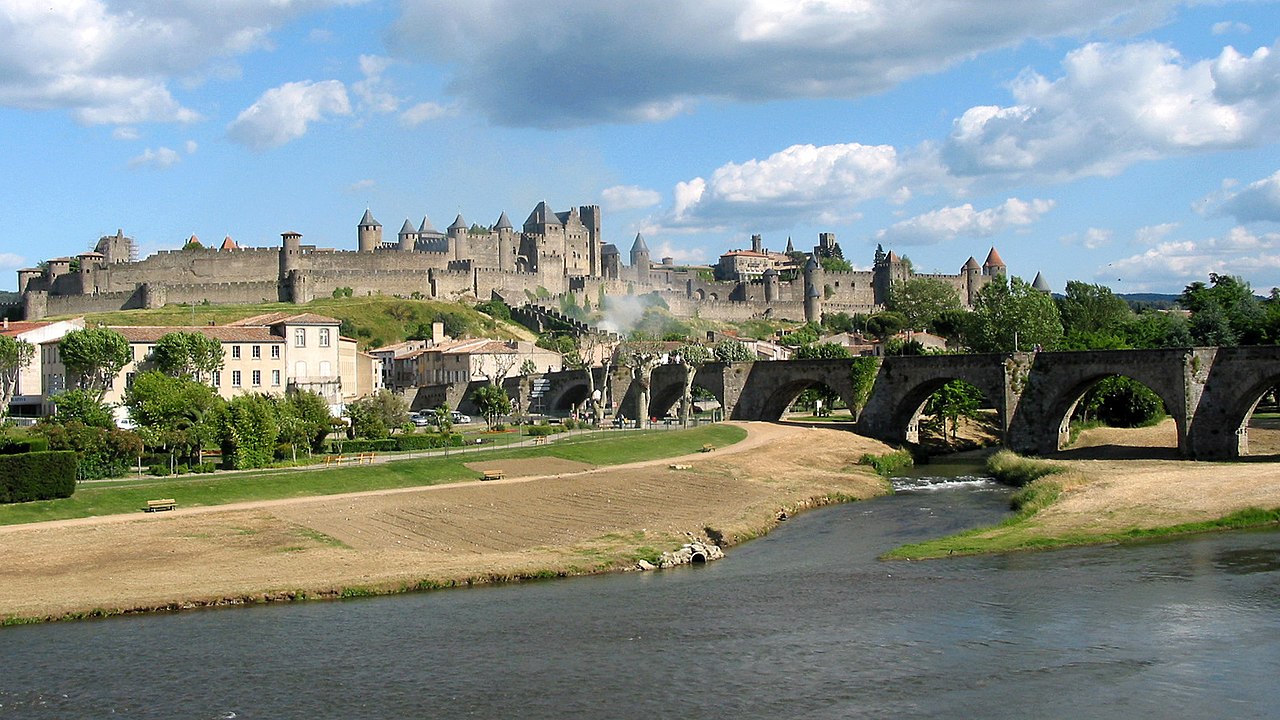


Setting and structure
The town sits on a hill and is traditionally divided into two parts: the fortified upper Cité and the more open lower town or ville basse. The Cité is enclosed by imposing defensive works—concentric curtain walls with many towers, gateways and battlements—while the lower settlement grew later as a commercial and residential area. Visitors encounter narrow medieval lanes, a central keep known as the castle or fortified enclosure, and important ecclesiastical buildings.
Architectural highlights
Notable monuments include the hilltop castle often called the Château Comtal, a Romanesque–Gothic basilica with ornate stained glass, and several well‑defined gates and barbicans such as the Porte Narbonnaise. The streets inside the Cité preserve a strong medieval character, and the surrounding walls show construction phases from Gallo‑Roman foundations to later medieval reinforcement.
History and development
Carcassonne grew from an ancient settlement into a fortified medieval stronghold. Control of the site changed many times over the centuries, reflecting its military and commercial role in the region of France. In the Middle Ages it figured in regional conflicts including those associated with the Cathars and the Albigensian Crusade, and later became part of the French crown lands. The lower town expanded as a bastide—an organized medieval new town—sometimes described as a bastide, which accommodated trade and crafts beyond the walls.
Restoration, recognition and preservation
In the 19th century the Cité underwent an extensive restoration led by architect Eugène Viollet‑le‑Duc beginning around 1853, a project that has been praised and debated for its 19th‑century interpretation of medieval forms. The importance of Carcassonne’s monuments and its conserved defensive ensemble led to formal recognition: the town and its fortifications were inscribed on the UNESCO list of World Heritage Sites in 1997. Carcassonne lies in the administrative area of the Aude département within the Occitanie region and remains an object of preservation efforts and research.
Cultural importance and tourism
Today Carcassonne is a major cultural and tourist destination. The fortified Cité attracts visitors for guided walks, historical interpretation and seasonal events such as medieval fairs and concerts. The town also figures in popular culture and games: the name is widely known through a modern board game inspired by its medieval layout. Local economy benefits from heritage tourism, regional wines and gastronomy linked to the Languedoc area.
Notable facts and distinctions
- The site demonstrates a layered history from ancient occupation to medieval fortification and modern restoration.
- Its defensive ensemble is an example of a fortified hilltop city, with a preserved double wall system and numerous towers.
- Carcassonne has stimulated debate among historians and conservationists about the aims and methods of 19th‑century restoration.
- Visitors can explore both the elevated Cité and the more expansive lower town to appreciate differences in urban form and function.
For further background on the town’s language and regional identity see the Occitan heritage via regional resources. Additional historical summaries and travel information may be found through general cultural sites and archives that cover medieval France and fortified towns (Occitan name, fortified, French, Aude département, Occitanie, regional resources, bastide, UNESCO, World Heritage Sites).
Questions and answers
Q: What is Carcassonne?
A: Carcassonne is a fortified French town located in the Aude département, Occitanie region.
Q: What two parts make up Carcassonne?
A: The two parts of Carcassonne are the fortified Cité de Carcassonne and the more expansive lower city, also known as the ville basse.
Q: Who restored Carcassone from 1853?
A: The theorist and architect Eugène Viollet-le-Duc restored Carcassone from 1853.
Q: When was it added to UNESCO's list of World Heritage Sites?
A: It was added to UNESCO's list of World Heritage Sites in 1997.
Q: Where is Carcassone located?
A: It is located in the Aude département, Occitanie region of France.
Q: What language do people speak in this area?
A: People in this area speak Occitan.
Related articles
Author
AlegsaOnline.com Carcassonne: the fortified city of southern France Leandro Alegsa
URL: https://en.alegsaonline.com/art/16908
Sources
- carcassonne.org : "Le Conseil Municipale"
- insee.fr : "Commune de Carcassonne (11069)"
- map-france.com : "City of Carcassonne"
- annuaire-mairie.fr : "La ville de Carcassonne"
- habitants.fr : "Aude (11)"
- insee.fr : "Régions, départements, arrondissements, cantons et communes"
- insee.fr : "Unité urbaine de Carcassonne (11501)"
- insee.fr : "Aire urbaine de Carcassonne (092)"