
Cantons of Luxembourg: administrative divisions, history, and role
An overview of Luxembourg's twelve cantons: their purpose, organization into communes, historical origin (1843), list of cantons, and their administrative significance.
Overview
The cantons of Luxembourg are the country's primary traditional subdivisions beneath the national level. Known in English as cantons, they carry local administrative, statistical and judicial functions. The term appears in multiple languages—see the common local names in French (cantons), German (Kantone) and Luxembourgish (Kantonen)—and are commonly referred to simply as cantons in English-language descriptions of the Grand Duchy of Luxembourg.
Image gallery
9 Images



Organization and characteristics
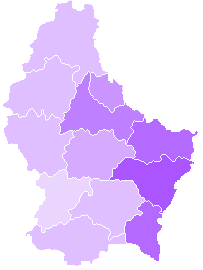
There are twelve cantons in the country. Each canton contains several communes (municipalities), which are the smallest units of local government. Cantons vary widely in size and population: some are concentrated around the capital and industrial south, others are largely rural with lower densities. Cantons do not function as fully autonomous regional governments; many daily responsibilities are handled by communes and central government agencies.
List of cantons
The twelve cantons are commonly listed by name and are used for administrative and statistical grouping:
- Clervaux
- Diekirch
- Echternach
- Esch-sur-Alzette
- Grevenmacher
- Luxembourg
- Mersch
- Remich
- Redange
- Vianden
- Wiltz
- Capellen
History and development
The cantonal framework was created on 24 February 1843 together with a higher-level tier of districts. Historically the twelve cantons were grouped into three districts (districts) for certain administrative and judicial purposes. Over time the role of districts has been reduced and their organization changed, while cantons have remained as stable geographic and statistical units.
Uses, examples and notable distinctions
Cantons serve as reference units in demographic statistics, judicial circuits and some public services, but they are not the primary level for most local governance tasks—that role belongs to the communes. For national elections, Luxembourg uses multi-member constituencies that do not align exactly with canton boundaries, so cantons are distinct from electoral districts. The cantonal system helps provide a balance between local municipal administration and national coordination.
Further information
For administrative details, current commune groupings, and maps that show the canton boundaries and compositions, consult official publications or national statistical sources. Readers seeking language-specific terminology and legal definitions can follow multilingual references or government portals that use the local terms (French, German, Luxembourgish) and broader country pages (Grand Duchy overview). Additional administrative background on historical district arrangements is available through archival summaries (district history).
Questions and answers
Q: What are the Cantons of Luxembourg?
A: The Cantons of Luxembourg are areas of local government which are subdivisions of the three districts of Luxembourg.
Q: How many cantons are there in Luxembourg?
A: There are 12 cantons in Luxembourg.
Q: What are the three districts of Luxembourg?
A: The three districts of Luxembourg are Diekirch, Grevenmacher, and Luxembourg.
Q: How many communes are there in Luxembourg?
A: There are 106 communes in Luxembourg.
Q: When were the cantons of Luxembourg created?
A: The cantons of Luxembourg were created on 24 February 1843, along with the districts.
Q: What is the role of the Cantons in Luxembourg?
A: Cantons of Luxembourg are responsible for local government and are responsible for administering the communes within their jurisdiction.
Q: What languages are the cantons referred to in Luxembourg?
A: The cantons in Luxembourg are referred to as 'cantons' in French, 'kantone' in German, and 'kantonen' in Luxembourgish.
Related articles
Author
AlegsaOnline.com Cantons of Luxembourg: administrative divisions, history, and role Leandro Alegsa
URL: https://en.alegsaonline.com/art/16663
Sources
- legilux.public.lu : "Mémorial A, 1843, No. 17"
- statistiques.public.lu : "Population by canton and municipality 1821 - 2017"
- statistiques.public.lu : "Surface area of the cantons and municipalities"