
Canonic Variations on “Vom Himmel hoch da komm' ich her” (BWV 769)
A late organ composition by J. S. Bach, BWV 769 presents five canonic settings of the Lutheran Christmas chorale “Vom Himmel hoch,” combining strict contrapuntal technique with liturgical melody for two manuals and pedal.
Overview
The Canonic Variations on "Vom Himmel hoch da komm' ich her," catalogued as BWV 769, are a compact but highly concentrated set of organ pieces by Johann Sebastian Bach. The work treats the familiar Lutheran Christmas chorale "Vom Himmel hoch" (text traditionally credited to Martin Luther) as the melodic basis for five short variations. Scored for an instrument with two manuals and pedals, the composition exploits the resources of the organ and the separation of hands and feet on two manuals and pedals, making it well suited to period German instruments. The chorale's seasonal associations (a well-known Christmas tune) would have made the piece immediately recognizable to congregations and listeners of Bach's time, while its contrapuntal craft appeals to later performers and scholars.
Image gallery
10 Images


Structure and contrapuntal technique
Each of the five variations is built as a canon, an imitative contrapuntal device in which one voice follows another at a fixed temporal and/or intervallic distance. Rather than simple repetition, Bach varies how the chorale tune is treated: sometimes it is stated clearly in one voice while other voices imitate at different pitches or time delays; at other times the tune is embedded within a more complex texture. The effect is both didactic and expressive—strict fugal procedure is combined with idiomatic organ writing that allows registration contrasts between manuals and pedal.
- Canonical conception: voices imitate the chorale at varying intervals and delays.
- Distribution: melodies and imitations are shared between the two manuals and the pedal.
- Contrast: dynamic and registration contrasts are implied by the separate keyboards and pedal.
History and sources
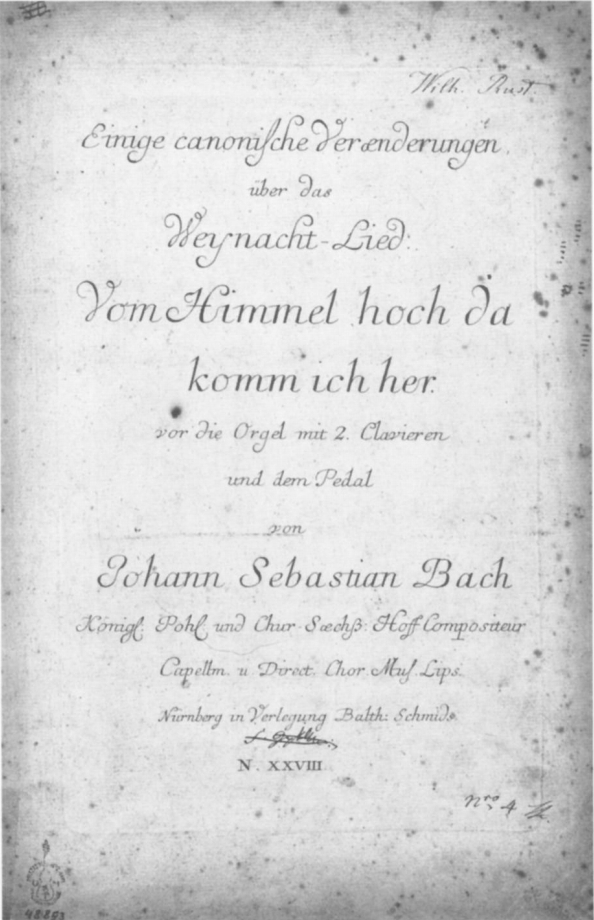
Bach presented the work in the mid‑18th century, around the time he joined Lorenz Mizler's musical society in Leipzig; a printed edition associated with that period appeared in 1747. A later autograph source survives among Bach's late organ material, compiled alongside other mature works. That manuscript context links the Canonic Variations to other late keyboard pieces, including the six Trio Sonatas and the collection of larger chorale preludes. The autograph differs from the printed version in ordering: Bach revised the sequence of variations in the later copy, notably relocating what had been the fifth variation toward the center of the set. These multiple sources give editors and performers material for comparison and interpretation.
Performance, liturgical use and reception
Practically, the piece demands clarity of articulation and careful registration to reveal the canonic relationships. An organ with two manuals and a well‑placed pedalboard best conveys the antiphonal and textural contrasts implied in the score. Originally grounded in a churchly chorale tradition, the work functions both as an organ piece suitable for Christmas services and as a concert miniature for recital programs. Modern audiences and performers prize BWV 769 as an example of Bach's late contrapuntal mastery: it is concise, rigorously constructed, and yet directly linked to congregational song through the underlying hymn.
Notable facts and study
BWV 769 is often studied alongside Bach's other late organ works for insights into his approach to counterpoint, variation technique, and organ registration. Scholars consult both the printed 18th‑century issue and the autograph manuscript to understand the composer's revisions; the autograph and related documents are sometimes referenced as primary sources or facsimiles in modern editions and discussions. For those interested in exploring more about the instrumentation and sources of Bach's organ repertoire, a modern introduction can be found via resources on the chorale, historical overviews of the Mizler Society, and manuscript studies of the autograph sources.
Questions and answers
Q: What is the Canonic Variations on "Vom Himmel hoch da komm' ich her"?
A: It is a piece of music for organ composed by Johann Sebastian Bach.
Q: What type of organ is needed to play this work?
A: An organ with two manuals (keyboards) and pedals is needed to play this work.
Q: How many variations are there in the Canonic Variations?
A: There are five variations in the Canonic Variations.
Q: What was the hymn that the music is based on?
A: The music is based on a Christmas hymn called "Von Himmel hoch".
Q: When did Bach compose the piece?
A: Bach composed the piece when he became a member of Mizler's Music Society in Leipzig in 1747.
Q: When was the piece first printed?
A: The piece was first printed in 1747.
Q: What was the most important difference in the later version that Bach made?
A: The most important difference Bach made in the later version is that the fifth variation was moved to the middle.
Related articles
Author
AlegsaOnline.com Canonic Variations on “Vom Himmel hoch da komm' ich her” (BWV 769) Leandro Alegsa
URL: https://en.alegsaonline.com/art/16600