
Calvin and Hobbes
A concise encyclopedia-style overview of the comic strip 'Calvin and Hobbes' by Bill Watterson: characters, themes, artistic approach, publication history, and cultural legacy.
Overview
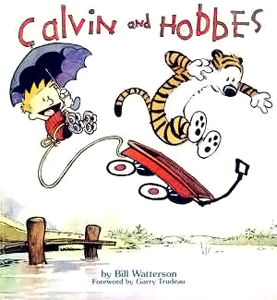
Calvin and Hobbes is a nationally syndicated comic strip created by Bill Watterson. It follows the daily adventures of Calvin, a spirited six-year-old, and Hobbes, his companion who appears as a living tiger to Calvin and as a stuffed toy to everyone else. First published on November 18, 1985, the strip ran until December 31, 1995 and at its peak appeared in more than 2,400 newspapers. Collections of the strips have sold in the millions and continue to be reprinted in book form.
Image gallery
7 Images



Characters and recurring elements
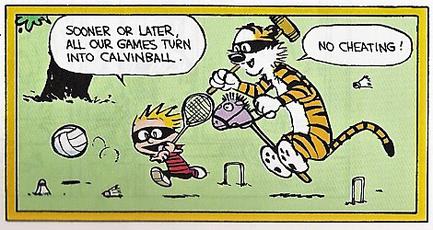
The series centers on a small recurring cast and a rotating set of imaginative scenarios. The dynamic between Calvin and Hobbes is the heart of the strip: it combines playful mischief with thoughtful exchanges about childhood, ethics and imagination.
- Calvin — an intelligent but impulsive boy whose wide imagination drives most plots.
- Hobbes — Calvin’s best friend and foil; simultaneously a live tiger (in Calvin’s eyes) and a stuffed animal (to other characters).
- Parents — often seen as bemused or exasperated, representing adult perspective and domestic reality.
- Other characters — classmates and neighbors, such as the thoughtful Susie, who balance and contrast Calvin’s energy.
Artistic style and format
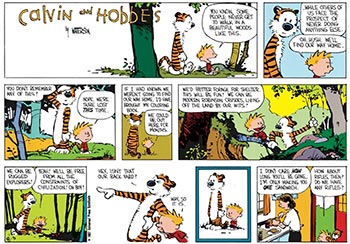
Watterson combined economical daily panels with richly detailed Sunday pages. The strip is notable for expressive line work, strong character poses and carefully composed panels that shift between tight gags and more expansive, scenic images. Watterson resisted reducing his art to licensed merchandise, and he worked to preserve creative control over the strip’s appearance, layout and print presentation.
Publication history and books
The strip’s ten-year run produced hundreds of daily and Sunday installments that were later gathered into multiple book collections. These volumes made the strip widely accessible to readers who did not follow newspapers and helped ensure its long-term availability. Watterson retired the strip at the end of 1995; since then, official material has been limited to authorized reprints and collections rather than a broad licensing program.
Themes, influence and legacy
Beyond humor, the strip explores imagination, friendship, the tensions between childhood freedom and adult expectations, and occasional philosophical asides. It has influenced many cartoonists and is often cited in discussions of the comic strip as an art form. Its lack of pervasive merchandising and Watterson’s insistence on artistic standards contributed to a reputation for integrity and helped sustain devoted readership over decades.
Notable distinctions
Calvin and Hobbes is remembered both for its lively characters and for the strong authorial stance behind its production: limited commercialization, careful attention to page design, and a compact but influential run that ended at the creator’s choosing. The strip remains widely read in collected editions and continues to be referenced in popular culture as a benchmark of character-driven, imagination-focused comic storytelling.
Questions and answers
Q: What is "Calvin and Hobbes"?
A: "Calvin and Hobbes" is a comic strip about a boy named Calvin and his toy tiger named Hobbes, created by Bill Watterson.
Q: How does Calvin see Hobbes?
A: When Calvin looks at Hobbes, he sees a real tiger.
Q: How do other people see Hobbes?
A: Other people see Hobbes as a toy.
Q: When did "Calvin and Hobbes" begin?
A: "Calvin and Hobbes" began in 1985.
Q: How many newspapers has "Calvin and Hobbes" been in?
A: "Calvin and Hobbes" has been in over 2,400 newspapers.
Q: How many Calvin and Hobbes books were sold to readers?
A: Readers bought almost 23 million Calvin and Hobbes books.
Q: When did the comic strip "Calvin and Hobbes" end?
A: The comic strip "Calvin and Hobbes" continued from November 18, 1985, until December 31, 1995.
Author
AlegsaOnline.com Calvin and Hobbes Leandro Alegsa
URL: https://en.alegsaonline.com/art/16212
Sources
- cleveland.com : "'Calvin and Hobbes' fans Still Pine 15 Years After Its Exit" · web.archive.org
- npr.org : "Spiffy: 'The Complete Calvin and Hobbes'"