
Caltrop: spiked anti-personnel and anti-vehicle device
Small multi‑pointed spikes used to impede movement of men, animals and vehicles from antiquity to the present; simple geometry, many cultural variants, and modern legal and safety issues.
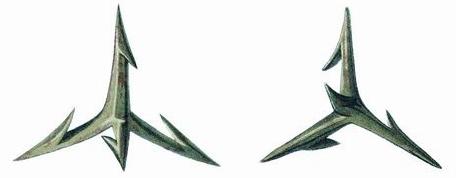
Caltrops are compact mechanical devices with multiple sharp points arranged so that when the object is cast onto the ground one spike always projects upward. Their simple, robust geometry makes them effective as passive obstacles: they can wound the feet of soldiers and animals, puncture the tires of wheeled vehicles, and deny access across lanes or approaches. Because of this straightforward function, variations of the caltrop appear in many regions and historical periods.
Image gallery
9 Images




Design and characteristics
The canonical form consists of four spikes joined so that the assembly is self‑righting: three points rest on the ground and a fourth is upright. This tetrahedral arrangement requires no moving parts and reliably presents a penetrating point regardless of how the device lands. Simpler three‑point forms and other multi‑spiked configurations also exist. Materials have ranged from wrought iron and bronze in antiquity to welded nails and stamped steel in modern manufactured examples. Some designs include barbs or hooked ends to make removal more difficult. Contemporary law‑enforcement spike strips and engineered tire‑deflation systems share a common purpose but are designed to be deployed and retrieved with greater control and less indiscriminate danger.
History and development
Archaeological and textual evidence shows the use of iron caltrops and related obstacles in classical antiquity; they are recorded in accounts of large pitched battles and antipersonnel defenses. Roman military manuals and later authors describe a device termed the tribulus, translated loosely as a jagged iron implement, used to disrupt cavalry, chariot operations and advancing troops. For general background on classical practice see sources collected under historical summaries and ancient battle accounts: historical summaries and ancient battle accounts.
Comparable objects evolved independently in other parts of the world. In Japan the makibishi, a star‑shaped caltrop often made from iron or hardened seed pods, was used by samurai, police and travelers to slow or deter pursuers. Museum catalogues and comparative studies provide details on regional forms: samurai makibishi and regional forms.
Military and modern uses
In pre‑modern warfare caltrops were scattered across likely approaches to break cavalry charges, protect fortifications, or channel enemy movement into prepared kill zones. With the rise of motorized warfare they were adapted to puncture pneumatic tires; documented use during the 20th century includes deployment by combatants in large conflicts to impede enemy vehicles. For 20th century and wartime reports see contemporary compilations and episode summaries: 20th century reports.
Outside formal warfare, improvised caltrops have occasionally been used in civil actions or sabotage. In industrial disputes in some countries, small welded nail or bolt clusters—sometimes called "jack rocks"—have been used to disable tires during strikes. Such incidents have been the subject of news and legal attention: labor dispute reports.
Legal, safety and countermeasures
Because caltrops are indiscriminate and can cause injury to civilians, animals and emergency services, many jurisdictions restrict or criminalize their manufacture, possession and use. Public safety guidance and legal reviews discuss risks and prohibitions, and police and armed forces favour regulated vehicle‑stopping tools over improvised spikes. Modern doctrine and vehicle control texts offer recommended alternatives and handling procedures: doctrinal texts, vehicle control, and public safety.
Manufacture, clearance and protection
Improvised caltrops can be fabricated from common materials such as nails, bolts and scrap metal; manufactured versions are stamped or forged for durability. Countermeasures include route clearance by engineering units, use of puncture‑resistant tires or liners, temporary road closures, and the adoption of controlled, retractable spike strips in law enforcement. Clearing fields of caltrops requires care: manual removal with protective equipment, mechanical sweeping devices and established safety protocols are standard practice.
Archaeology, collections and legacy
Caltrops survive in archaeological contexts and museum collections, where they illustrate convergent problem solving across cultures. As artifacts they illuminate aspects of mobility, logistics and defensive planning. For curated examples and comparative material consult museum entries and artifact catalogues: museum entries and further catalogues at battle records.
- Terminology: historical names include tribulus and regional equivalents; "caltrop" is the common English term for the device class.
- Function: self‑righting geometry that presents a penetrating point is the defining technical trait.
- Modern relevance: while military use has declined with changes in mobility, the principle underlies modern vehicle‑stopping technologies and remains a subject in legal and safety discussions.
Further reference and reading can be found in general historical summaries and comparative studies, legal and doctrinal materials, museum catalogues, and contemporary incident reports: historical summaries, comparative studies, museum entries, battle records, doctrinal texts, vehicle control, public safety, 20th century reports, and labor dispute reports.
Questions and answers
Q: What is a caltrop?
A: A caltrop is a device composed of four spikes or points arranged so that in whatever manner it is thrown on the ground, it rests on three and presents the fourth upright. It has been used since at least Roman times as an anti-personnel and anti-vehicular weapon.
Q: How were caltrops used by the Romans?
A: The Romans used caltrops to render chariots useless during battle. They would strew the field of battle with them, causing any horses that ran over them to be destroyed.
Q: What was a similar weapon used by Japanese samurai?
A: Japanese samurai used a similar weapon called makibishi.
Q: When were iron caltrops first used?
A: Iron caltrops were first used as early as 331 BC at Gaugamela.
Q: In which war were they also employed?
A: Caltrops were employed by both Allies and Axis forces during World War II to puncture tires of wheeled vehicles.
Q: How have labor activists in the United States sometimes made use of them?
A: Labor activists in the US have occasionally improvised caltrops out of welded nails for use during strikes to destroy tires belonging to management and replacement workers; these devices are more often referred to as jack rocks.
Related articles
Author
AlegsaOnline.com Caltrop: spiked anti-personnel and anti-vehicle device Leandro Alegsa
URL: https://en.alegsaonline.com/art/16196
Sources
- books.google.com : Cavalry from hoof to track: the quest for mobility
- pvv.ntnu.no : The Military Institutions of the Romans Book III: Dispositions for Action
- wvgazette.com : "Two arrested in strike at Constellium"