
Caihong — a Late Jurassic paravian with iridescent plumage evidence
Caihong juji is a small, Late Jurassic paravian from China notable for preserved feathers and melanosomes suggesting iridescent coloration and a mix of primitive and bird-like skeletal features.
Caihong is an extinct small paravian theropod from the Late Jurassic of northeastern China. Its genus name means "rainbow" in Chinese; the characters are shown as 彩虹 and pronounced cǎihóng. The fossil was recovered from well‑preserved continental deposits and described formally in 2018 as the type species Caihong juji. Specimens discovered in 2014 revealed an animal with both primitive dinosaurian bones and advanced feather structures, and the find has been cited in discussions of early bird evolution and the origin of colorful plumage.
Image gallery
10 Images





Discovery and naming
The specimen was first reported in 2014 and studied by a team of paleontologists before its formal naming in 2018. It comes from the same broad region that has produced numerous other early paravians. The specific name juji refers to a noticeable bony crest on the skull, a feature that helped distinguish the animal from related taxa. Some authors have noted that Caihong may slightly predate specimens assigned to Aurornis xui, placing it among the earlier representatives of birdlike theropods.
Anatomy and feathers
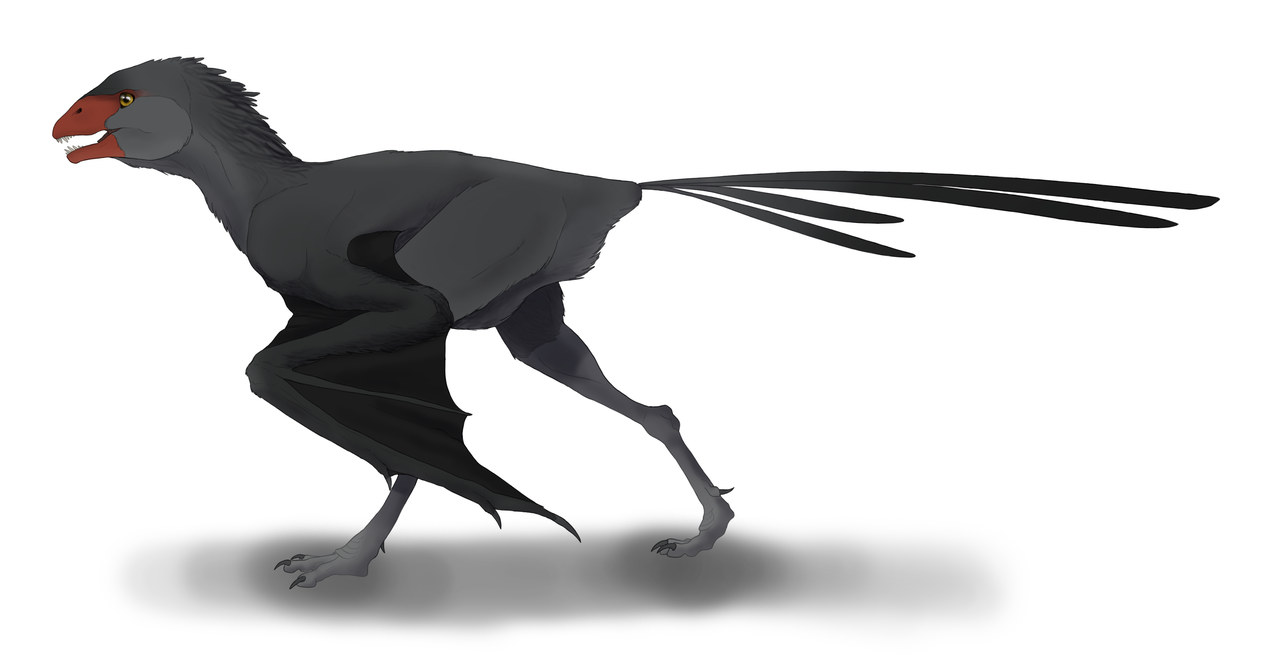
Caihong was a small, gracile animal with a long, bony tail and relatively long forelimbs, both bearing pennaceous (shafted) feathers. Its skeleton displays a mosaic of characters: several primitive traits retained from nonavian theropods alongside features that are more typical of avialans. The skull bore a prominent crest, and the body was covered in filamentous to pennaceous feathers, indicating that well-developed feathers were present in some dinosaur lineages before the evolution of powered flight.
Evidence for coloration
One of the most discussed aspects of Caihong is the preservation of melanosomes—microscopic, pigment‑containing organelles—within the fossilized feathers. The shapes and arrangements of those melanosomes have been interpreted by researchers as consistent with iridescent or metallic sheens in life, analogous to the glossy colors seen in some modern birds. This interpretation suggests that complex color signals, including glossy or iridescent displays, evolved early among paravians and may have been used for species recognition or sexual signaling.
Significance and comparisons
- Evolutionary role: Caihong helps bridge anatomical and behavioral gaps between nonavian theropods and early birds, illustrating how feathers and coloration diversified prior to the origin of modern flight.
- Mosaic anatomy: Its mix of primitive skeletal features and derived integumentary traits highlights the stepwise nature of avian characteristics.
- Context: The specimen comes from Late Jurassic deposits in China that have yielded other important paravian fossils, informing debates about timing and pattern of early bird evolution. Late Jurassic deposits in China remain a key source of information about these transitions.
In sum, Caihong juji is widely cited for its well‑preserved feathers and pigment evidence, which together provide rare direct insight into the colors and display structures of a Jurassic paravian. Its discovery underscores that complex feather morphologies and visual signaling were established well before the Cretaceous and the radiation of crown birds.
Questions and answers
Q: What does the word "Caihong" mean in English?
A: "Caihong" means "rainbow" in English.
Q: What is Caihong?
A: Caihong is an extinct dinobird from Late Jurassic China.
Q: When was Caihong discovered?
A: Caihong was discovered in 2014.
Q: How old is Caihong?
A: Caihong is from Late Jurassic, which lasted from approximately 163.5 to 145 million years ago.
Q: What is the significance of Caihong's discovery?
A: Caihong may predate the famous Aurornis xui, the earliest bird, by about 1 million years.
Q: When was the type species, Caihong juji, named?
A: The type species, Caihong juji, was named in 2018.
Q: Where was Caihong discovered?
A: Caihong was discovered in China.
Related articles
Author
AlegsaOnline.com Caihong — a Late Jurassic paravian with iridescent plumage evidence Leandro Alegsa
URL: https://en.alegsaonline.com/art/15978