
Caesars Palace Grand Prix
A short-lived Formula One round held in the Caesars Palace hotel parking lot in Las Vegas (1981–1982), notable for its temporary counter‑clockwise circuit, smooth surface and low spectator turnout.
Overview
The Caesars Palace Grand Prix was a Formula One race staged in Las Vegas for two seasons, 1981 and 1982. Promoted as an American round on the F1 world championship calendar, the event took place on a temporary circuit built in the hotel parking complex of Caesars Palace. The races were presented by Nissan/Datsun, which served as title sponsor for both events. Although prepared to high standards for a short‑term venue, the event struggled to attract large crowds and the F1 era at Caesars Palace ended after 1982.
Image gallery
2 Images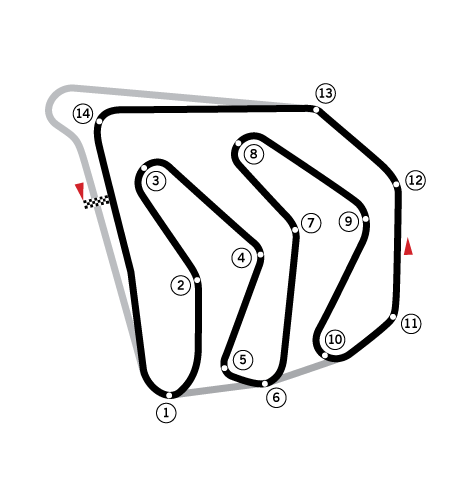

Location and circuit characteristics
The circuit occupied the open areas around the Caesars Palace resort in the Las Vegas Strip precinct. Its layout was compact and technical rather than high‑speed: a sequence of tight turns, 90‑degree corners and hairpins that required frequent gear changes and strong braking. The surface was noted for being exceptionally smooth for a temporary course, and organizers provided generous run‑off areas filled with sand in several places to help reduce the risk of damage in incidents.
- Direction: The track ran counter‑clockwise, uncommon among many contemporary circuits, and this direction placed unusual lateral and muscular stresses on drivers, especially on the neck.
- Layout type: A temporary parking‑lot circuit designed for TV visibility and spectator viewing, rather than the flowing character of permanent road circuits.
- Surface and safety: Smooth asphalt with wide lanes permitted passing opportunities; run‑off areas and sand traps were used to improve safety.
History and context
The Caesars Palace races arrived on the Formula One calendar after Watkins Glen lost its place following the 1980 season. Promoters sought to maintain an American presence in the championship at a venue that could offer convenient amenities, corporate hospitality and television exposure in Las Vegas. Despite commercial backing and a prepared temporary circuit, fan interest proved limited. After two years of modest attendances the decision was made to discontinue F1 competition at the site. The same circuit configuration, with adjustments, later hosted CART Champ Car events in 1983 and 1984.
For reference on the broader location see the venue coordinates and details: Caesars Palace location. The races were part of the official world championship calendar: Formula One. The promoter relationship included a presenting sponsor, Nissan/Datsun, and the circuit was built around the resort that lent the event its name: Caesars Palace.
Legacy and notable facts
Although short‑lived, the Caesars Palace Grand Prix is remembered for several distinctive features: its hotel‑parking‑lot setting close to the Strip, the counter‑clockwise layout that taxed drivers physically, and the contrast between a well‑constructed temporary surface and the surprisingly low spectator numbers. The event is often cited in discussions about the challenges of staging urban or temporary Grands Prix—balancing commercial goals, fan engagement and the needs of teams and drivers.
Decades after Caesars Palace hosted F1, Las Vegas again returned to the Formula One spotlight with a different grand prix format and circuit; however, the Caesars Palace races remain a compact episode in the sport's American history, illustrative of an era when promoters experimented with unconventional venues to broaden the championship's reach.
Questions and answers
Q: Where was the Caesars Palace Grand Prix held?
A: The Caesars Palace Grand Prix was held in the parking lot of the Caesars Palace hotel in Las Vegas, Nevada.
Q: What were the coordinates of the location?
A: The coordinates of the location were 36°07′1″N 115°10′30″W / 36.11694°N 115.17500°W / 36.11694; -115.17500.
Q: Who sponsored both races?
A: Both races were sponsored by Nissan/Datsun.
Q: What year did Watkins Glen leave F1 schedule?
A: Watkins Glen left F1 schedule after 1980.
Q: How was the track set up for a temporary circuit?
A: The track was surprisingly well set up for a temporary circuit, being wide enough for passing, providing ample run-off areas filled with sand, and having a surface that was as smooth as glass.
Q: What direction did it go in?
A: It went in a counter-clockwise direction which put a tremendous strain on drivers' necks.
Q: When did Formula One racing end in Las Vegas?
A: Formula One racing ended in Las Vegas in 1982 due to drawing only tiny crowds to both races
Related articles
Author
AlegsaOnline.com Caesars Palace Grand Prix Leandro Alegsa
URL: https://en.alegsaonline.com/art/15953
Sources
- nytimes.com : "ADVERTISING; Nissan Promotion"