
AIM-9 Sidewinder: Short-range infrared air-to-air missile
The AIM-9 Sidewinder is a widely used short-range, heat-seeking air-to-air missile introduced in the 1950s and continually upgraded into modern infrared-guided variants.
The AIM-9 Sidewinder is a family of short-range, infrared-guided air-to-air missiles originally developed for the United States Navy and now used by many air forces worldwide. Designed to home on the heat emitted by aircraft engines, the Sidewinder was among the first operational heat-seeking missiles and has been continuously improved since its first flight in the early 1950s. It is typically carried on fighter aircraft and used in close-range aerial combat (dogfighting) as well as for short-range engagements.
Image gallery
10 Images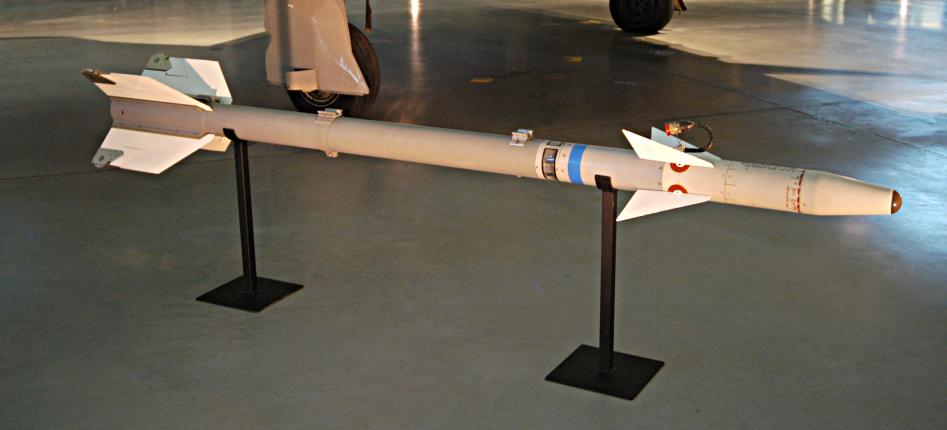


Characteristics
The Sidewinder is characterized by a compact airframe, a solid-fuel rocket motor, and a passive infrared seeker in the missile nose that detects and tracks thermal signatures. Launch platforms have included wingtip rails and underwing pylons. Key features often cited in modern variants include all-aspect seekers (allowing head-on engagements), imaging infrared guidance, high off-boresight aiming, and thrust-vectoring control for agility. For an overview of technical specifications and typical employment details, see AIM-9 overview.
History and development
Development began in the late 1940s and early 1950s at U.S. Naval research facilities; the missile made its first flight in 1953 and entered service later in the 1950s. Early models proved revolutionary but had limitations: initial seekers were less discriminating and could be fooled by flares, the sun, or other heat sources. These problems became evident in combat during conflicts such as the Vietnam War, prompting successive upgrades to guidance electronics, counter-countermeasure performance, and reliability. More on historical use and development can be found at development history and early service record.
Operational use and effectiveness
Although early Sidewinders achieved modest kill probabilities in their first combat uses, later variants improved dramatically and helped shape modern close-range air combat doctrine. The missile has been used in numerous conflicts since the 1960s and remains a standard short-range weapon on many fighter types. Typical effective ranges vary by variant and launch conditions; later models are often cited with ranges on the order of tens of kilometers (roughly up to 11 miles in some descriptions). Pilots rely on combining aircraft sensors, helmet-mounted sights, and the missile's seeker to engage maneuvering targets; countermeasures such as flares and newer electronic tactics continue to influence engagement outcomes. For combat reports and operational doctrine, see operational use and combat performance.
Variants and upgrades
- Early models (AIM-9B/D) — basic rear-aspect infrared seekers and incremental improvements.
- Mid-life models (AIM-9G/M) — improved electronics, sensitivity, and counter-countermeasure features.
- Modern designs (AIM-9L, AIM-9X series) — all-aspect and imaging infrared seekers, high off-boresight capability, and thrust-vectoring for increased agility and hit probability.
The most advanced Sidewinder variants incorporate helmet-mounted cueing systems and digital imaging seekers, allowing pilots to lock onto targets outside the aircraft's nose direction. Current lifecycle upgrades and international sales mean that the Sidewinder continues to evolve; for manufacturer and upgrade program information see modern upgrades and export and service.
As a design, the AIM-9 Sidewinder is notable for its longevity, adaptability, and influence on short-range missile design worldwide. From its experimental origins to today’s imaging-seeker models, it exemplifies how iterative engineering and combat experience drive weapons evolution while shaping aerial tactics and aircraft equipment standards.
Questions and answers
Q: What is the AIM-9 Sidewinder?
A: The AIM-9 Sidewinder is a short-range air-to-air missile that is heat-seeking and is designed to be shot from an aircraft to hit another aircraft.
Q: When was the AIM-9 Sidewinder first flown?
A: The AIM-9 Sidewinder first flew in 1953 and was used in air forces in 1956.
Q: Was the AIM-9 Sidewinder successful during the Vietnam War?
A: Initially, the AIM-9 Sidewinder was not successful during the Vietnam War as it only hit 10-20% of the time and could be fooled by locking on to bogus heat sources.
Q: Were the problems with the AIM-9 Sidewinder fixed?
A: Yes, the problems with the AIM-9 Sidewinder were later fixed, and it now has a good hitting rate.
Q: How far can the AIM-9 Sidewinder hit from?
A: The AIM-9 Sidewinder can hit from 11 miles.
Q: In how many air forces is the AIM-9 Sidewinder used?
A: The AIM-9 Sidewinder is used in a lot of air forces worldwide.
Q: Is the AIM-9 Sidewinder still used today?
A: Yes, the AIM-9 Sidewinder is still used on many different aircraft around the world today.
Related articles
Author
AlegsaOnline.com AIM-9 Sidewinder: Short-range infrared air-to-air missile Leandro Alegsa
URL: https://en.alegsaonline.com/art/1572
Sources
- designation-systems.net : "Raytheon AIM-9 Sidewinder"
- ausairpower.net : ausairpower.net/TE-Sidewinder-94.html