
Bucket-wheel excavator (BWE)
A bucket-wheel excavator is a massive continuous digging machine used primarily in large-scale surface mining. This article explains design, history, operation, notable examples and typical applications.
Overview
A bucket-wheel excavator (BWE) is a continuous mining machine designed to remove large volumes of overburden or ore in open-pit operations. Unlike shovels or draglines that load intermittently, a BWE uses a rotating wheel outfitted with a series of buckets to scoop material as the wheel turns, feeding it onto conveyors for continuous transport. BWEs are most commonly associated with large-scale surface mining for coal, lignite and some soft rock deposits, where continuous removal and high throughput are priorities. They are among the largest land vehicles ever built and are often cited in industry and engineering literature for their extreme scale.
Image gallery
3 Images

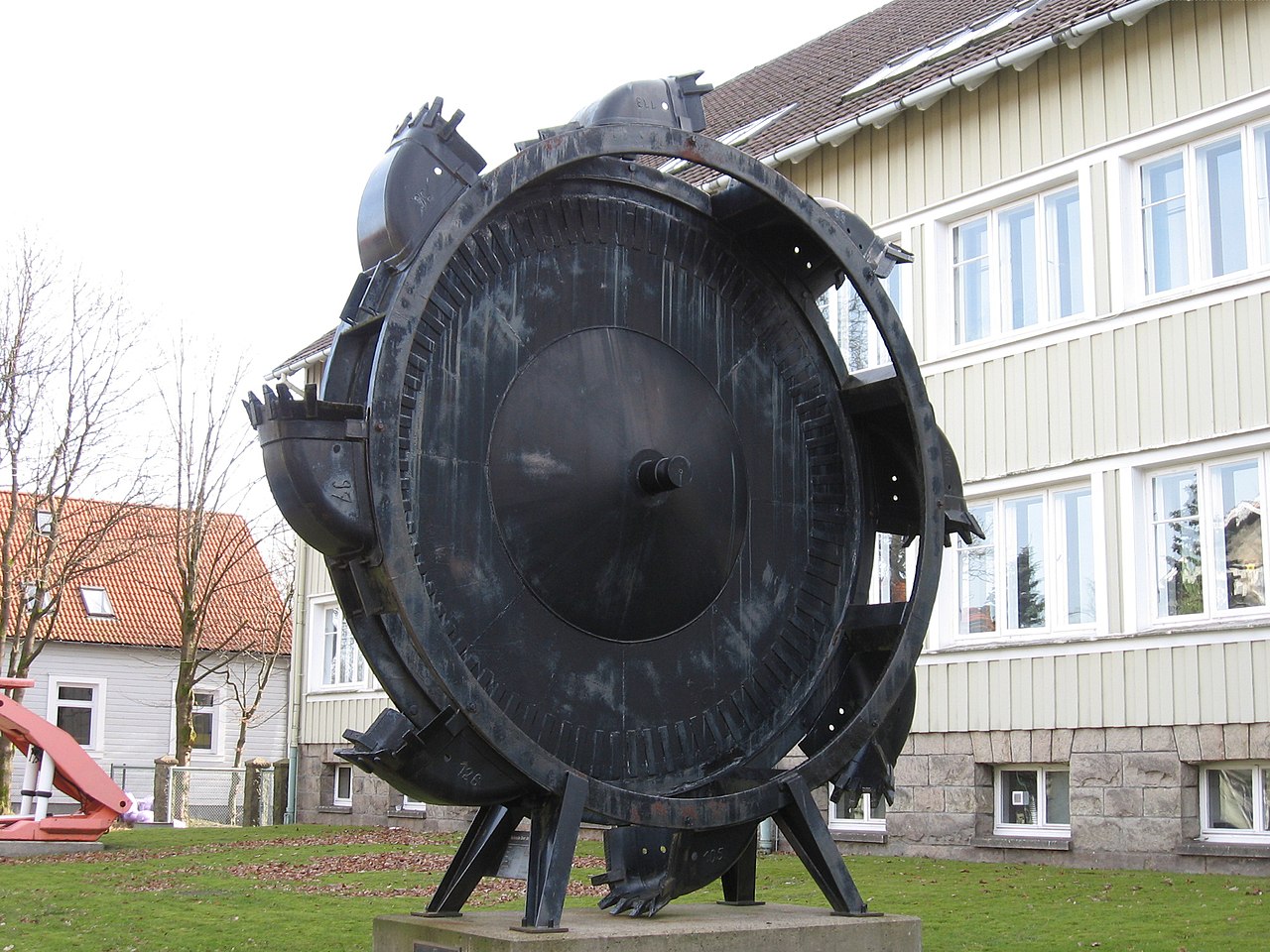
Design and components
A typical BWE integrates several major subsystems that work together to maintain continuous excavation and material handling. Key elements include:
- Bucket wheel: a large rotary drum carrying many buckets arranged around its circumference to cut into the material and lift it.
- Buckets: individual scoops that collect and discharge material; bucket capacity and number determine cycle volume.
- Superstructure and boom: support the wheel and position it against the face; booms can be slewed and raised or lowered to control cutting depth.
- Conveyor system: an integrated network of conveyors that transfers material from the buckets to stockpiles or to secondary conveyors and crushers.
- Mobility and foundations: large BWEs commonly travel on crawler tracks or rail-mounted bogies to advance the machine as mining progresses.
History and development
Bucket-wheel technology evolved in the 20th century to meet the needs of expanding surface mines, particularly in Europe and later worldwide. Early designs focused on efficiency for removal of overburden and low-grade coal seams. Over decades of engineering, BWEs grew in size and complexity: modern machines from the late 20th century onward incorporated automated controls, stronger materials, and advanced conveyor integration. Some modern BWEs are engineered to operate in harsh climates and at very large scales; one well-known example frequently cited in technical sources is the Bagger 293, often described as one of the largest terrestrial machines ever constructed.
Operations, applications and examples
In operation, a BWE continuously excavates and transfers material to a system of conveyors that carries it away from the digging face to crushers, stockpiles or loading points. Typical applications include:
- Removal of overburden in lignite and coal surface mines.
- Bulk excavation in large earthworks and certain industrial mineral operations.
- Where continuous, high-capacity material handling is more economical than cyclic shovel-and-truck fleets.
Examples of notable machines highlight the scale: modern BWEs can exceed 200 meters in length with bucket-wheels many meters in diameter, and individual buckets able to hold several cubic meters of material. For further technical background on surface mining contexts where BWEs are used, see surface mining.
Notable distinctions and operational considerations
BWEs differ from other excavation equipment in several important ways. Their continuous mode of operation makes them highly efficient where geology and mine layout permit, but they require significant upfront capital, engineering of conveyor networks, and continuous power. They are best suited to relatively uniform, unconsolidated or soft rock deposits rather than hard rock faces. Environmental and land-reclamation considerations are also important: large-scale excavations change landscapes and demand rehabilitation planning. For details on wheel and bucket arrangements that influence performance, see bucket arrangement and design.
Summary: Bucket-wheel excavators are specialized, extremely large machines optimized for continuous, high-volume earthmoving in open-pit mining and bulk excavation. Their design emphasizes a rotating bucket wheel, integrated conveyors, and mobility suitable for long-term, large-scale operations.
Questions and answers
Q: What are Bucket-wheel excavators?
A: Bucket-wheel excavators (BWEs) are enormous machines used in surface mining.
Q: What makes BWEs stand out from other mining equipment?
A: BWEs have a large wheel with a continuous pattern of buckets, which helps them scoop material as the wheel turns.
Q: What is the biggest bucket-wheel excavator ever built?
A: The biggest bucket-wheel excavator ever built is the Bagger 293, which is also the largest terrestrial vehicle in human history.
Q: What are the dimensions of the largest bucket-wheel excavators built since the 1990s?
A: The largest BWEs built since the 1990s can be as tall as 96 meters (314.9 feet), as long as 225 meters (738.2 feet), and as heavy as 14,200 metric tons (31.3 million lb).
Q: What is the size of the bucket-wheel in BWEs?
A: The bucket-wheel itself can be over 70 feet in diameter with as many as 20 buckets, each of which can hold over 15 cubic meters of material.
Q: Are BWEs designed to operate in extreme climates?
A: Yes, BWEs are now capable of operating in extreme climates, with some designed to operate in temperatures as low as -45°C (-49°F).
Q: How do BWEs work?
A: BWEs use their large wheel with buckets to scoop up material and transport it to a conveyor belt system, which then moves the material to a processing plant.
Related articles
Author
AlegsaOnline.com Bucket-wheel excavator (BWE) Leandro Alegsa
URL: https://en.alegsaonline.com/art/15027
Sources
- womp-int.com : womp-int.com