
Brush-tailed rock-wallaby (Petrogale penicillata)
A medium-sized rock-wallaby of eastern Australia, adapted to cliffs and rocky outcrops. Faces declines from introduced predators and habitat loss; recovery uses predator control, captive breeding and reintroductions.
Brush-tailed rock-wallaby (Petrogale penicillata), also known as the small-eared rock-wallaby, is a marsupial in the rock-wallaby group. It belongs to the genus Petrogale and is native to eastern Australia. The species is adapted to life on cliffs and rocky escarpments of the Great Dividing Range, occupying a ribbon of habitat that runs roughly from northwest of Brisbane down to the Grampians in Victoria. Within this band it occupies a variety of local habitats, from moist gullies and rainforest pockets to dry sclerophyll forest and open woodland, using rocky refuges for shelter and breeding.
Image gallery
6 Images

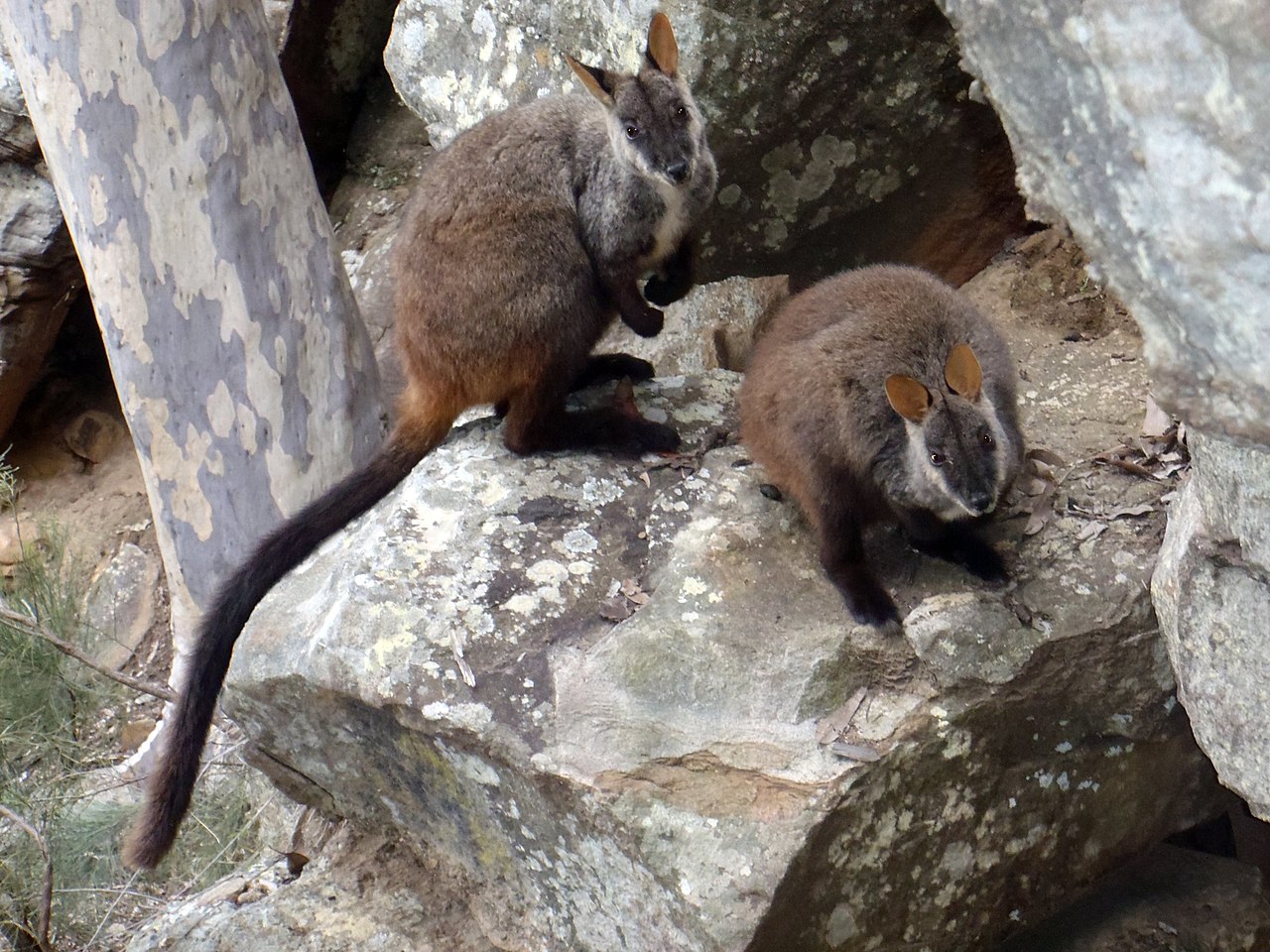


Appearance and biology
The brush-tailed rock-wallaby is medium-sized among macropods, with a compact, muscular build suited for leaping and climbing on steep, uneven ground. It has relatively small ears compared with some other wallabies and a distinctive bushy-tipped tail that aids balance. Coat colour varies between grey and brown shades, often patterned to blend with rock surfaces. Specialized pads on the feet and powerful hindlimbs allow secure movement on narrow ledges and boulders. Diet is mainly herbivorous and opportunistic, consisting of grasses, leaves, fruits and other vegetation found near rocky refuges. Like other marsupials, females raise young in a forward-opening pouch; typically a single joey develops in the pouch before emerging and continuing to be carried for some time.
Distribution and habitat
Historically the species occurred continuously along suitable rocky country on the eastern uplands, but populations are now fragmented and confined to isolated cliffs, gorges and rocky outcrops. It uses a mosaic of rocky refuges and adjacent feeding areas, and local populations may be strongly tied to particular cliff systems. The brush-tailed rock-wallaby can be found in rainforest pockets (rainforest), open woodland and dry sclerophyll communities; overall habitat quality, availability of sheltered crevices and connectivity between sites strongly influence survival. The species persists in parts of northern New South Wales and southern Queensland, while populations in the south and west of the range have declined and become very small in places.
Behavior and reproduction
Brush-tailed rock-wallabies are primarily crepuscular and nocturnal, sheltering in caves and rock crevices during the day and moving to feed on nearby vegetation in the cooler hours. Social organisation typically centres on small colonies that occupy discrete rocky refuges; there is a degree of territorial behaviour and hierarchical relationships within groups. Reproductive timing can vary with local conditions and food availability. After birth the underdeveloped young crawl into the pouch and continue development; they later emerge and may ride on the mother's back while still dependent.
Threats
- Introduced predators such as red foxes and feral cats are major causes of mortality and local decline.
- Habitat loss, fragmentation and lowered connectivity between rocky sites reduce access to feeding areas and genetic exchange.
- Competition with introduced herbivores and changes to fire regimes can degrade food resources and shelter.
- Small, isolated populations are vulnerable to stochastic events and inbreeding.
Conservation and recovery
Conservation action combines on-ground management, research and community involvement. Practical measures used in recovery programs include predator control, fencing of key sites, habitat protection and restoration, and carefully planned captive-breeding and translocation efforts. Monitoring with camera traps, direct surveys and radio-tracking helps managers assess population trends and the success of interventions. State and national conservation listings have prompted targeted management where populations are small or isolated; historical accounts record very low numbers in some Victorian populations, illustrating the urgency of recovery work.
Successful long-term recovery depends on reducing predation pressure, maintaining or restoring habitat connectivity between rocky refuges, managing fire to conserve shelter and food resources, and maintaining genetic diversity through managed translocations when appropriate. Partnerships between government agencies, conservation groups and local communities are central to these efforts, and ongoing research informs best-practice reintroduction and monitoring techniques.
For more information on taxonomy and species accounts consult genus resources at Petrogale, regional overviews of the Great Dividing Range, and habitat guides under habitats, rainforest and sclerophyll. State conservation pages for northern New South Wales and southern Queensland contain local recovery information, while national and park-level resources cover areas such as the Grampians and sites near Brisbane.
Questions and answers
Q: What is the brush-tailed rock-wallaby?
A: The brush-tailed rock-wallaby is a type of wallaby that lives in the rocks and cliffs of Australia's Great Dividing Range.
Q: How many rock-wallabies are there in the genus Petrogale?
A: There are several rock-wallabies in the genus Petrogale.
Q: Where does the brush-tailed rock-wallaby live?
A: The brush-tailed rock-wallaby lives in the Australia's Great Dividing Range from about 100 km northwest of Brisbane to the Grampians in southwest Victoria.
Q: What kind of habitats does the brush-tailed rock-wallaby live in?
A: The brush-tailed rock-wallaby lives in rainforest and dry sclerophyl forests.
Q: Have the numbers of brush-tailed rock-wallabies decreased throughout its range?
A: Yes, the numbers of brush-tailed rock-wallabies have gone down in the south and west of its range.
Q: Where is the brush-tailed rock-wallaby still locally common?
A: The brush-tailed rock-wallaby is still locally common in northern New South Wales and southern Queensland.
Q: Is the brush-tailed rock-wallaby endangered?
A: Yes, the brush-tailed rock-wallaby is endangered. In Victoria, the species is nearly extinct, with only four in the Grampians National Park and 20 in East Gippsland. Additionally, a reintroduction program in New South Wales did not have great success, with only seven remaining out of 80 released.
Related articles
Author
AlegsaOnline.com Brush-tailed rock-wallaby (Petrogale penicillata) Leandro Alegsa
URL: https://en.alegsaonline.com/art/14914
Sources
- bucknell.edu : Mammal Species of the World
- iucnredlist.org : "Petrogale penicillata"
- fnpw.org.au : "Brush-tailed Rock-wallaby"
- doc.govt.nz : Management of North Island weka and wallabies on Kawau Island
- abc.net.au : "Rock wallabies"
- waterfallsprings.com.au : "Saving the Brush-tailed Rock Wallaby"
- birdinghawaii.co.uk : "Brush-tailed rock walaby"