
Brubaker (1980 film)
1980 prison drama directed by Stuart Rosenberg, starring Robert Redford. Based on Tom Murton's account of prison corruption, the film examines reform, abuse, and institutional resistance.
Overview
Brubaker is a 1980 American prison drama directed by Stuart Rosenberg. The screenplay, adapted by W. D. Richter, draws on the book Accomplices to the Crime: The Arkansas Prison Scandal by Tom Murton and Joe Hyams. The film stars Robert Redford as a reform-minded warden who goes undercover to expose corruption and abuse within a state penitentiary. Its narrative combines elements of investigative drama and social commentary about the failures of penal institutions.
Image gallery
1 Image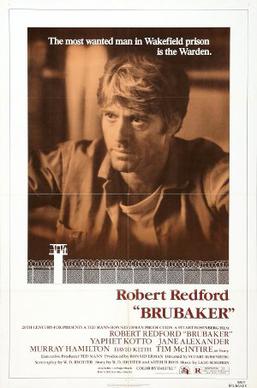
Plot summary
The central premise follows Henry Brubaker, a newly appointed prison superintendent who assumes the appearance of an inmate in order to witness firsthand the conditions and the covert economy that sustains abuse. As Brubaker implements reforms—searches, record-keeping, sanitation improvements—he confronts entrenched staff corruption, political interference, and resistance from those who profit from the status quo. The story charts the clash between moral conviction and institutional inertia, and the personal costs of trying to change a closed system.
Cast and characters
- Robert Redford as Henry Brubaker, the reformer at the center of the story
- Yaphet Kotto, a key inmate who becomes an important figure in the unfolding events
- Jane Alexander as a staff member whose loyalties and conscience are tested
- Murray Hamilton in a supporting role representing local authority
- Morgan Freeman among the ensemble of inmates and guards
- Nicolas Cage appears in an uncredited early-career part
Production and source material
The screenplay is based on the 1969 account by Tom Murton, a corrections official whose revelations about Arkansas prison conditions attracted national attention. Director Stuart Rosenberg, known for character-driven dramas, aimed for a measured, realistic tone rather than sensationalism. The film was distributed by 20th Century Fox and emphasizes institutional detail to support its critique.
Themes, reception and significance
Brubaker explores themes of institutional corruption, accountability, and the practical difficulties of reforming a punitive system. Critics noted the film's attention to procedural detail and the moral clarity of its central performance. Audiences and commentators have regarded Brubaker as a socially engaged picture that raised awareness of prison conditions and the political obstacles to change.
Legacy and notable facts
While dramatized for the screen, the film helped keep public attention on prison reform debates of the era and introduced several performers who later became prominent. Its mix of investigative drama and moral portraiture makes it a reference point for later movies that tackle systemic abuse in institutions. For further reading on the true events and figures that inspired the film, consult accounts of the Arkansas prison investigations from the late 1960s and early 1970s.
Questions and answers
Q: Who directed the movie Brubaker?
A: The movie Brubaker was directed by Stuart Rosenberg.
Q: Who are the actors starring in Brubaker?
A: Robert Redford, Yaphet Kotto, Jane Alexander, Murray Hamilton, Morgan Freeman, and Nicolas Cage in an uncredited role are the actors starring in Brubaker.
Q: Who distributed Brubaker?
A: Brubaker was distributed by 20th Century Fox.
Q: What is the genre of the movie Brubaker?
A: Brubaker is a prison drama movie.
Q: What is the name of the novel that was the basis for the movie Brubaker?
A: The basis for the movie Brubaker is the 1969 novel Accomplices to the Crime: The Arkansas Prison Scandal by Tom Murton and Joe Hyams.
Q: Who wrote the screenplay for the movie Brubaker?
A: The screenplay for the movie Brubaker was written by W.D. Richter.
Q: When was the movie Brubaker released?
A: The release date of the movie Brubaker is not provided in the given text.
Related articles
Author
AlegsaOnline.com Brubaker (1980 film) Leandro Alegsa
URL: https://en.alegsaonline.com/art/14821