
The Secret Life of an American Wife (1968 film)
1968 American comedy directed by George Axelrod, starring Walter Matthau and Anne Jackson. A satirical look at marriage and suburban life; released by 20th Century Fox and not a commercial success.
The Secret Life of an American Wife is a 1968 American comedy film directed by George Axelrod and released by 20th Century Fox. The picture is best known for its cast and its era: made during a period when Hollywood comedies were beginning to address changing social norms, it presents a satirical and sometimes farcical take on marriage, media, and middle-class life in the late 1960s.
Image gallery
1 Image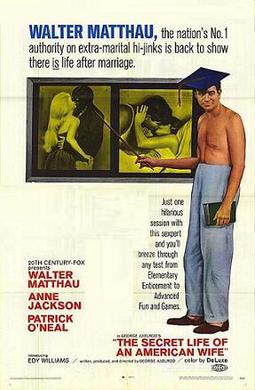
Cast and principal crew
- Walter Matthau — one of the film's leading performers, known for his comic timing and character roles.
- Anne Jackson — co-star, an accomplished stage and screen actress who appears in a central role.
- Supporting players include Patrick O'Neal, Edy Williams, Richard Bull, and Paul Napier.
- Directed and shaped by George Axelrod, who brought a background in writing and satirical storytelling to the project.
The film's title indicates its thematic focus: the contrast between outward appearances and private desires. Although the screenplay and performances aim for comedy, the material also touches on social changes of the era, including shifting expectations around marriage, sexuality, and the influence of mass media and advertising on personal life.
Production and style
Produced and distributed by a major studio, the picture reflects late-1960s production values and a willingness to experiment with topical subject matter within a commercial framework. Axelrod's direction emphasizes dialogue and character interactions more than broad slapstick, placing the film within a strand of American comedies that blend satire with domestic situations.
Release and reception
Upon release the movie did not find a wide audience and is generally regarded as a commercial disappointment. Contemporary critics were mixed: some praised elements of the performances and the film's attempt at social satire, while others found the tone uneven. Over time it has remained a lesser-known entry in the filmographies of its director and stars.
Legacy and notable facts
Today the film is chiefly of interest to viewers studying late-1960s Hollywood, the careers of its principal actors, or George Axelrod's work in blending comedy with social commentary. It is sometimes cited as an example of studio-era attempts to respond to cultural change, even when those attempts failed to achieve box-office success.
For readers seeking more information on the people involved or the film's place in the period, the names listed above are useful starting points for further research into American screen comedy and the transitional cinema of the late 1960s.
Author
AlegsaOnline.com The Secret Life of an American Wife (1968 film) Leandro Alegsa
URL: https://en.alegsaonline.com/art/146674