
The Falcon and the Snowman (1985 film)
1985 espionage drama about two young Americans who sold classified information to the Soviet Union. Directed by John Schlesinger; stars Timothy Hutton and Sean Penn; noted for Mark Knopfler's soundtrack.
The Falcon and the Snowman is a 1985 espionage crime drama directed by John Schlesinger, adapted from Robert Lindsey's 1979 book. The film dramatizes a true Cold War case from the 1970s, following two young Americans who sold classified U.S. defense material to the Soviet Union. Rather than presenting a gadget-driven thriller, the picture concentrates on character, motive and the steady unravelling of a friendship under pressure. The movie is also remembered for its atmospheric score by Mark Knopfler, which underscores mood and intimacy more than action.
Image gallery
1 Image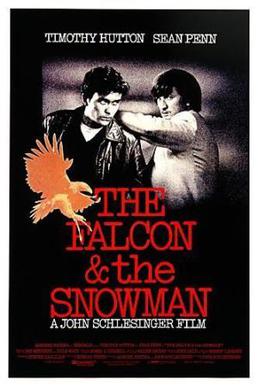
Synopsis
The story centers on a technically skilled but disaffected worker at a defense contractor and his charismatic, trouble-prone friend. Economic ambition, personal disillusionment and poor judgment lead the pair into contact with Soviet intelligence channels. What starts as a search for quick money becomes a hazardous espionage entanglement with consequences that extend far beyond the protagonists’ control. The film emphasizes moral ambiguity, the costs of betrayal, and how ordinary choices accumulate into serious, irreversible outcomes.
Principal cast and credits
- Timothy Hutton — lead role
- Sean Penn — co-lead
- Pat Hingle — supporting role
- David Suchet — supporting role
- Richard Dysart — supporting role
- Lori Singer — supporting role
- Nicholas Pryor — supporting role
The screenplay draws on Lindsey’s investigative reporting and reframes documented events as a focused, two‑character drama. The film was produced and financed through international collaboration and was released by Orion Pictures. Filmmakers retained the broad outline of the real-life case—widely associated with Christopher Boyce and Andrew Daulton Lee—while condensing episodes and dialogue to serve cinematic pacing and character development.
Production, music and style
Schlesinger’s direction favors close psychological observation and a restrained visual approach. Rather than employing conventional spy clichés, the production foregrounds interpersonal dynamics and the social contexts that shape the protagonists’ decisions. Mark Knopfler’s score and songs provide a melancholic, contemplative tone that many viewers and critics singled out as integral to the film’s atmosphere.
Reception and legacy
At the time of release the film received attention for its performances, particularly those of the two leads, and for its mature treatment of a sensational real story. Critical response varied, with praise for acting and music balanced by some criticism of pacing and narrative compression. Over subsequent decades the film has been discussed in studies of cinematic portrayals of Cold War espionage and as an example of drama that treats spycraft as personal tragedy rather than spectacle. For further reading on the background and interpretations, see contemporary reviews and retrospective essays.
Author
AlegsaOnline.com The Falcon and the Snowman (1985 film) Leandro Alegsa
URL: https://en.alegsaonline.com/art/146605