
List of leaders of North Korea
Chronological list and explanatory overview of North Korea's supreme leaders, their formal titles, constitutional roles, and the political development that produced hereditary succession.
Overview
The leadership of the Democratic People's Republic of Korea is centered on a single dominant figure often referred to in English as the supreme leader. That individual functions as the principal executive authority, the top party official and the chief military commander of the state. In North Korean practice the person who occupies this position combines roles that in other countries are divided between a head of state and a head of government, although constitutional titles have changed over time. The country's political life is organized under the Workers' Party of Korea and state institutions that formally concentrate power in the top office.
Image gallery
1 Image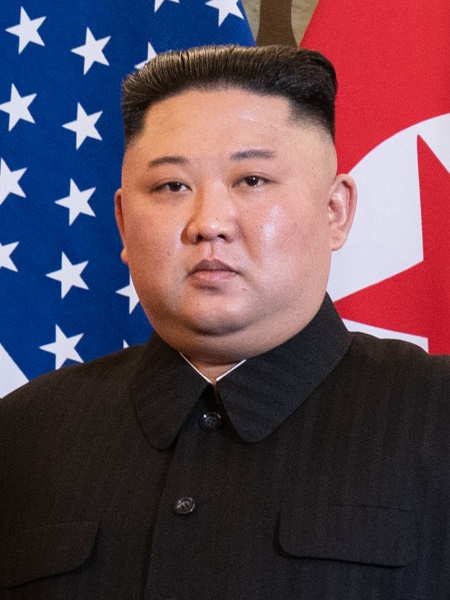
List of supreme leaders
Since the founding of the state in 1948, three members of the Kim family have served as the country's supreme leader. Their succession established a hereditary pattern that is exceptional among self-described socialist states:
- Kim Il-sung (1948–1994) — Founding leader who held top government and party posts and was later declared Eternal President by the state.
- Kim Jong-il (1994–2011) — Son of Kim Il-sung who consolidated control of party, military and state institutions and became the central national authority after his father's death.
- Kim Jong-un (2011–present) — Grandson of Kim Il-sung, who holds the highest party and state positions and commands the armed forces of North Korea.
Office, titles and constitutional changes
The precise legal titles associated with supreme power have shifted. Early constitutions used the office of Premier and later created a presidential office. After Kim Il-sung's death the constitution was amended to confer upon him the status of Eternal President; subsequent leaders assumed differently named top posts, such as Chairman of the National Defence Commission or Chairman of the State Affairs Commission. Parallel authority comes from leadership of the Workers' Party, where the top party title has also changed in name and rank over time.
Historical development and succession
The political system evolved from a postwar socialist state model to a centralized leadership cult centered on the Kim family. Succession has been managed through party and military promotion, elevation to senior state positions, and official ceremonies that legitimize the incoming leader. This pattern of dynastic transition—father to son to grandson—is a defining feature of North Korean governance since the mid‑20th century.
Notable facts and distinctions
North Korea's leadership is notable for concentrating party, state and military authority in one person and for the creation of institutional honors that memorialize previous leaders. Titles often reflect political priorities: e.g., emphasis on military leadership during periods of heightened defense policy. Observers also note that the combination of formal constitutional offices and informal authority exercised through the party makes the practical distribution of power distinct from many other contemporary states.
Questions and answers
Q: Who is the Supreme Leader of North Korea?
A: The Supreme Leader of North Korea is the head of state and head of government.
Q: What are the responsibilities of the Supreme Leader?
A: The Supreme Leader chairs the executive branch, is commander in chief of the North Korean Armed Forces, and is chief executive of the state.
Q: What type of government does North Korea have?
A: North Korea has a unitary government.
Q: Is there an official title for this position?
A: Yes, it is officially known as the Supreme Leader of the Democratic People's Republic of Korea.
Q: Does this leader hold any other positions within North Korea?
A: Yes, they are also head of state and head of government.
Q: How long has this position been in existence?
A: This position has been in existence since North Korea was founded in 1948.
Q: What type of authority does this leader have over their citizens?
A: The supreme leader holds ultimate authority over all citizens within North Korea.
Author
AlegsaOnline.com List of leaders of North Korea Leandro Alegsa
URL: https://en.alegsaonline.com/art/146319
Sources
- leonidpetrov.wordpress.com : "Kim Jong-il's 'Mt. Ryongnam Range' is succeeded by Kim Jong-un's 'Mt. Ami Range'"
- aljazeera.com : "Is Kim Jong Un 'supreme representative of all the Korean people'?"