
Stephenson 2-18 (St2-18): an extreme red supergiant
Stephenson 2-18 (St2-18) is an extraordinary red supergiant near the open cluster Stephenson 2, notable for its enormous radius, high luminosity, cool spectrum and uncertain cluster membership.
Stephenson 2-18 (often abbreviated St2-18 and catalogued as RSGC2-18) is a very large, luminous red supergiant star located in the direction of the constellation Scutum. It lies in a heavily obscured region of the Milky Way at an estimated distance of order a few thousand parsecs; commonly cited values translate to roughly 20,000 light‑years (about 6,000 parsecs) from the Sun distance estimate and are subject to revision with improved measurements independent discussion. St2-18 is notable for both its extreme size and its cool spectral type, and it is sometimes described in literature as a red hypergiant in recognition of its extraordinary properties.
Image gallery
6 Images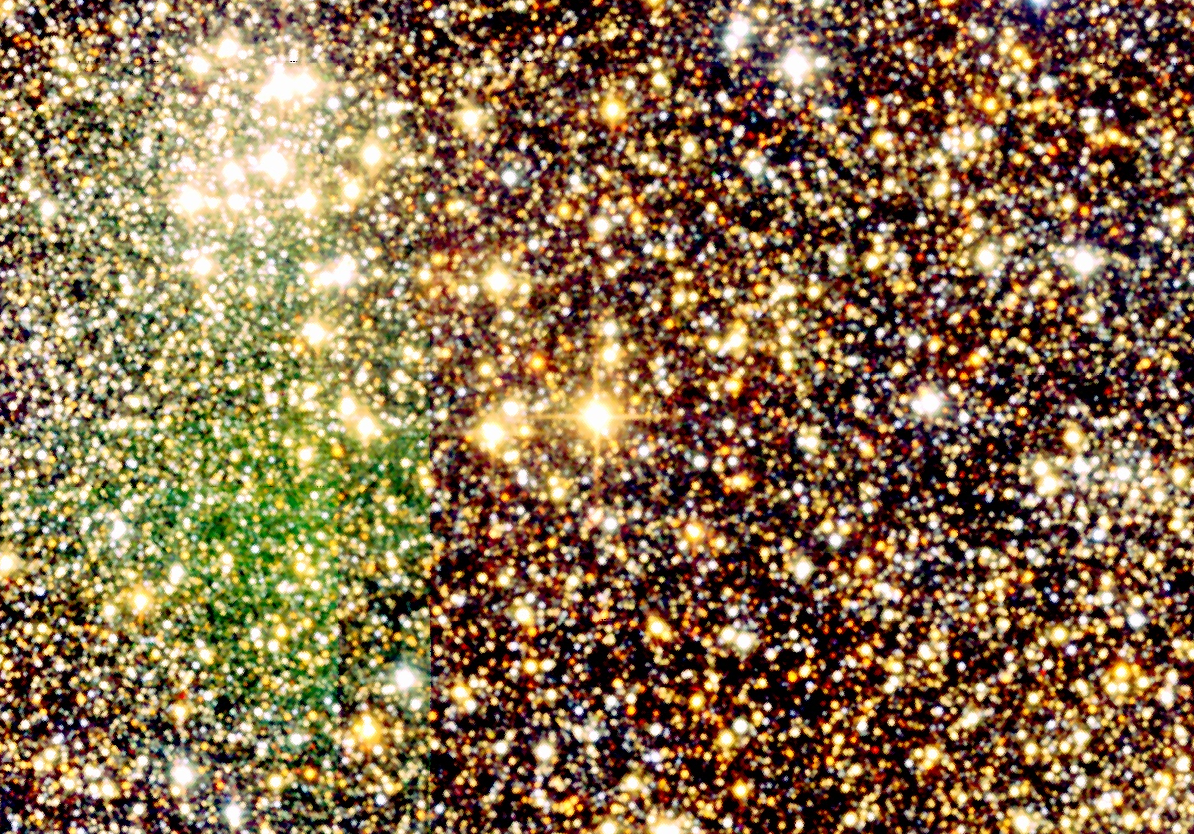




Physical characteristics
Observations place St2-18 among the largest known stars by radius and among the most luminous red supergiants. Spectral classifications around M6 correspond to a relatively cool effective temperature near 3,200 K for the visible surface, unusually late for a supergiant and indicating a very red spectrum. Radius estimates vary with method and adopted distance, but one commonly quoted value is on the order of 2,150 times the Sun's radius radius estimate; that corresponds to a geometric volume many billions of times larger than the Sun's volume comparison. Likewise, its output ranks it among the brightest of its class in terms of total radiative power luminosity context.
Cluster membership and discovery context
St2-18 sits near the open cluster known as Stephenson 2 (also RSGC2), a group identified in surveys of the inner Galaxy that revealed concentrations of red supergiant stars in regions with high interstellar extinction. Whether St2-18 is a gravitationally bound member of the cluster or merely a line‑of‑sight neighbor is still a topic of study: proper motions, radial velocity measurements and improved distance determinations are needed to confirm true membership. The star's location toward Scutum connects it to that constellation from Earth's viewpoint constellation.
Why St2-18 matters
- Extreme stellar physics: As one of the most extended known cool supergiants, St2-18 tests models of stellar structure, mass loss and convection in massive, evolved stars.
- Late evolutionary stage: Stars of this mass and luminosity are expected to end their lives as core‑collapse supernovae, so observing such objects helps constrain pre‑supernova behavior.
- Benchmark for comparisons: It provides a reference point when comparing the largest known stars and when assembling catalogs of luminous red supergiants largest stars comparison.
Many of the reported attributes of St2-18—radius, luminosity and implied volume—depend sensitively on the assumed distance and on modeling of the star's extended, often dusty atmosphere. For instance, statements that St2-18 could contain trillions or quadrillions of Earth volumes are order‑of‑magnitude illustrations based on the larger radius estimates and should be treated as approximate Earths comparison rather than exact counts. Its radius is often quoted as thousands of times that of the Sun, and the Sun comparison is a natural way to express its size solar reference.
Observational challenges and notable facts
Because St2-18 resides in a dust‑rich region and is bright in the infrared, much of what is learned about it comes from infrared and radio observations rather than visible light. Mass loss, circumstellar dust and molecular emission complicate efforts to measure its photosphere directly and to determine a precise luminosity. Despite these challenges, St2-18 remains an object of interest for studies of the most massive, coolest stars in our Galaxy and for understanding the end stages of stellar evolution among the heaviest stars scientific interest. Further high‑precision astrometry and spectroscopic follow‑up will refine its properties and clarify its relationship to the Stephenson 2 cluster cluster studies and broader catalogs of red supergiants catalog comparisons.
Questions and answers
Q: What is Stephenson 2-18?
A: Stephenson 2-18 is a red supergiant or red hypergiant star and is one of the largest known stars.
Q: How far away is Stephenson 2-18 from Earth?
A: Stephenson 2-18 is about 6,000 parsecs (20,000 ly) away from Earth in the constellation of Scutum.
Q: What is the spectral type of Stephenson 2-18?
A: The spectral type of Stephenson 2-18 is M6, which is pretty unusual for a supergiant star and corresponds to its cool temperature of 3,200 Kelvin.
Q: What is the radius of Stephenson 2-18 compared to the Sun?
A: The radius of Stephenson 2-18 is 2,150 times that of the Sun.
Q: What is the volume of Stephenson 2-18 compared to the Sun?
A: The volume of Stephenson 2-18 is 10 billion times that of the Sun.
Q: Is Stephenson 2-18 a member of the open cluster Stephenson 2?
A: Yes, Stephenson 2-18 is close to and a possible member of the open cluster Stephenson 2.
Q: Can Stephenson 2-18 fit many Earths in it?
A: Yes, Stephenson 2-18 can fit about 13 quadrillion Earths in it.
Tags
Related articles
Author
AlegsaOnline.com Stephenson 2-18 (St2-18): an extreme red supergiant Leandro Alegsa
URL: https://en.alegsaonline.com/art/146142
Sources
- arxiv.org : arxiv.org
- dx.doi.org : "A possible new and very remote galactic cluster"
- doi.org : 10.1086/115464
- cosmoknowledge.com : "Stephenson 2-18: The Largest Star in the Universe"
- dx.doi.org : "MASER OBSERVATIONS OF WESTERLUND 1 AND COMPREHENSIVE CONSIDERATIONS ON MASER PROPERTIES OF RED SUPERGIANTS ASSOCIATED WITH MASSIVE CLUSTERS"
- doi.org : 10.1088/0004-637x/760/1/65