
St. Peter's Basilica: history, architecture, art, and significance
Major Renaissance and Baroque church in Vatican City traditionally associated with Saint Peter; a center of papal liturgy, pilgrimage, and monumental art and architecture.
Overview
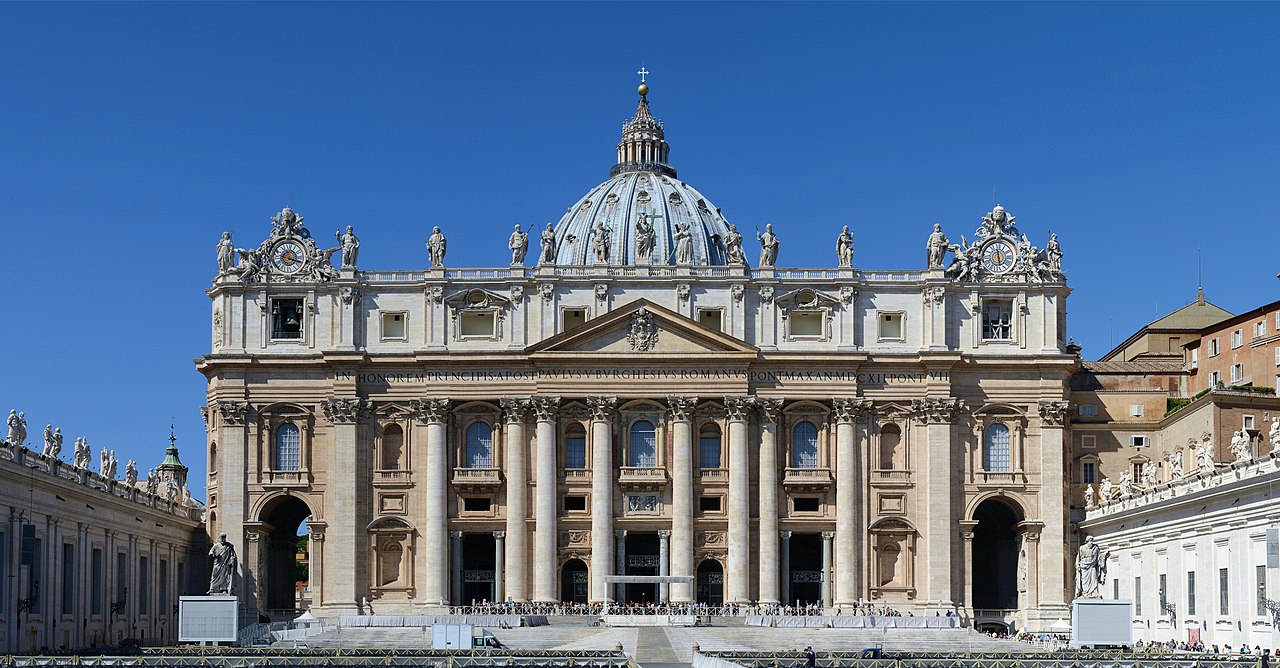
St. Peter's Basilica (Italian: Basilica di San Pietro in Vaticano) is the principal church of the Vatican and one of the most important buildings of Western Christianity. Located within the independent city-state of Vatican City but facing Rome, it is renowned for its monumental scale, artistic masterpieces, and central role in Catholic worship. Tradition holds that the basilica stands above the burial place of Saint Peter, one of Jesus' apostles and considered by Catholic tradition to be the first Bishop of Rome.
Image gallery
10 Images


Origins and history
The site has been sacred since antiquity. A 4th‑century Constantinian basilica was erected over an early Roman cemetery, and the present building replaced that older church. Construction of the current basilica began in the early 16th century, officially under Pope Julius II, and continued through the 17th century. Many architects and artists contributed over the long building period, producing a blend of High Renaissance planning and later Baroque additions. Archaeological investigations beneath the basilica revealed a Roman necropolis and a complex of early Christian tombs and monuments.
Architecture and major works
The design synthesizes large-scale engineering and sculptural ornament. The giant dome, completed in its principal form by a master architect of the Renaissance, dominates the skyline and was a technical achievement of its time. The interior is arranged as a long nave with side aisles and chapels, terminating at the high altar, above which stands a vast sculpted canopy. The basilica houses important works of art including a celebrated marble sculpture by Michelangelo and grand bronze and marble fittings executed by leading Baroque artists. Surrounding St. Peter's, an expansive elliptical piazza with sweeping colonnades frames the approach and organizes large public gatherings.
Religious function and ceremonies
Although often thought of as the pope's cathedral, St. Peter's is technically not the cathedral of the Diocese of Rome; that title belongs to the Archbasilica of Saint John Lateran. Instead, St. Peter's is a papal basilica and principal venue for major liturgical celebrations led by the pope. It is a destination for pilgrims from around the world and hosts ordinations, feast-day liturgies, papal Masses, and other rites central to Catholic life.
Archaeology, relics, and tombs
Excavations beneath the basilica uncovered a multi‑layered archaeological record, including a funerary area traditionally associated with Saint Peter. A tomb complex was found beneath the main altar; while remains and early inscriptions have been reported, definitive identification remains debated among scholars. Numerous popes and other notable figures are buried in the basilica, making it also a monumental funerary church.
Art, conservation, and public access
The basilica’s collections include painting, sculpture, gilding, and architectural sculpture spanning centuries. Conservation and restoration are ongoing efforts to preserve fragile works and the fabric of the building itself. Visitors may enter for prayer, liturgy, or sightseeing; access is managed to balance the needs of worship, pilgrimage, and heritage preservation.
Notable facts and distinctions
- The building combines Renaissance ideals of symmetry and proportion with Baroque theatricality in decoration and spatial effects.
- Its forecourt accommodates enormous gatherings and was planned to create a monumental approach for processions.
- It remains one of the most visited religious sites in the world and a frequent focus of scholarly study in art history, architecture, and archaeology.
Further information
- Vatican City — general information
- Rome — historical context and urban setting
- Italy — national heritage overview
- Saint Peter — apostolic tradition
- The Twelve Apostles — background
- Jesus of Nazareth — historical and religious context
- Bishop of Rome — ecclesiastical role
- The Bible — sources and interpretations
- Tombs and burial customs — archaeology
- Altars and liturgical furniture — explanation
- Key dates in construction and dedication
- Year 1506 — start of major rebuilding
- Popes — burial and patronage history
- Cathedral vs basilica — canonical distinctions
- Basilica — architectural and ecclesiastical meaning
- Constantine and the early Christian buildings
Questions and answers
Q: What is St. Peter's Basilica called in Italian?
A: St. Peter's Basilica is called "Basilica di San Pietro in Vaticano" in Italian.
Q: What is the significance of St. Peter's Basilica to Catholics?
A: To Catholics, St. Peter's Basilica is believed to be the burial place of Saint Peter, one of Jesus' twelve apostles and the first Bishop of Rome.
Q: When was the building that stands today completed?
A: The building that stands at St. Peter's today was completed in 1626 on April 18, 1506.
Q: Is St. Peter's a cathedral?
A: No, although many people think it is a cathedral, it does not have a bishop so it cannot be considered a cathedral; instead, it is an important church known as a basilica.
Q: How did Christianity become legal in Roman Empire?
A: Christianity became legal in the Roman Empire when Emperor Constantine made it so soon after 300s AD (early 4th century).
Q: How many ancient basilicas are there in Rome?
A: There are four ancient basilicas located in Rome -St. Peter's Basilica, St John Lateran, Santa Maria Maggiore and St Paul outside the Walls- which were all begun by Emperor Constantine shortly after he legalized Christianity within the Roman Empire during early 4th century AD (300s).
Q: What makes St Peters famous?
A:St Peters has become famous for many reasons such as its long history and its association with Catholicism and Pope Francis who usually uses this church as his main church due to him living within Vatican City
Author
AlegsaOnline.com St. Peter's Basilica: history, architecture, art, and significance Leandro Alegsa
URL: https://en.alegsaonline.com/art/146076