
St. Francis River
A tributary of the Mississippi River running through southeastern Missouri and northeastern Arkansas, notable for its length, rural watershed, reservoirs, floodplain habitats and recreational use.
The St. Francis River is a major southeastern Missouri and northeastern Arkansas waterway that empties into the Mississippi River. Measuring roughly 426 miles (about 686 km), it flows across rural landscapes, carving floodplains and supporting wetland and bottomland forests before reaching the Mississippi.
Image gallery
4 Images


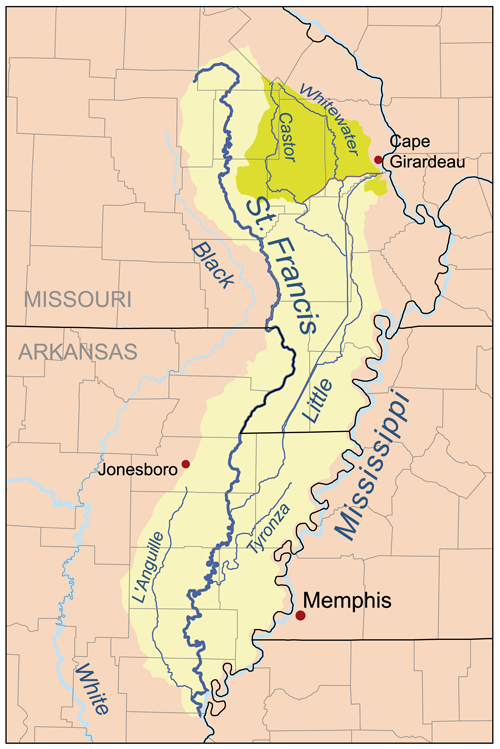
Course and characteristics
The river rises in the uplands of southeastern Missouri and travels generally southeastward into northeastern Arkansas. Along its course it passes through varied terrain — wooded hills and agricultural plains — and in places defines the boundary of the western Missouri Bootheel. Human engineering has altered stretches of the channel for flood control and impoundment, most notably at Wappapello Reservoir.
Ecology and watershed
The St. Francis watershed drains a largely rural portion of the central United States, with areas of timber, pasture and cropland that influence water quality and habitat structure. The lower reaches and overflow plains host bottomland hardwood forests and wetlands that are important for waterfowl, fish spawning, and other wildlife. Seasonal flooding shapes soils and vegetation along the river corridor.
History and human use
Early European explorers and settlers recognized the river as a local transportation and resource corridor. Today it serves multiple purposes: flood control through dams and levees, recreation such as boating and fishing, and local water supply for rural communities. Portions of the river retain a natural character while other stretches show visible modification for agriculture and flood management.
- Recreation: angling, canoeing and wildlife observation are common.
- Infrastructure: reservoirs and levees reduce flood risk but alter flows.
- Conservation: bottomland forests and wetlands along the river are ecologically significant.
As a feature of the United States inland river system, the St. Francis illustrates how regional rivers link upland landscapes to the major continental drainage of the Mississippi. It drains a mostly rural area, and its shape, uses and ecology reflect the long interaction between natural processes and human land use in this part of the country.
Questions and answers
Q: What is the St. Francis River?
A: The St. Francis River is a river in southeastern Missouri and northeastern Arkansas that feeds into the Mississippi River.
Q: How long is the St. Francis River?
A: The St. Francis River is approximately 426 miles (686 km) long.
Q: In which states is the St. Francis River located?
A: The St. Francis River is located in southeastern Missouri and northeastern Arkansas in the United States.
Q: What kind of area does the St. Francis River drain?
A: The St. Francis River drains a mostly rural area.
Q: Does the St. Francis River form any state lines?
A: Yes, the St. Francis River forms part of the Missouri-Arkansas state line along the western side of the Missouri Bootheel.
Q: What river does the St. Francis River feed into?
A: The St. Francis River feeds into the Mississippi River.
Q: How important is the St. Francis River?
A: The text does not provide information on the importance of the St. Francis River.
Author
AlegsaOnline.com St. Francis River Leandro Alegsa
URL: https://en.alegsaonline.com/art/146028