
R (programming language) — statistical computing and graphics
R is a free, open-source programming language and environment for statistical computing, data analysis and visualization. It is extensible through packages and widely used in research and data science.
Overview
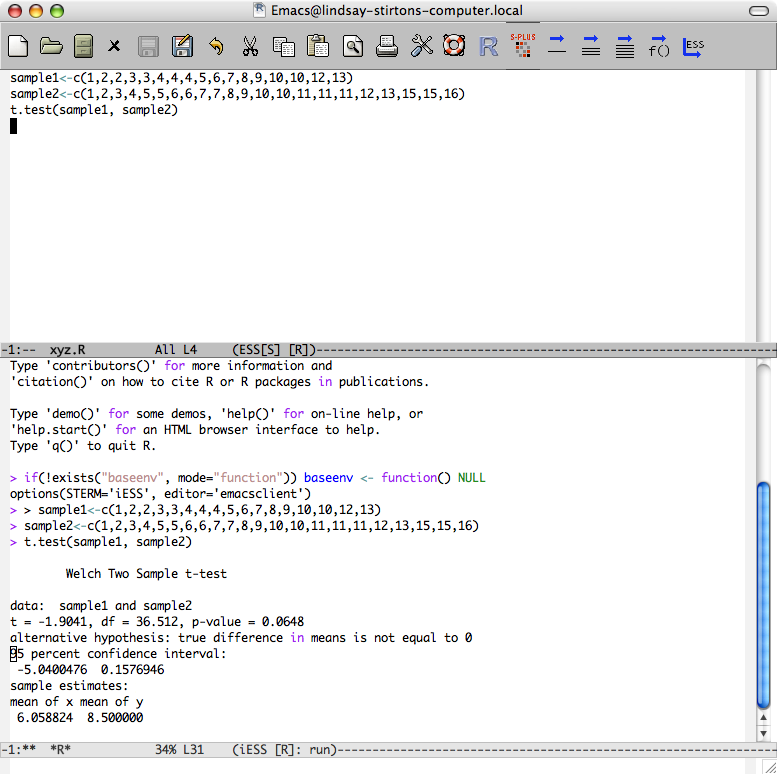
R is a programming language and software environment specifically oriented toward statistics, data analysis and graphics. It provides a high-level, interactive language for manipulating data, implementing statistical models and producing publication-quality plots. The core distribution is free and extensible, and it is commonly used by statisticians, data analysts, researchers and scientists.
Image gallery
8 Images



Characteristics and ecosystem
R emphasizes vectorized operations, a functional programming style and a comprehensive set of built-in statistical functions. Its standard distribution includes a command-line interpreter and a set of core packages, while additional functionality is obtained through an extensive package ecosystem. The Comprehensive R Archive Network (CRAN) serves as the primary repository for user-contributed packages and documentation.
- Data structures: vectors, matrices, lists, data frames and factors for categorical data.
- Modeling: regression, time series, survival analysis and many other model types via well-tested routines.
- Graphics: base graphics, lattice and grammar-of-graphics implementations for flexible visualization.
- Packages: thousands of packages cover data manipulation, visualization, machine learning, bioinformatics and more.
History and development
R began as an implementation of the S language and was developed by statisticians looking for an open, extensible platform for statistical computing. Early development is attributed to academics who wanted a freely available environment that could be adapted by the community. Since its inception it has been maintained and extended by a broad community of contributors; the core project and most packages are distributed under free software licenses.
Common uses and examples
R is widely used for exploratory data analysis, statistical modeling, reproducible research and visualization. Analysts often combine scripts, reports and plots to produce reproducible results. Well-known packages such as ggplot2 for layered graphics, dplyr for data manipulation and shiny for interactive web applications illustrate how R can be used end-to-end to prepare data, build models and present results.
Notable distinctions and resources
Compared with general-purpose languages, R is purpose-built for statistical tasks and offers a dense library of specialized routines. It is often used alongside other languages; for example, Python is popular for general scripting and machine learning workflows while R remains strong where statistical methodology and specialized tests are primary. For official information and downloads see the R project home, for source and binary distributions see source and downloads, and for community packages consult the CRAN package repository.
Because R is maintained by a large user community, new methods and domain-specific tools appear frequently. Users new to R often begin with basic data frames and plotting, then adopt packages that implement modern data workflows and reproducible reporting. The language continues to be a core tool in statistics and data science education, research and professional practice.
Questions and answers
Q: What is R?
A: R is a programming language and free software environment for statistics.
Q: What is R primarily used for?
A: R is strictly designed for statistical analysis.
Q: Are statistical models created in R?
A: Yes, algorithms for many statistical models are devised in R.
Q: Who is R the language of?
A: R is the language of Statistical Analyzers.
Q: Is R open source?
A: Yes, R is open source.
Q: Who is R the best suite for?
A: R is the best suite for statisticians to develop statistical software.
Q: What language is R trying to parallel with?
A: R is putting utmost efforts to walk parallelly to Python.
Author
AlegsaOnline.com R (programming language) — statistical computing and graphics Leandro Alegsa
URL: https://en.alegsaonline.com/art/145216