
Royal Pavilion, Brighton — history, architecture and public significance
Former royal seaside residence in Brighton, transformed in the Regency era into an exotic palace by the Prince Regent; noted for its Indo‑Saracenic exterior, chinoiserie interiors, Grade I listing and museum role.
The Royal Pavilion is a landmark former royal residence in the English seaside town of Brighton. Initially a modest dwelling, it was acquired and enlarged in the late 18th and early 19th centuries by the Prince Regent (later King George IV). Under his patronage the building was transformed into an ornamental seaside palace that became closely associated with Regency taste and high society.
Image gallery
10 Images


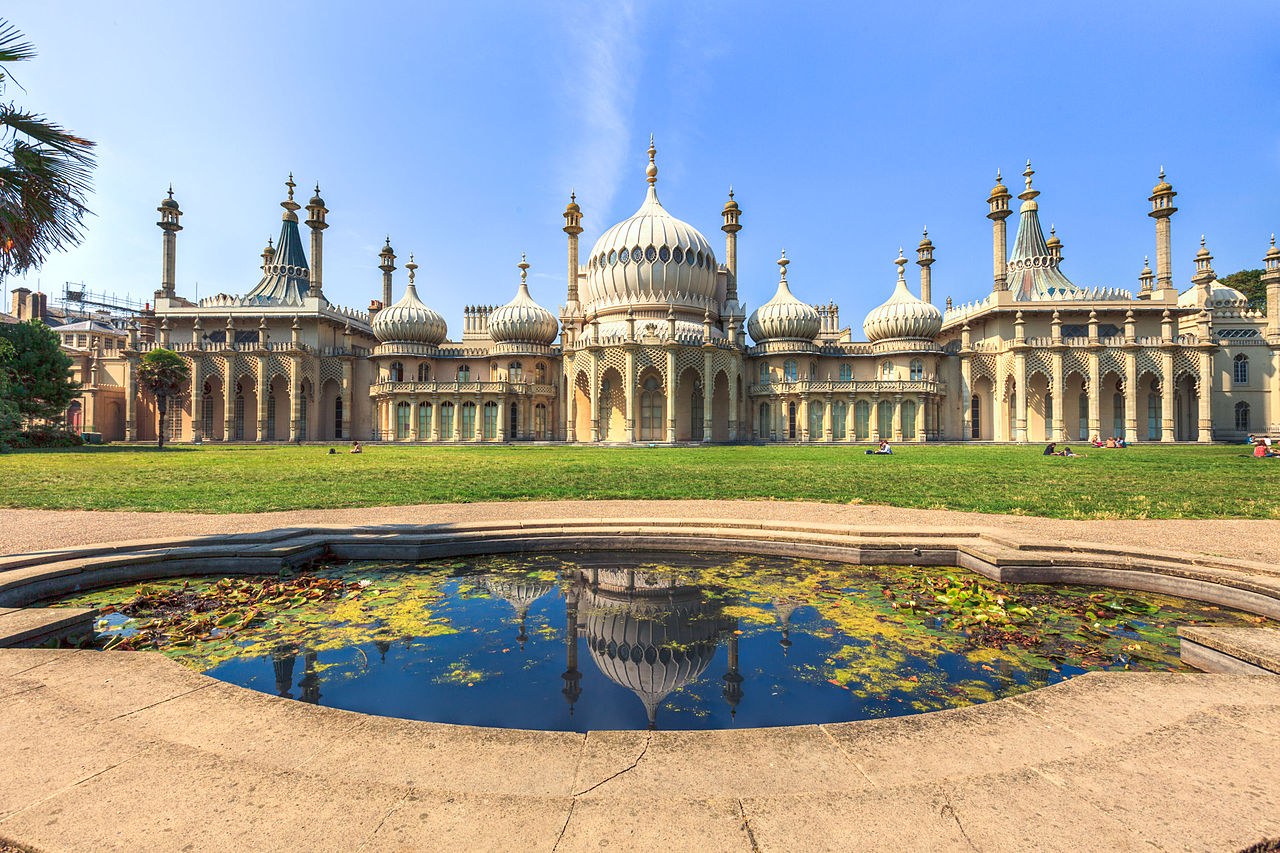


Architecture and decoration
Its exterior is best known for an exotic silhouette of onion domes, minarets and sweeping roofs that draw on an Indo‑Saracenic or broadly "Orientalist" vocabulary popular at the time. Internally the principal reception rooms feature richly patterned surfaces, lacquerwork and chinoiserie: a marked interest in Chinese and East Asian motifs interpreted through European decorative arts. Key spaces often noted by visitors include the Music Room, the Saloon and the Banqueting Room, each conceived to impress guests with scale, colour and ornament.
Development and history
The Pavilion evolved in stages rather than as a single completed scheme. Early enlargements preceded the major remodelling of the early 19th century when architects working for the Prince Regent created much of the familiar outline and decorative ensemble. After the end of its use as a royal residence the building passed into civic ownership in the 19th century and became a focus for public interest. During the First World War the Pavilion was adapted as a military hospital for wounded soldiers from the Indian subcontinent, an episode now recognised as part of its layered history.
Preservation and public role
The Royal Pavilion is protected as a Grade I building in recognition of its special architectural and historic interest (listed building). Conservation and restoration efforts in the 20th and 21st centuries have aimed to repair alterations and to reveal or interpret Regency-era interiors for visitors. Today it operates as a museum and cultural venue managed for public access, hosting exhibitions, concerts and events and contributing to the story of Brighton as a seaside resort. Practical visitor information is available from official resources and guides (visitor information).
Significance and visiting
The Pavilion remains one of the most recognisable historic buildings on the English coast, often cited for its unusual mixture of stylistic influences and its role in shaping Brighton's identity. It attracts architects, historians and general visitors interested in Regency architecture, social history and decorative arts. Onsite interpretation explains the building's changing functions, its decorative schemes and its place in local and national history.
- Notable features: onion domes, minarets and richly decorated reception rooms.
- Historic uses: royal retreat, civic property and wartime hospital.
- Access: open as a museum and cultural venue with exhibitions and events; see visitor information for details.
Questions and answers
Q: What is the Royal Pavilion?
A: The Royal Pavilion is a former Royal residence located in the city of Brighton.
Q: Who originally owned the building that became the Royal Pavilion?
A: Originally it was a farmhouse, so it is unclear who the original owners were.
Q: Who bought the building and turned it into a palace?
A: The building was bought by the Prince Regent who had the original farmhouse turned into a Palace.
Q: What is the current status of the Royal Pavilion?
A: The Royal Pavilion is now a Grade I Listed building.
Q: What does it mean for a building to be Grade I Listed?
A: Being Grade I Listed means that the building is of exceptional interest and is recognized for its historic or architectural significance.
Q: Can tourists visit the Royal Pavilion today?
A: Yes, the Royal Pavilion is open to the public and tourists can visit it.
Q: Where is the Royal Pavilion located?
A: The Royal Pavilion is located in the city of Brighton.
Author
AlegsaOnline.com Royal Pavilion, Brighton — history, architecture and public significance Leandro Alegsa
URL: https://en.alegsaonline.com/art/145119