
Rose of Washington Square (1939 film)
1939 American musical drama directed by Gregory Ratoff, starring Tyrone Power, Alice Faye and Al Jolson. A backstage-style studio picture built around popular songs and the era's vaudeville milieu.
Overview
Rose of Washington Square is a 1939 American musical drama produced by 20th Century Fox and directed by Gregory Ratoff. The film assembles three of the studio era's marquee names: Tyrone Power, Alice Faye and Al Jolson. It follows the conventions of the late‑1930s backstage musical, combining dramatic narrative with staged song-and-dance numbers and a focus on life in popular entertainment during the early decades of the 20th century.
Image gallery
1 Image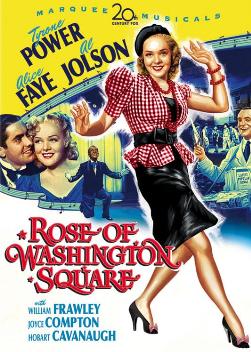
Production and principal cast
The picture was developed and released by 20th Century Fox. The main cast includes Tyrone Power in a leading dramatic role, Alice Faye as the film's singing protagonist, and Al Jolson in a featured musical role. Supporting performers named in contemporary credits include Moroni Olsen, Winifred Harris, Joyce Compton, William Frawley, Ralph Dunn and bandleader Louis Prima. Cast highlights and promotion emphasized the stars: for example, the movie was marketed around performances by Tyrone Power, Alice Faye and musical moments from Al Jolson.
Plot and style
The narrative is typical of backstage musicals of its day: it centers on a young singer's rise to public attention, the pressures of fame and tangled personal relationships that complicate a theatrical career. Musical interludes are woven into the story, using period popular songs and arranged production numbers to evoke the vaudeville and early Broadway atmosphere that inspired the subject. The film blends dramatic scenes with showy performance sequences to appeal both to moviegoers seeking spectacle and to audiences who followed the performers individually.
Themes, music and cinematic context
Rose of Washington Square participates in a broader trend of 1930s studio films that dramatized show business careers and nostalgia for earlier entertainment forms. Its themes include ambition, celebrity, loyalty and the costs of public life. Musically, the film showcases tunes associated with the era and gives screen space to featured singers and instrumentalists, reflecting Hollywood's practice of cross-promoting recording and film stars. The presence of established entertainers lent the picture popular appeal beyond the plot itself.
Reception and legacy
Contemporary audiences recognized the film for its star-driven cast and musical numbers; modern interest is chiefly historical, tied to studies of Hollywood's studio system and representations of vaudeville and Broadway on film. It remains an example of how major studios of the period packaged biography-tinged stories of performers and used musical cinema to celebrate and mythologize American popular entertainment.
Notable facts
- The title references a popular song and the public's fascination with early 20th-century New York performance culture.
- The movie exemplifies 1930s studio-era musical drama, combining narrative and staged performances.
- Its cast mixes dramatic actors and well-known musical entertainers, a common studio strategy for broad appeal.
Author
AlegsaOnline.com Rose of Washington Square (1939 film) Leandro Alegsa
URL: https://en.alegsaonline.com/art/145091