
Nine Hours to Rama
A 1963 British–American drama directed by Mark Robson, adapted from Stanley Wolpert’s novel. The film dramatizes the final nine hours before Mahatma Gandhi’s assassination and provoked controversy on release.
Nine Hours to Rama is a 1963 British–American drama film directed by Mark Robson and released by 20th Century Fox. It was adapted from Stanley Wolpert’s 1962 novel of the same title. The picture reconstructs the period immediately preceding the assassination of Mahatma Gandhi, using a close, often psychological focus on the man who carried out the killing and the events that led up to the crime.
Image gallery
1 Image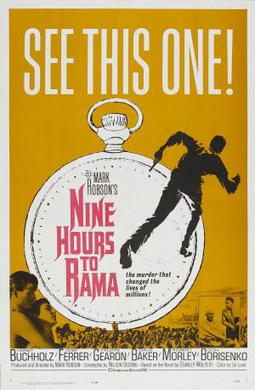
Overview and plot focus
The narrative compresses time into the titular nine hours and mixes present-moment scenes with flashbacks and recollections to explore motive and mindset rather than offering a straightforward historical chronicle. Rather than striving for a documentary account, the film treats the subject as a personal drama: it follows the would-be assassin as he moves through the city, interacts with others, and reflects on political and personal grievances that the story presents as contributing factors.
Cast and production
- Horst Buchholz appears in a leading role, portraying the central figure at the heart of the drama.
- Diane Baker, José Ferrer and Robert Morley are credited among the principal supporting cast.
- Mark Robson, known for versatile work in mid‑20th century Hollywood, directed the film, which was produced for international audiences and distributed by 20th Century Fox.
The film is a studio-era international production; its dramatic style reflects mainstream 1960s filmmaking with an emphasis on character study and moral ambiguity rather than documentary realism. The screenplay adapts Wolpert’s novel, which itself was a fictionalized, psychological treatment of a recent historical event.
Reception, controversy and legacy
Upon release the film attracted attention and controversy because of its subject matter and the sympathetic, intimate presentation of a real and traumatic political assassination. Contemporary responses ranged from dramatic praise of the performances and direction to criticism that a fictionalized treatment risked misunderstanding or offending those who remembered the events. In several places the film met with official objections or distribution restrictions; it has since been discussed in books and articles about film portrayals of political violence and the challenges of adapting recent, sensitive history for a popular audience.
Notable aspects and distinctions
- The picture is notable for attempting a psychological portrait at feature‑film length rather than a straight historical reenactment.
- It is an example of how 1960s cinema sometimes tackled contemporary political subjects from a dramatic, character-driven angle.
- As an adaptation, it highlights tensions between novelist and filmmaker choices when transforming real events into fiction.
Today Nine Hours to Rama is remembered primarily for its provocative subject and as part of a broader cultural moment when filmmakers engaged directly with recent political history. Its performances and the ethical questions it raises about representation continue to interest students of film and modern history.
Author
AlegsaOnline.com Nine Hours to Rama Leandro Alegsa
URL: https://en.alegsaonline.com/art/143404