
M62 motorway
Major trans-Pennine motorway in Northern England linking Liverpool, Manchester, Leeds and Hull.
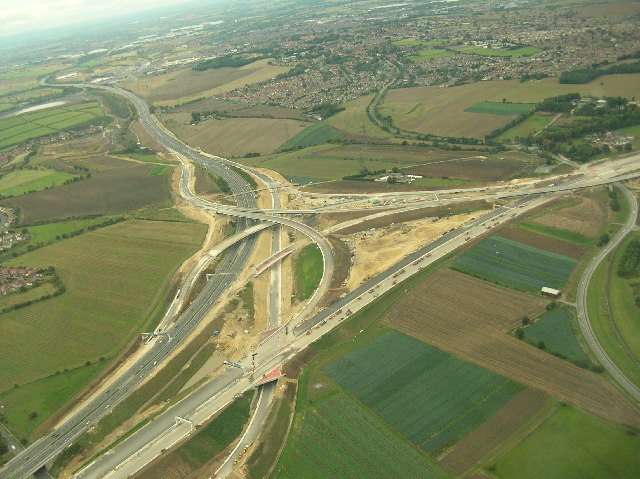
The M62 is a motorway in Northern England and one of the region’s most important east–west transport corridors. It connects Liverpool and Manchester with Leeds and Hull, carrying long-distance traffic, freight and daily commuter journeys across the Pennines. At about 107 miles (172 km), it is a major route in the English motorway network.
Image gallery
10 Images


Route and character
The motorway is known for linking large urban and industrial areas with more exposed upland sections in the centre of the country. A short stretch near Manchester is shared with the M60, the city’s orbital motorway, so the same carriageway serves both routes for part of the journey. This arrangement reflects the M62’s role as both a regional through route and an urban connector.
Because it crosses the Pennines, the M62 includes some of the highest and most weather-sensitive motorway sections in England. Snow, strong winds and mist can affect traffic more often here than on lower routes, especially on the central upland stretches. For that reason, it has long been associated with difficult driving conditions as well as heavy strategic importance.
Development and importance
The M62 was built in stages during the 1960s and 1970s, when motorway construction was reshaping travel between Britain’s major cities and ports. It helped shorten journey times between Merseyside, Greater Manchester, West Yorkshire and East Yorkshire, and it remains important for logistics, manufacturing and retail distribution. In practice, it is one of the main roads that keeps the North of England economically connected.
- Main function: east–west transport across northern England
- Key cities served: Liverpool, Manchester, Leeds and Hull
- Notable feature: trans-Pennine route with exposed upland sections
- Network role: includes a shared section with the M60 near Manchester
As a result, the M62 is not only a route for local traffic but also a vital corridor for national movement between the Irish Sea side of England and the Humber region.
Questions and answers
Q: What is the M62 motorway?
A: The M62 motorway is a road network in Northern England that connects Liverpool and Manchester with Leeds and Hull.
Q: How long is the M62 motorway?
A: The M62 motorway is approximately 107 miles (172 km) long.
Q: Which other motorway shares a portion of the M62?
A: Around seven miles of the M62 motorway is shared with the M60 motorway.
Q: What is the purpose of the M62 motorway?
A: The M62 motorway was built with the primary purpose of connecting the cities of Liverpool, Manchester, Leeds, and Hull for easier and more efficient transportation.
Q: What type of transportation is used on the M62 motorway?
A: The M62 motorway serves as a major highway for automobiles and other road vehicles.
Q: What are some of the cities connected by the M62 motorway?
A: The M62 motorway connects Liverpool, Manchester, Leeds, and Hull, which are major cities in Northern England.
Q: How important is the M62 motorway to transportation in Northern England?
A: The M62 motorway is a major transportation artery in Northern England that helps connect important cities, and is thus highly significant for transportation and commerce in the region.
Author
AlegsaOnline.com M62 motorway Leandro Alegsa
URL: https://en.alegsaonline.com/art/141981