
M23 motorway: route, characteristics, history and role
Overview of the M23 motorway in Surrey and West Sussex, England: route, length, physical features, history of development, connections to Gatwick, the A23 and the M25, and its transport importance.
Overview
The M23 is a short but important motorway in southern England that connects the orbital M25 with the Crawley area and the southern trunk road toward Brighton. It runs through parts of Surrey and West Sussex, providing a key high-speed link from the London region toward the south coast. The motorway is roughly 16 miles (about 26 km) long and is a primary route for both local traffic and longer-distance journeys.
Image gallery
5 Images


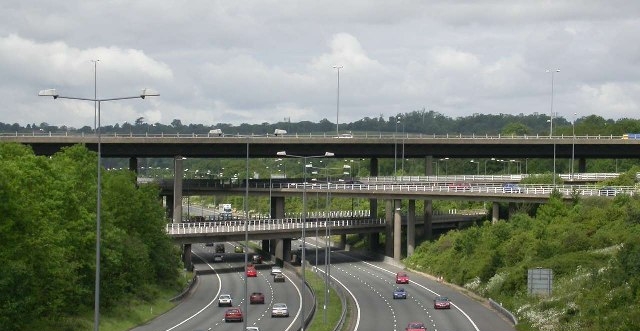
Route and characteristics
The M23 begins at its junction with the M25 and proceeds southward toward the Crawley area, where the grade-separated motorway standard ends and traffic continues on the A23 toward Brighton. The road passes close to Gatwick Airport, making it a principal surface route for airport access. Most of the motorway carries four running lanes in each direction on the busiest sections, with some stretches reduced to three lanes per carriageway where constraints or demand are lower.
History and planning
The present M23 was constructed in sections during the post‑war period of motorway expansion. Early planning envisaged a longer route into south London as part of wider urban motorway proposals, but those northern extensions were not completed when plans changed. The current alignment reflects a compromise between serving regional movements, providing airport access and linking with the national motorway network at the M25.
Uses and importance
As a short connector motorway it performs several transport roles:
- Fast link between the M25 orbital and the south coast corridor.
- Primary road access to Gatwick Airport for passengers and freight.
- Relief route for local and commuter traffic around Crawley and surrounding towns.
Because of these functions the M23 carries a mix of commuter, airport and long‑distance holiday traffic and can experience congestion at peak times and during holiday weekends. The route is maintained as part of the national strategic road network by the bodies responsible for England's motorways.
Notable features and distinctions
The M23 is notable for its short length relative to many other motorways yet outsized strategic importance due to the airport and coastal connections. Beyond the motorway's southern end the A23 continues the mainline toward Brighton, while the M25 provides the circular link around London. The corridor intersects a mix of suburban, industrial and protected landscapes across Surrey and West Sussex, which influenced junction placement and subsequent upgrade choices.
Further reading
For maps, traffic information and official guidance see national road authorities and regional transport pages. General background on motorway design and regional planning can be found through transport resources and local government publications that cover the M23 corridor and its connections to the M25, A23 and Gatwick Airport.
Questions and answers
Q: What is the M23?
A: The M23 is a motorway in Surrey and West Sussex, England.
Q: Where does the M23 start and end?
A: The M23 starts at the M25 near London and ends in Crawley.
Q: How long is the motorway?
A: The motorway is 16 miles (26 km) long.
Q: How many lanes does most of the road have?
A: Most of the road has 4 lanes in each direction, some has three lanes.
Q: Does it go past Gatwick Airport?
A: Yes, it goes past Gatwick Airport.
Q: What other roads connect to the M23? A: The A23 connects to the M23 and goes on to Brighton.
Author
AlegsaOnline.com M23 motorway: route, characteristics, history and role Leandro Alegsa
URL: https://en.alegsaonline.com/art/141959