
Local Bubble (Local Cavity): the low-density region around the Sun
A hot, sparse region of the interstellar medium surrounding the Solar System. The Local Bubble was produced by ancient supernovae, spans hundreds of light years, and contributes to the soft X‑ray background.
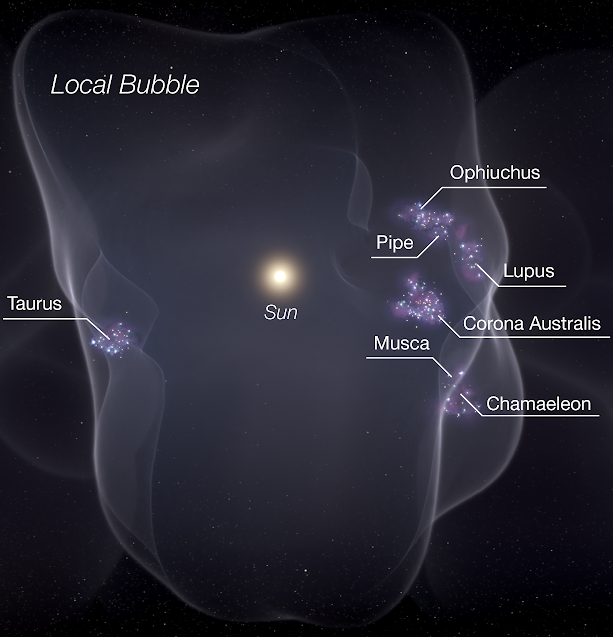
The Local Bubble, also called the Local Cavity, is a region of unusually low interstellar density that surrounds the Sun. It lies within our galaxy in the Orion Arm and is part of the local structure of the galactic disk. The cavity is immersed in the broader interstellar medium and is located on the Orion spur of the Orion Arm of the Milky Way. Contained within the Bubble are smaller, denser clouds such as the Local Interstellar Cloud and the G‑Cloud; the Solar System currently traverses one of these embedded clouds.
Image gallery
7 Images


Principal characteristics
The Local Bubble is comparatively large — at least a few hundred light years across in some directions — and is filled with very low‑density, hot plasma. Typical neutral‑hydrogen measurements give an average of roughly 0.05 atoms per cubic centimetre, far below the galactic mean, and are used to map its extent (neutral hydrogen, atoms/cm3). The gas inside the cavity is substantially ionized and has temperatures that are estimated to be around one million kelvin, producing emission at soft X‑ray energies.
Origin and development
Most researchers attribute the Local Bubble’s creation to multiple stellar explosions. A succession of supernovae and strong stellar winds from massive stars over the past ten to twenty million years is the leading explanation for carving out the low‑density volume. The shock waves and expanding material heated and rarefied the surrounding medium, leaving behind a hot, tenuous plasma that still radiates today.
Observational evidence and importance
The Local Bubble is detected through several observational signatures. It contributes to the diffuse soft‑X‑ray background; ultraviolet and X‑ray spectroscopy reveal highly ionized species that trace hot gas; and maps of neutral hydrogen (H I) and interstellar reddening show the cavity’s boundaries where denser clouds begin. Studying the Bubble helps astronomers understand the life cycle of interstellar gas, the impact of massive stars on galactic environments, and the conditions encountered by the heliosphere as the Solar System moves through local clouds.
Key features and how it is studied
- Size and shape: irregular, a few hundred light years across, not a perfect sphere.
- Density: much lower than average galactic values; typical H I densities near 0.05 atoms/cm3.
- Temperature: hot, ionized plasma that emits soft X‑rays.
- Internal structure: contains smaller clouds such as the Local Interstellar Cloud and the G‑Cloud that are denser and cooler.
- Methods of study: X‑ray and UV spectroscopy, radio H I surveys, stellar absorption lines, and maps of interstellar extinction.
Notable context and open questions
The Local Bubble is one of several nearby cavities and superbubbles in the solar neighborhood; it may be partially connected to adjacent features produced by other star‑forming regions. While the broad picture of supernova‑driven formation is well supported, details such as the exact number, timing and locations of the progenitor explosions, and the Bubble’s three‑dimensional boundaries are still refined as new observations arrive. Understanding the Local Bubble remains important for interpreting the interstellar environment experienced by the Sun and for placing local astrophysical phenomena into a galactic context.
Questions and answers
Q: What is the Local Bubble?
A: The Local Bubble is a relative cavity in the interstellar medium (ISM) of the Orion Arm in the Milky Way.
Q: What does the Local Bubble contain?
A: The Local Bubble contains among others, the Local Interstellar Cloud, which contains the Solar System, and the G-Cloud.
Q: How large is the Local Bubble?
A: The Local Bubble is at least 300 light years across.
Q: What is the neutral-hydrogen density of the Local Bubble?
A: The neutral-hydrogen density of the Local Bubble is about 0.05 atoms/cm3, or about one tenth of the average for the ISM in the Milky Way (0.5 atoms/cm3).
Q: What is the cause of the exceptionally sparse gas of the Local Bubble?
A: The exceptionally sparse gas of the Local Bubble is the result of supernovae that exploded within the past ten to twenty million years.
Q: What is the state of the gas in the Local Bubble?
A: The gas in the Local Bubble is still in an excited state, emitting in the X-ray band.
Q: How long ago did the supernovae that caused the Local Bubble explode?
A: The supernovae that caused the Local Bubble exploded within the past ten to twenty million years.
Author
AlegsaOnline.com Local Bubble (Local Cavity): the low-density region around the Sun Leandro Alegsa
URL: https://en.alegsaonline.com/art/141744