
List of Manhattan neighborhoods
Organized overview of Manhattan neighborhoods: common divisions, representative areas from north to south, historical context, uses, and how names and boundaries are defined.
This article provides a structured overview of neighborhoods within the Manhattan borough of New York City in the United States. Manhattan is a densely settled island with dozens of named neighborhoods whose limits are informal and often overlap. Use local maps or the browser find function to locate particular names; municipal and commercial maps may differ.
Image gallery
1 Image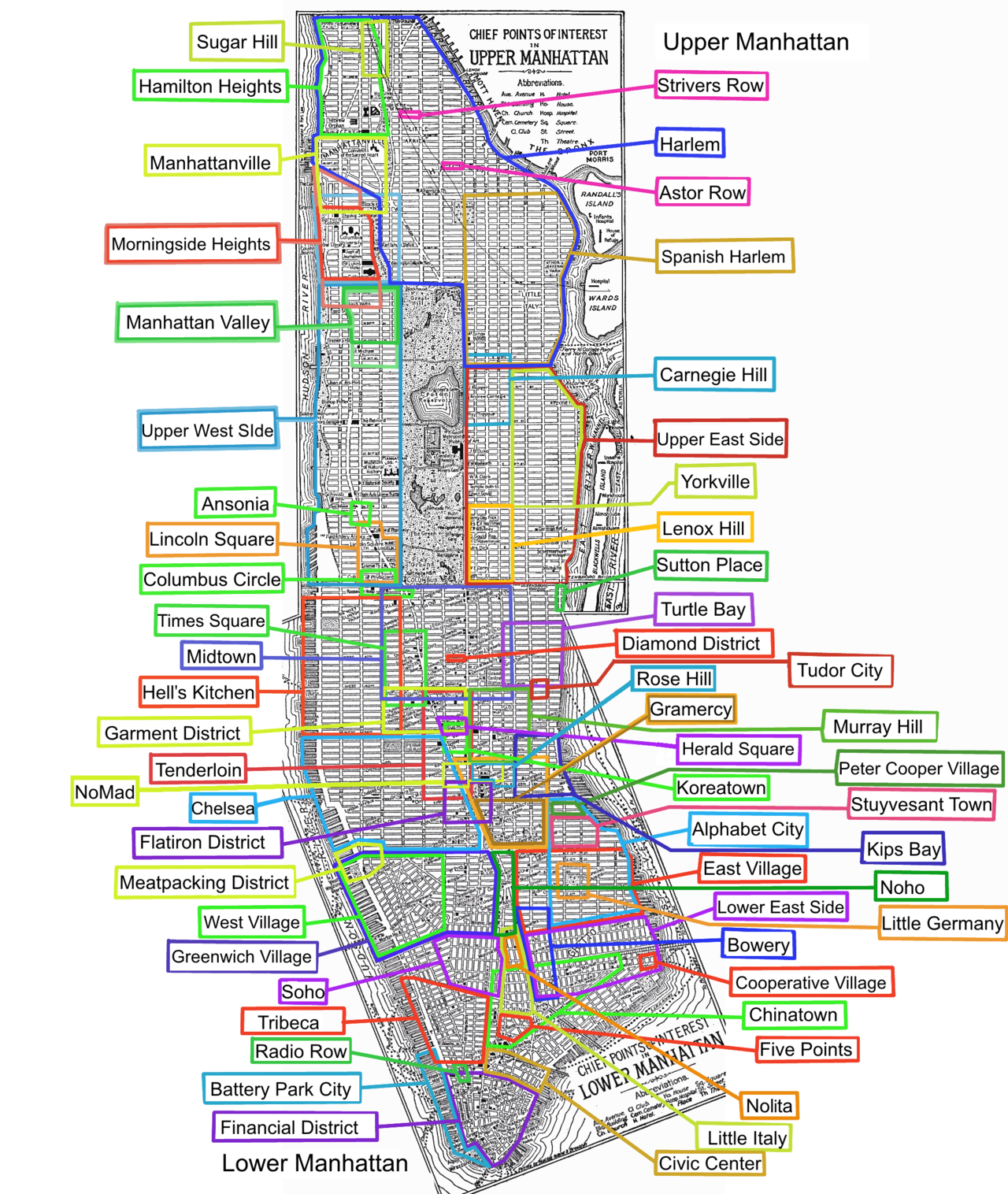
Common divisions and terms
New Yorkers commonly describe Manhattan by broad bands or sides rather than strict municipal borders. These terms are useful for orientation but are not legal definitions:
- Uptown — generally the area north of 59th Street; Upper Manhattan often refers to neighborhoods above about 96th Street.
- Midtown — roughly between 34th and 59th Streets, the city’s principal commercial corridor in many respects.
- Downtown — generally south of 14th Street; the phrase Lower Manhattan usually denotes the island’s southern tip and the Financial District.
- East Side / West Side — informal designations based on Fifth Avenue; areas east of it are called the East Side, and areas to the west are the West Side.
Neighborhoods by broad area (north to south)
The following groups list many well-known neighborhoods in rough geographic order. Each entry is a common name rather than a precise legal boundary.
- Upper Manhattan and Washington Heights: Inwood, Washington Heights, Harlem, Hamilton Heights — areas with strong residential communities, historic brownstones, and cultural institutions.
- Upper West & Upper East Sides: The Upper West Side and Upper East Side flank Central Park and include museum districts, institutional campuses, and residential streets.
- Morningside & Columbia area: Morningside Heights and Manhattanville — neighborhoods anchored by universities and cultural venues.
- Midtown & Midtown South: Midtown, Midtown East, Midtown West, Hell’s Kitchen, Garment District, Times Square — commercial and tourist centers with a high concentration of offices, theaters, and hotels.
- Chelsea to Greenwich Village: Chelsea, Flatiron, NoMad, Gramercy, Greenwich Village, West Village — mixed commercial and residential areas noted for galleries, parks, and nightlife.
- Lower Manhattan and the Battery: SoHo, Tribeca, Chinatown, Little Italy, Lower East Side, Financial District, Battery Park City — historically commercial or immigrant neighborhoods that have seen residential conversion and rising tourism.
These lists are illustrative rather than exhaustive; many smaller enclaves and historic districts exist within and between the names above.
History and development
Manhattan’s neighborhood identities grew from Indigenous settlement, Dutch and British colonial development, nineteenth-century grid planning and immigration, and twentieth-century commercial expansion. Land use changed as transportation (ferries, elevated trains, subways) and industry shaped local economies; in more recent decades, gentrification, landmarking and redevelopment have further altered character and boundaries.
Uses, importance and how names are applied
Neighborhood names help residents, businesses, planners and visitors communicate location, describe real estate markets, and promote cultural identity. Different sources — long-time residents, real estate brokers, city agencies and community boards — may emphasize different limits and labels. For authoritative neighborhood planning matters consult city planning materials or local community boards, but for everyday use the names listed here reflect common parlance and historical usage. For further general definitions see general definitions.
Because names and borders evolve, this list should be read as a practical guide rather than a definitive map. For mapped boundaries and administrative districts consult municipal resources or local historical references.
Questions and answers
Q: What is the purpose of the list of Manhattan neighborhoods?
A: The purpose of the list is to provide all the areas in the Manhattan borough of New York City (U.S.).
Q: How is the list arranged?
A: The list is arranged by neighborhood location, from north to south on the island.
Q: How can one search for a specific neighborhood?
A: One can use the browser "find" button to search for a specific neighborhood name.
Q: What is the definition of Uptown Manhattan?
A: Uptown Manhattan refers to the area above 59th Street.
Q: What is the definition of Downtown Manhattan?
A: Downtown Manhattan refers to the area below 14th Street.
Q: Are neighborhood names and boundaries officially defined?
A: No, neighborhood names and boundaries are not officially defined and may change from time to time.
Q: What is the definition of the West Side?
A: The West Side refers to the area west of Fifth Avenue.
Author
AlegsaOnline.com List of Manhattan neighborhoods Leandro Alegsa
URL: https://en.alegsaonline.com/art/141630