
Agni — Vedic god of fire and sacrificial mediator
Agni is the ancient Vedic deity of fire in Hindu tradition, personifying sacrificial flame, domestic hearth, and divine messenger invoked throughout Vedic hymns and later ritual life.
Overview
Agni is the Vedic god of fire central to early Hindu religion and ritual life. He appears throughout the Vedas as the living flame that transforms offerings into spiritual sustenance, and as an intermediary between humans and gods. Scholars and tradition alike describe Agni both as a natural phenomenon and as a divine personification invoked in rites and daily worship. For a basic reference, see the entry for the Vedic fire god.
Image gallery
10 Images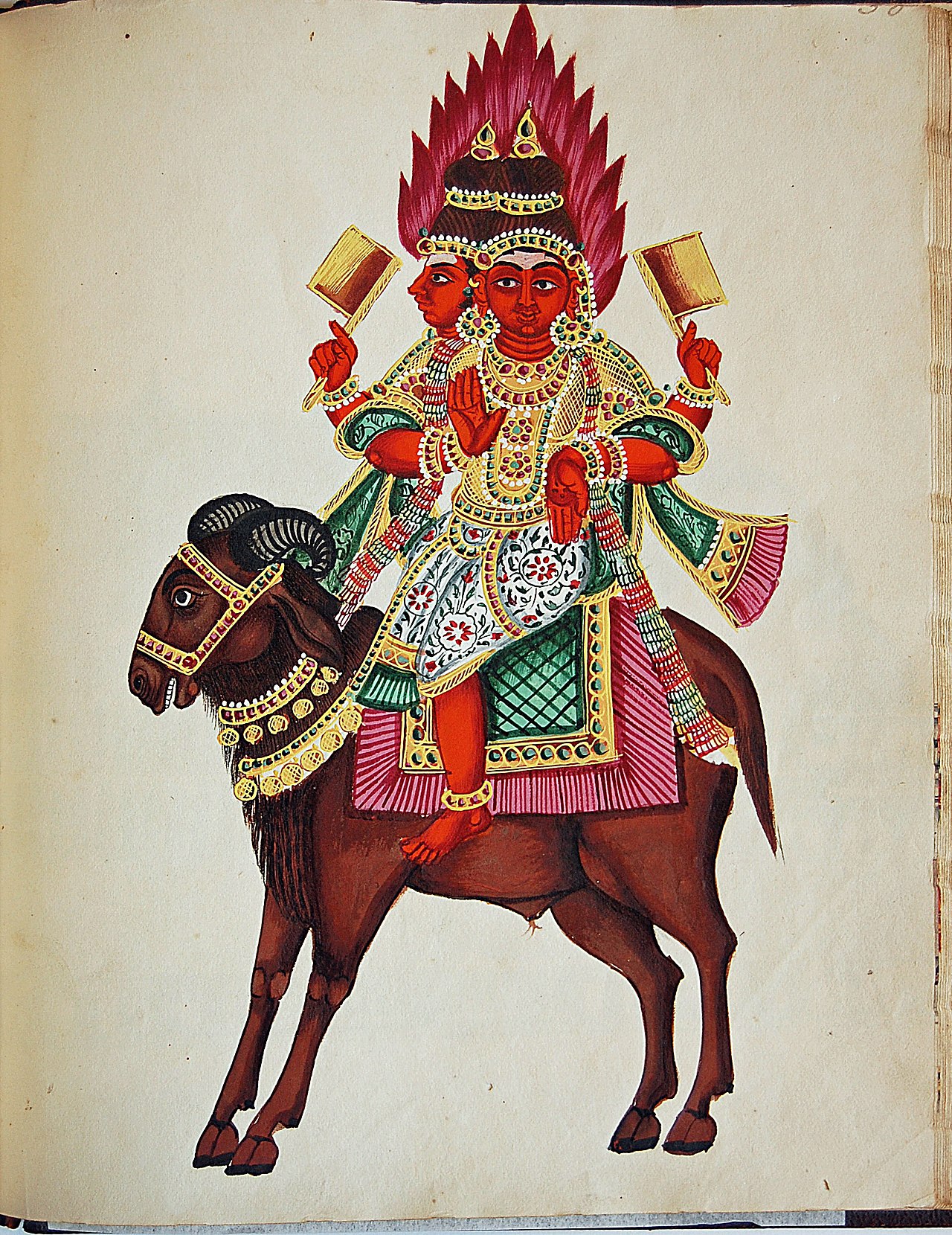


Characteristics and symbolism
In Vedic poetry Agni is depicted with vivid, symbolic features: fiery hair, multiple tongues of flame, and the ability to consume and carry oblations to other deities. He is sometimes represented with two heads and is traditionally associated with the ram as his vehicle. Linguistically his name is related to words for fire in other Indo-European languages (cf. Latin ignis and English derivatives such as "ignite").
Ritual functions
Agni performs multiple ritual roles. He is the priest who receives and transmits offerings, the visible mouth by which gods partake of sacrifice, and the sacred hearth maintained in homes and temples. Vedic ritual distinguishes forms of sacrificial fire (for example the household fire gārhapatya and the offering fire āhavanīya) used in different ceremonies. Religious practitioners perform a range of fire rites, including the daily agnihotra and more elaborate yajñas, where Agni is repeatedly invoked as recipient and messenger.
Mythology and historical development
Agni is one of the most frequently invoked deities in the Rigveda, and his portrayal evolves across later literature. In Puranic stories and epics he appears as a participant in mythic genealogies and as a divine witness. Some medieval Puranic texts also recount origin myths linking ruling clans to Agni; for example, the Bhavishya Purana contains a tradition associating certain Rajput lineages with descent from Agni. Such accounts are presented within their mythic and genealogical context rather than as verifiable historical genealogy (see Agnivanshi Rajputs and related clans such as the Parmaras).
Importance and cultural legacy
Agni's presence extends beyond Vedic sacrifice into household rites, marriages (where the couple makes vows around the sacred fire), and funerary ceremonies. He is invoked as witness, purifier, and protector. Over centuries his role has been reinterpreted in diverse regional practices, classical Sanskrit drama, and devotional literature, keeping fire as a central symbol of transformation and connection between worlds.
Further sources and distinctions
- The primary textual basis for Agni's character is the Vedas; see treatments of the Vedas for hymns and invocations.
- In Vedic cosmology Agni is described as the "mouth" through which the gods receive offerings; this metaphor and its ritual implications are discussed in later exegesis (mouth of the deities).
- For comparative and cultural notes, consult studies of Indo‑Iranian fire cults and later Puranic genealogies (overview).
Questions and answers
Q: Who is Agni?
A: Agni is the Vedic fire god of Hinduism.
Q: What significance does Agni have in the Vedas?
A: Agni is considered as the mouth of the Deities, and the medium that conveys offerings to them in the Yagynas.
Q: Who are the Agnivanshi Rajputs?
A: The Agnivanshi Rajputs (Parmaras, Chauhanas, Pratiharas, and Solankis) are the descendants of the fire god Agni.
Q: What does the Bhavishya Purana say about Agni and the Agnivanshi Rajputs?
A: According to the Bhavishya Purana, the Agnivanshi Rajputs are the descendants of the fire god Agni.
Q: What is the significance of Agni as the mouth of the Deities?
A: Agni is considered the mouth of the deities because he facilitates communication between the gods and humans through offerings.
Q: What does the term Yagynas refer to?
A: Yagynas refer to the Hindu ritual of making offerings to the deities using fire to carry the offerings to the gods.
Q: What is the role of Agni in Yagynas?
A: Agni is the medium that conveys offerings to the deities in the Yagynas.
Related articles
Author
AlegsaOnline.com Agni — Vedic god of fire and sacrificial mediator Leandro Alegsa
URL: https://en.alegsaonline.com/art/1410