
I Ought to Be in Pictures (1982 film)
1982 American comedy-drama directed by Herbert Ross, adapted from Neil Simon's play. A young woman travels to Hollywood to find her estranged screenwriter father; stars Walter Matthau and Dinah Manoff.
Overview
Herbert Ross directed I Ought to Be in Pictures, a 1982 American comedy-drama adapted from the 1980 stage play by Neil Simon. The film was released by 20th Century Fox and transposes Simon's intimate, dialogue-driven piece into a cinematic Los Angeles setting. It foregrounds performance and character interaction, preserving the playwright's mixture of humor and bittersweet emotion while opening scenes beyond the confines of a single stage.
Image gallery
1 Image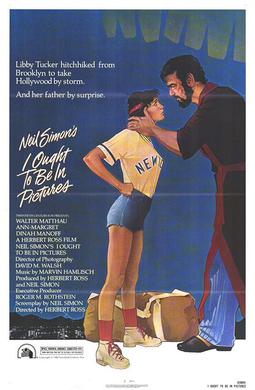
Plot
The story follows a young woman who arrives in Hollywood determined to find her estranged father, a once-successful screenwriter. Her sudden appearance forces both characters to confront past neglect, unresolved anger and differing ideas of success. The narrative balances scenes of awkward comedy with more reflective moments as the two attempt to rebuild trust and make choices about career and family life.
Themes
Central themes include reconciliation between parent and child, the compromises inherent in creative careers, and the contrast between theatrical integrity and the commercial pressures of Hollywood. The film also examines how absence and abandonment shape adult identity and ambitions, using gentle humor to reveal vulnerability.
Production and adaptation
As an adaptation of a recent Broadway play, the screenplay retains much of Simon's conversational rhythm and character-focused structure. Director Herbert Ross emphasized actors' performances and scene work when translating the play to film, expanding settings and adding visual context appropriate to a motion picture while attempting to keep the play's emotional core intact.
Cast and performances
The film is led by Walter Matthau as the father, with Dinah Manoff portraying the daughter whose arrival catalyzes the drama. Ann-Margret appears in a supporting role, and the cast includes a number of character actors and bit players who populate the Hollywood milieu; among the smaller credited performances is David Faustino. Reviewers commonly praised the cast's ability to navigate the shifts between comedic beats and more poignant exchanges.
Reception and legacy
Contemporary reviews were mixed: critics often commended the acting and faithful rendering of Simon's dialogue, while some observers felt the piece showed the limitations of adapting stage work directly to film. Over time the picture has retained interest for viewers who study stage-to-screen adaptations and the careers of those involved, particularly as an example of early 1980s American character comedy that foregrounds family dynamics over spectacle.
Notable distinctions
- Adapted from a recent Broadway play by a prominent American playwright.
- Directed by a filmmaker experienced in translating theatrical material to cinema.
- Maintains a focus on performance and character study rather than large-scale production values.
Author
AlegsaOnline.com I Ought to Be in Pictures (1982 film) Leandro Alegsa
URL: https://en.alegsaonline.com/art/140138